
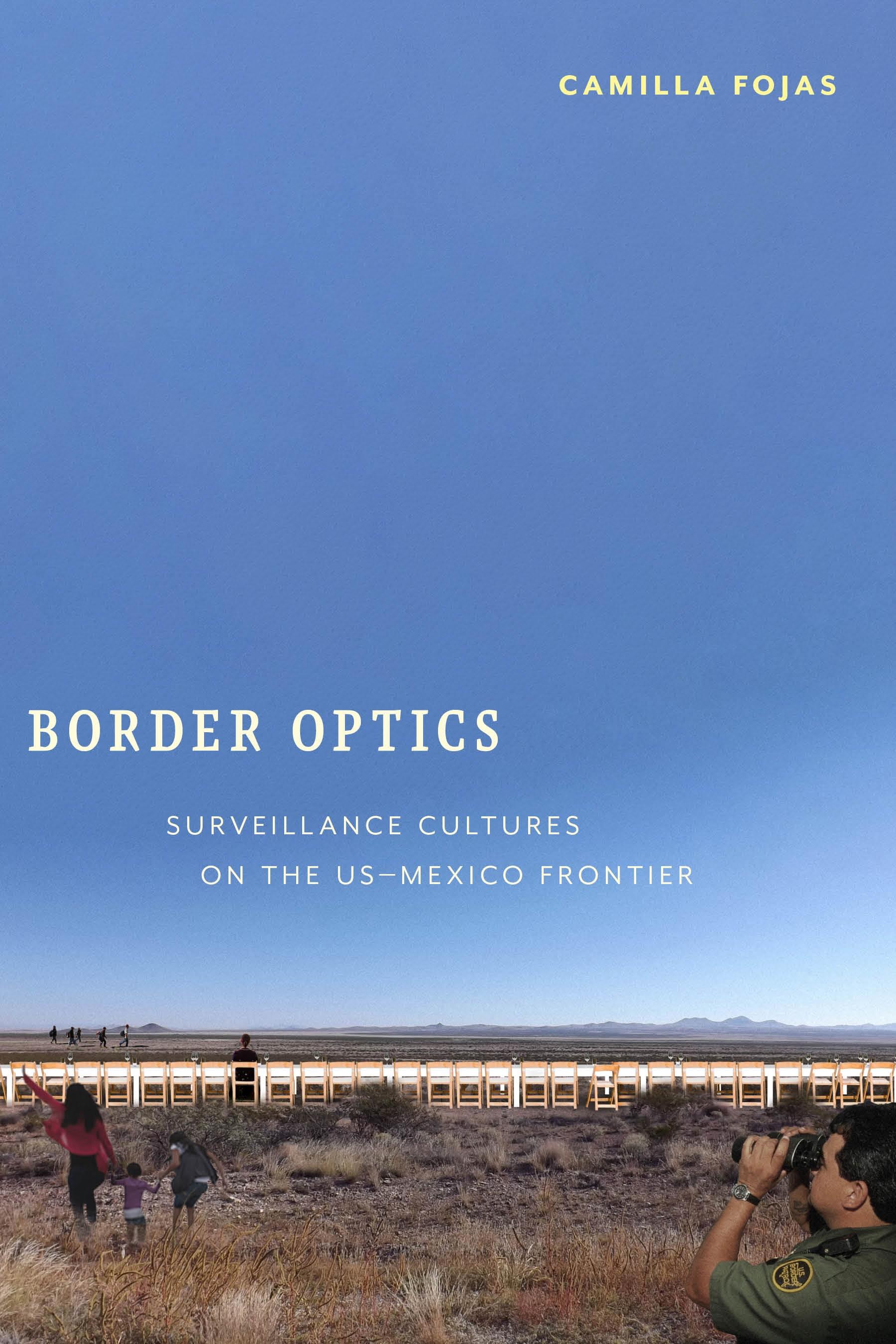
Examines how the US-Mexico border is seen through visual codes of surveillance
When Donald Trump promised to “build a wall” on the U.S.-Mexico border, both supporters and opponents visualized a snaking barrier of concrete cleaving through nearly two thousand miles of arid desert. Though only 4 percent of the US population lives in proximity to the border, imagining what the wall would look like came easily to most Americans, in part because of how images of the border are reproduced and circulated for national audiences.
Border Optics considers the US-Mexico border as one of the most visualized and imagined spaces in the US. As a place of continual crisis, permanent visibility, and territorial defense, the border is rendered as a layered visual space of policing—one that is seen from watchtowers, camera-mounted vehicles, helicopters, surveillance balloons, radar systems, unmanned aerial vehicles, and live streaming websites. It is also a space that is visualized across various forms and genres of media, from maps to geographical surveys, military strategic plans, illustrations, photographs, postcards, novels, film, and television, which combine fascination with the region with the visual codes of surveillance and survey.
Border Optics elaborates on the expanded vision of the border as a consequence of the interface of militarism, technology, and media. Camilla Fojas describes how the perception of the viewing public is controlled through a booming security-industrial complex made up of entertainment media, local and federal police, prisons and detention centers, the aerospace industry, and all manner of security technology industries. The first study to examine visual codes of surveillance within an analysis of the history and culture of the border region, Border Optics is an innovative and groundbreaking examination of security cultures, race, gender, and colonialism.
Payez facilement par carte, Klarna, Apple Pay ou Google Pay. Pas satisfait ? Vous avez toujours une garantie de remboursement de 14 jours. En savoir plus dans nos conditions. Si vous avez des questions, envoyez-nous un e-mail à hello@memmo.org.
Memmo facilite tes études, où que tu sois dans le monde. On rassemble tes manuels de cours et des outils d'étude intelligents au même endroit : résumés, quiz, podcasts et flashcards. Et il y a Ted, ton compagnon d'étude qui répond à toutes tes questions. Plus de 50 000 étudiants étudient déjà ici – conçu pour t'aider à apprendre plus vite et à moins stresser.