
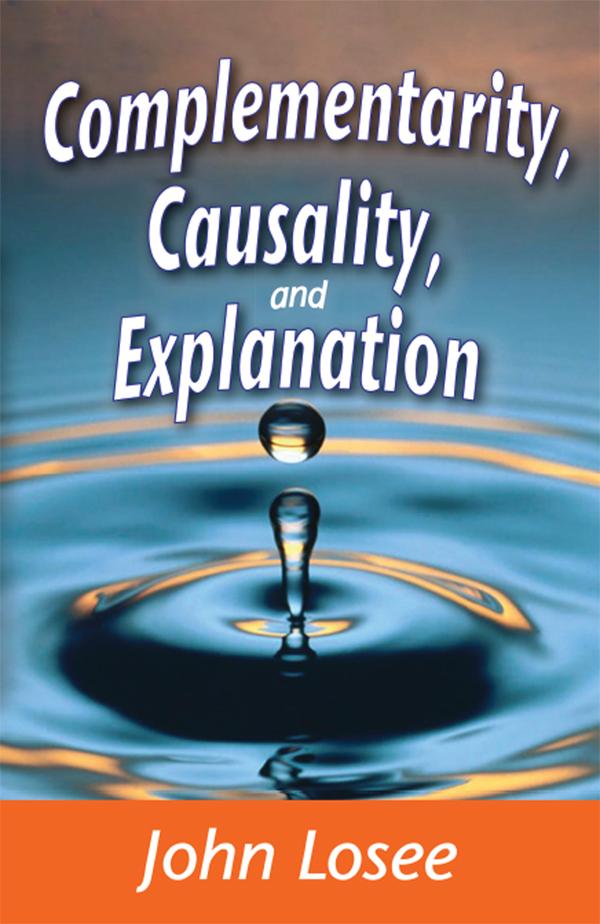
Philosophers have discussed the relationship of cause and effect from ancient times through our own. Prior to the work of Niels Bohr, these discussions presupposed that successful causal attribution implies explanation. The success of quantum theory challenged this presupposition. Bohr introduced a principle of complementarity that provides a new way of looking at causality and explanation.In this succinct review of the history of these discussions, John Losee presents the philosophical background of debates over the cause-effect relation. He reviews the positions of Aristotle, Rene Descartes, Isaac Newton, David Hume, Immanuel Kant, and John Stuart Mill. He shows how nineteenth-century theories in physics and chemistry were informed by a dominant theory of causality and how specific developments in physics provided the background for the emergence of quantum theory.Problems created for the causality implies explanation thesis by the emergence of quantum theory are reviewed in detail. Losee evaluates Bohr's proposals to apply a principle of complementarity within physics, biology, and psychology. He also discusses the feasibility of using complementarity as a principle of interpretation within Christian theology. This volume, which includes an in-depth index, is an essential addition to the libraries of advanced undergraduate and graduate students, philosophers, and those interested in causality and explanation.
Payez facilement par carte, Klarna, Apple Pay ou Google Pay. Pas satisfait ? Vous avez toujours une garantie de remboursement de 14 jours. En savoir plus dans nos conditions. Si vous avez des questions, envoyez-nous un e-mail à hello@memmo.org.
Memmo facilite tes études, où que tu sois dans le monde. On rassemble tes manuels de cours et des outils d'étude intelligents au même endroit : résumés, quiz, podcasts et flashcards. Et il y a Ted, ton compagnon d'étude qui répond à toutes tes questions. Plus de 50 000 étudiants étudient déjà ici – conçu pour t'aider à apprendre plus vite et à moins stresser.
Tu pourrais aussi aimer
Acheter le livre0