
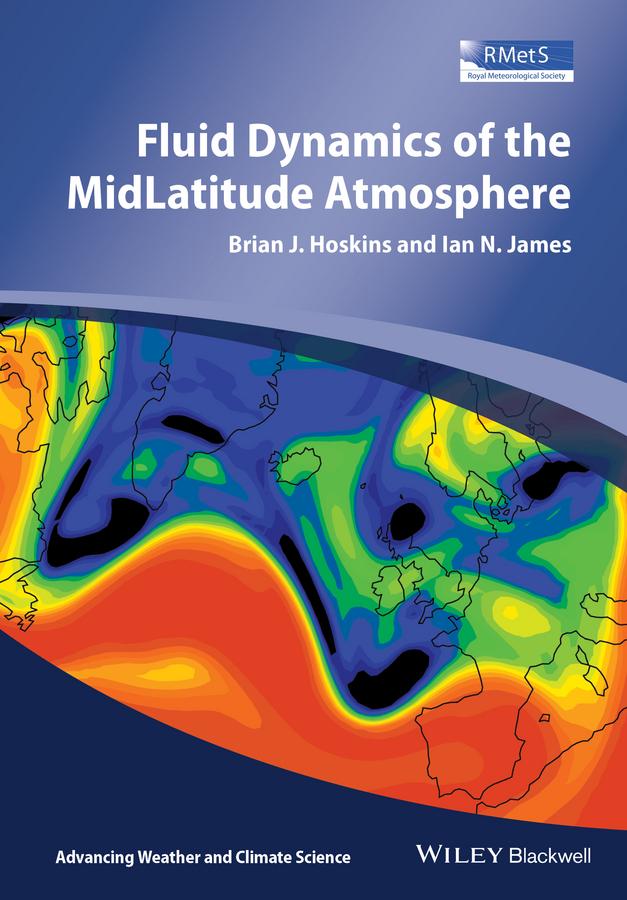
This book gives a coherent development of the current understanding of the fluid dynamics of the middle latitude atmosphere. It is primarily aimed at post-graduate and advanced undergraduate level students and does not assume any previous knowledge of fluid mechanics, meteorology or atmospheric science. The book will be an invaluable resource for any quantitative atmospheric scientist who wishes to increase their understanding of the subject. The importance of the rotation of the Earth and the stable stratification of its atmosphere, with their implications for the balance of larger-scale flows, is highlighted throughout.
Clearly structured throughout, the first of three themes deals with the development of the basic equations for an atmosphere on a rotating, spherical planet and discusses scale analyses of these equations. The second theme explores the importance of rotation and introduces vorticity and potential vorticity, as well as turbulence. In the third theme, the concepts developed in the first two themes are used to give an understanding of balanced motion in real atmospheric phenomena. It starts with quasi-geostrophic theory and moves on to linear and nonlinear theories for mid-latitude weather systems and their fronts. The potential vorticity perspective on weather systems is highlighted with a discussion of the Rossby wave propagation and potential vorticity mixing covered in the final chapter.
Clearly structured throughout, the first of three themes deals with the development of the basic equations for an atmosphere on a rotating, spherical planet and discusses scale analyses of these equations. The second theme explores the importance of rotation and introduces vorticity and potential vorticity, as well as turbulence. In the third theme, the concepts developed in the first two themes are used to give an understanding of balanced motion in real atmospheric phenomena. It starts with quasi-geostrophic theory and moves on to linear and nonlinear theories for mid-latitude weather systems and their fronts. The potential vorticity perspective on weather systems is highlighted with a discussion of the Rossby wave propagation and potential vorticity mixing covered in the final chapter.
Payez facilement par carte, Klarna, Apple Pay ou Google Pay. Pas satisfait ? Vous avez toujours une garantie de remboursement de 14 jours. En savoir plus dans nos conditions. Si vous avez des questions, envoyez-nous un e-mail à hello@memmo.org.
Memmo facilite tes études, où que tu sois dans le monde. On rassemble tes manuels de cours et des outils d'étude intelligents au même endroit : résumés, quiz, podcasts et flashcards. Et il y a Ted, ton compagnon d'étude qui répond à toutes tes questions. Plus de 50 000 étudiants étudient déjà ici – conçu pour t'aider à apprendre plus vite et à moins stresser.