
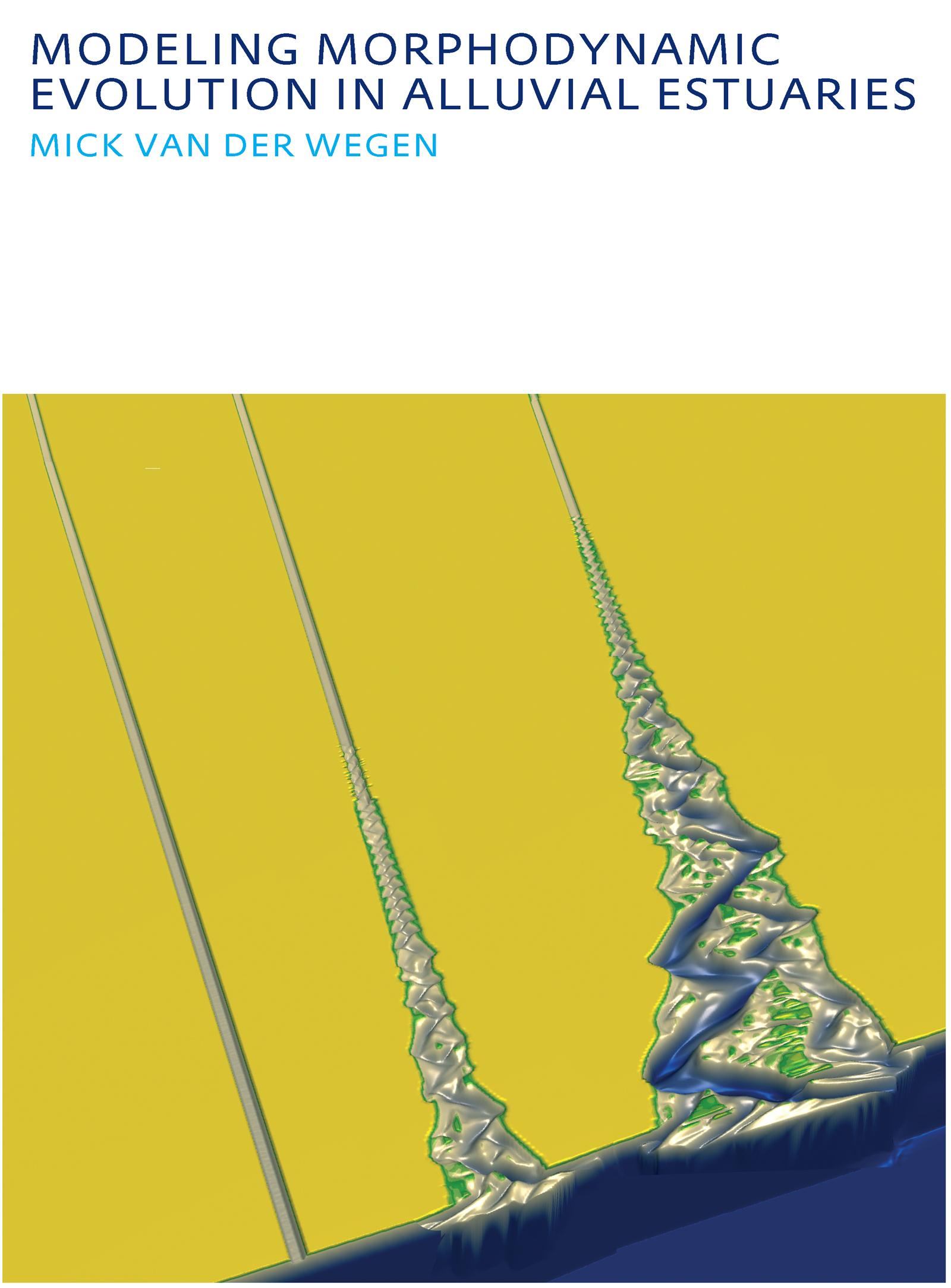
The main objective of this research is to investigate the governing processes and characteristics that drive morphodynamic evolution in alluvial estuaries by application of a process-based numerical model (Delft3D). It is of utmost importance to understand estuarine processes so that impact of human interference (like dredging and land reclamation) and long-term changes (like sea level rise) can be evaluated.
The research addresses a number of cases ranging from an rectangular basins to real estuaries like the Western Scheldt in the Netherlands or San Pablo Bay in California. The more schematized approach allow to study morphodynamic evolution over several millennia under constant forcing and answers more fundamental questions related to conditions of equilibrium and related time scales. The more realistic cases give insight into the skill of the approach in predicting decadal morphodynamic developments. More processes are included to mimic realistic conditions and model results are compared to bathymetric measurements over the last century.
The research shows that the modeling approach is good capable of describing stable morphodynamic calculations over a timescale of millennia with patterns similar to patterns observed in reality. Additionally, the approach shows that it is possible to predict decadal morphodynamic developments in real estuaries with significant skill.
Payez facilement par carte, Klarna, Apple Pay ou Google Pay. Pas satisfait ? Vous avez toujours une garantie de remboursement de 14 jours. En savoir plus dans nos conditions. Si vous avez des questions, envoyez-nous un e-mail à hello@memmo.org.
Memmo facilite tes études, où que tu sois dans le monde. On rassemble tes manuels de cours et des outils d'étude intelligents au même endroit : résumés, quiz, podcasts et flashcards. Et il y a Ted, ton compagnon d'étude qui répond à toutes tes questions. Plus de 50 000 étudiants étudient déjà ici – conçu pour t'aider à apprendre plus vite et à moins stresser.