
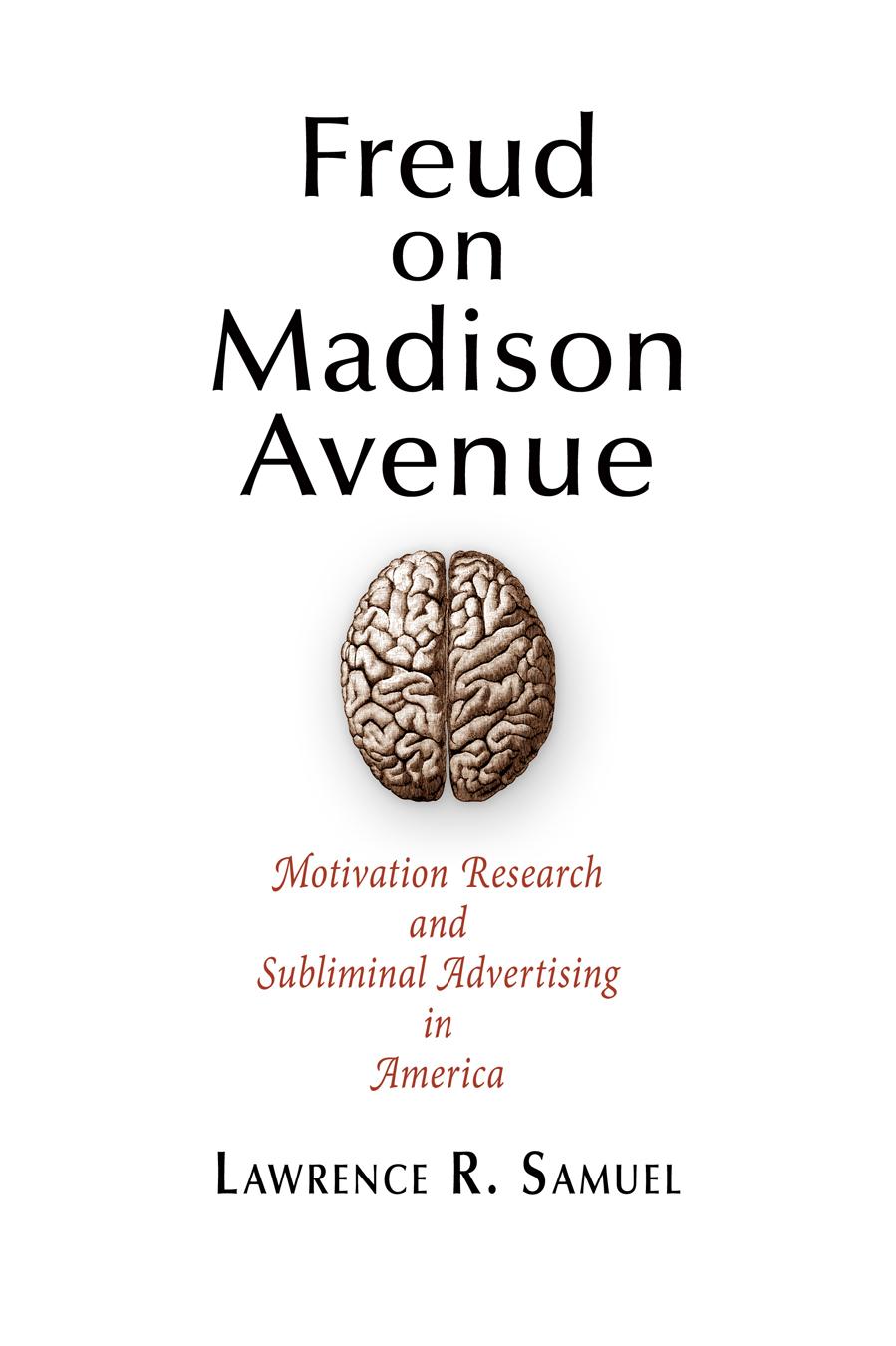
What do consumers really want? In the mid-twentieth century, many marketing executives sought to answer this question by looking to the theories of Sigmund Freud and his followers. By the 1950s, Freudian psychology had become the adman's most powerful new tool, promising to plumb the depths of shoppers' subconscious minds to access the irrational desires beneath their buying decisions. That the unconscious was the key to consumer behavior was a new idea in the field of advertising, and its impact was felt beyond the commercial realm.
Centered on the fascinating lives of the brilliant men and women who brought psychoanalytic theories and practices from Europe to Madison Avenue and, ultimately, to Main Street, Freud on Madison Avenue tells the story of how midcentury advertisers changed American culture. Paul Lazarsfeld, Herta Herzog, James Vicary, Alfred Politz, Pierre Martineau, and the father of motivation research, Viennese-trained psychologist Ernest Dichter, adapted techniques from sociology, anthropology, and psychology to help their clients market consumer goods. Many of these researchers had fled the Nazis in the 1930s, and their decidedly Continental and intellectual perspectives on secret desires and inner urges sent shockwaves through WASP-dominated postwar American culture and commerce.
Though popular, these qualitative research and persuasion tactics were not without critics in their time. Some of the tools the motivation researchers introduced, such as the focus group, are still in use, with "consumer insights" and "account planning" direct descendants of Freudian psychological techniques. Looking back, author Lawrence R. Samuel implicates Dichter's positive spin on the pleasure principle in the hedonism of the Baby Boomer generation, and he connects the acceptance of psychoanalysis in marketing culture to the rise of therapeutic culture in the United States.
Payez facilement par carte, Klarna, Apple Pay ou Google Pay. Pas satisfait ? Vous avez toujours une garantie de remboursement de 14 jours. En savoir plus dans nos conditions. Si vous avez des questions, envoyez-nous un e-mail à hello@memmo.org.
Memmo facilite tes études, où que tu sois dans le monde. On rassemble tes manuels de cours et des outils d'étude intelligents au même endroit : résumés, quiz, podcasts et flashcards. Et il y a Ted, ton compagnon d'étude qui répond à toutes tes questions. Plus de 50 000 étudiants étudient déjà ici – conçu pour t'aider à apprendre plus vite et à moins stresser.