
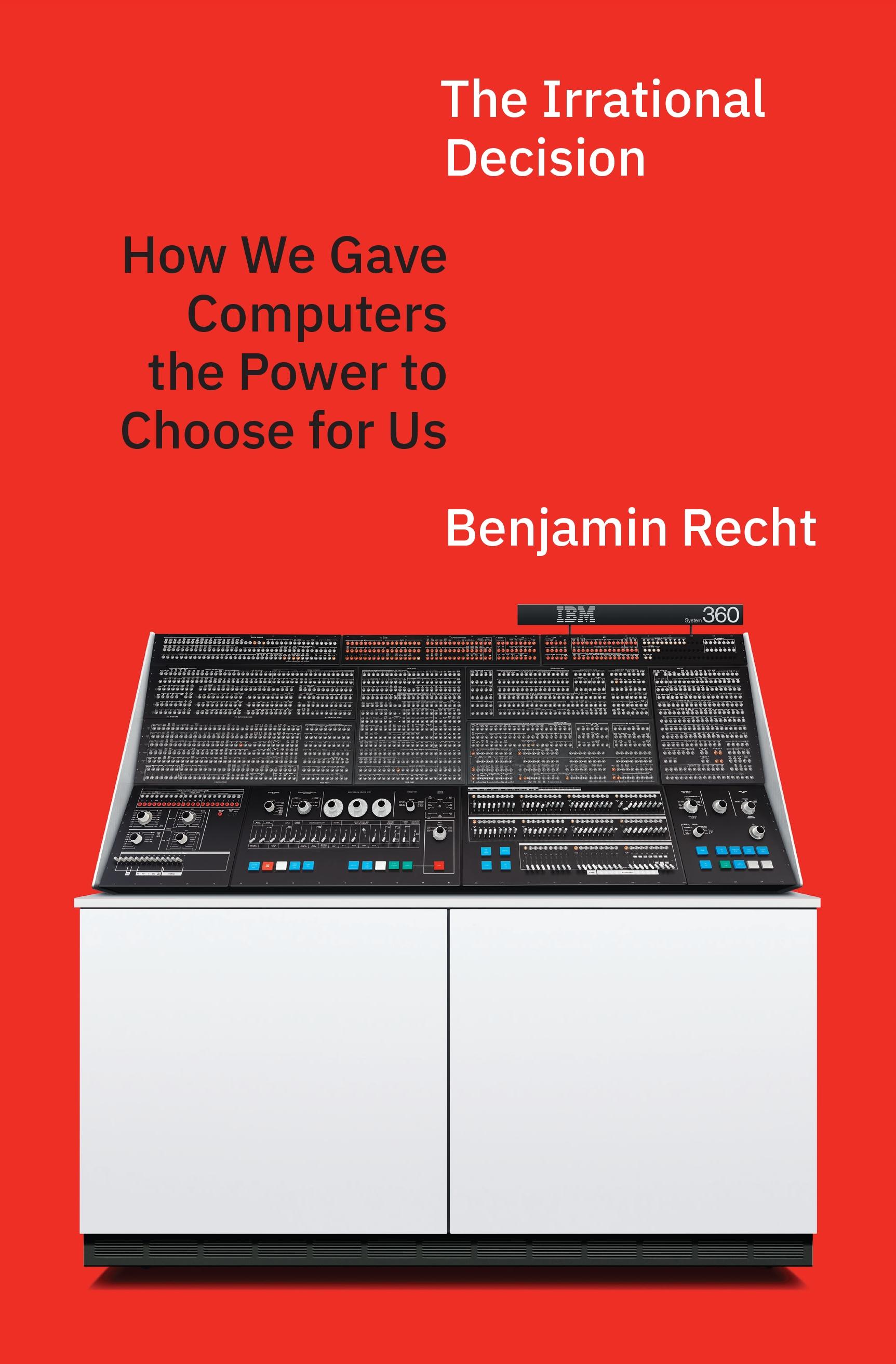
How the computer revolution shaped our conception of rationality—and why human problems require solutions rooted in human intuition, morality, and judgment
In the 1940s, mathematicians set out to design computers that could act as ideal rational agents in the face of uncertainty. The Irrational Decision tells the story of how they settled on a peculiar mathematical definition of rationality in which every decision is a statistical question of risk. Benjamin Recht traces how this quantitative standard came to define our understanding of rationality, looking at the history of optimization, game theory, statistical testing, and machine learning. He explains why, now more than ever, we need to resist efforts by powerful tech interests to drive public policy and essentially rule our lives.
While mathematical rationality has proven valuable in accelerating computers, regulating pharmaceuticals, and deploying electronic commerce, it fails to solve messy human problems and has given rise to a view of a rational world that is not only overquantified but surprisingly limited. Recht shows how these mathematical methods emerged from wartime research and influenced fields ranging from economics to health care, drawing on illuminating examples ranging from diet planning to chess to self-driving cars.
Highlighting both the power and limitations of mathematical rationality, The Irrational Decision reveals why only humans can resolve fundamentally political or value-based questions and proposes a more expansive approach to decision making that is appropriately supported by computational tools yet firmly rooted in human intuition, morality, and judgment.
Payez facilement par carte, Klarna, Apple Pay ou Google Pay. Pas satisfait ? Vous avez toujours une garantie de remboursement de 14 jours. En savoir plus dans nos conditions. Si vous avez des questions, envoyez-nous un e-mail à hello@memmo.org.
Memmo facilite tes études, où que tu sois dans le monde. On rassemble tes manuels de cours et des outils d'étude intelligents au même endroit : résumés, quiz, podcasts et flashcards. Et il y a Ted, ton compagnon d'étude qui répond à toutes tes questions. Plus de 50 000 étudiants étudient déjà ici – conçu pour t'aider à apprendre plus vite et à moins stresser.