
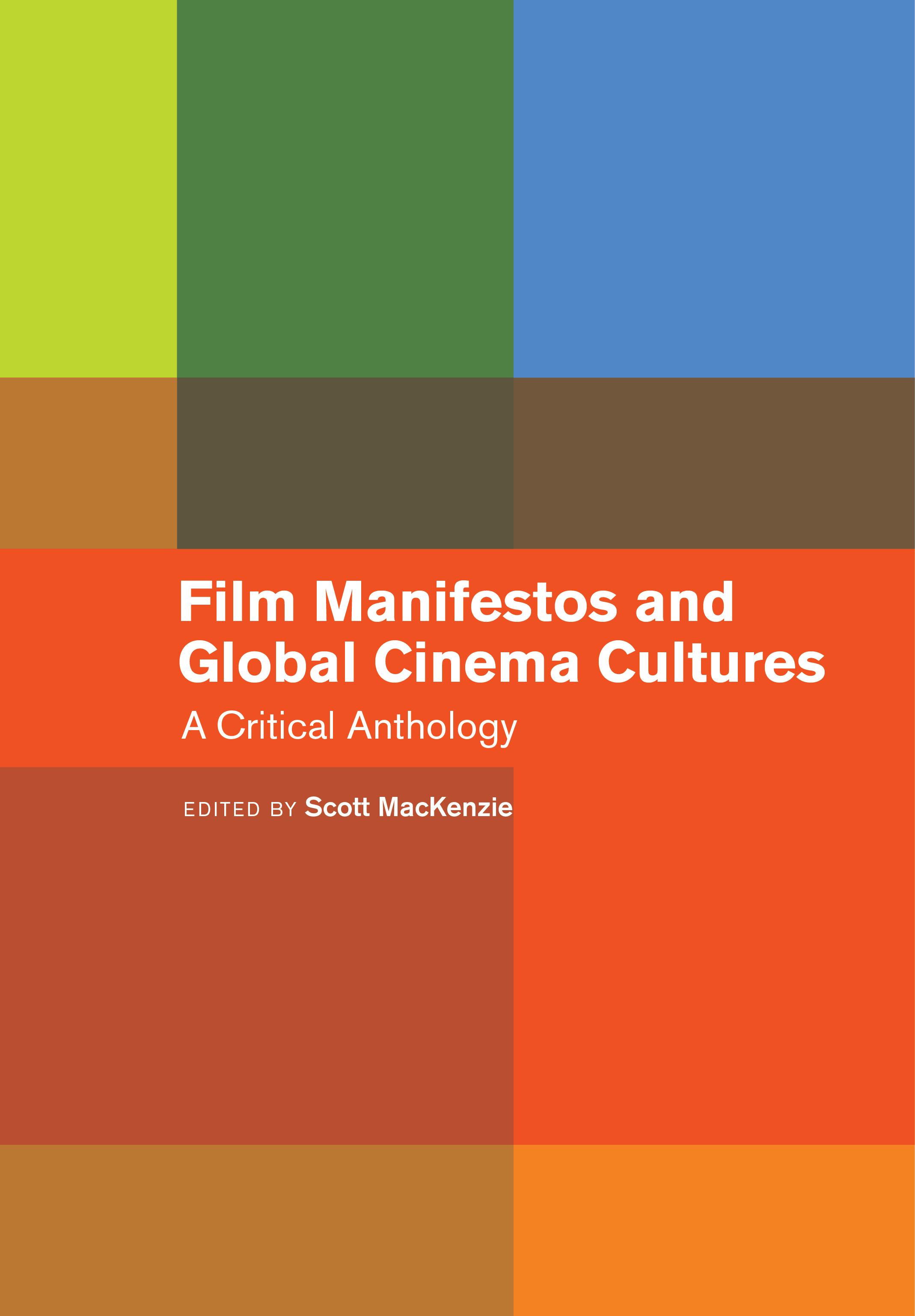
Film Manifestos and Global Cinema Cultures is the first book to collect manifestoes from the global history of cinema, providing the first historical and theoretical account of the role played by film manifestos in filmmaking and film culture. Focusing equally on political and aesthetic manifestoes, Scott MacKenzie uncovers a neglected, yet nevertheless central history of the cinema, exploring a series of documents that postulate ways in which to re-imagine the cinema and, in the process, re-imagine the world.
This volume collects the major European “waves” and figures (Eisenstein, Truffaut, Bergman, Free Cinema, Oberhausen, Dogme ‘95); Latin American Third Cinemas (Birri, Sanjinés, Espinosa, Solanas); radical art and the avant-garde (Buñuel, Brakhage, Deren, Mekas, Ono, Sanborn); and world cinemas (Iimura, Makhmalbaf, Sembene, Sen). It also contains previously untranslated manifestos co-written by figures including Bollaín, Debord, Hermosillo, Isou, Kieslowski, Painlevé, Straub, and many others. Thematic sections address documentary cinema, aesthetics, feminist and queer film cultures, pornography, film archives, Hollywood, and film and digital media. Also included are texts traditionally left out of the film manifestos canon, such as the Motion Picture Production Code and Pius XI's Vigilanti Cura, which nevertheless played a central role in film culture.
This volume collects the major European “waves” and figures (Eisenstein, Truffaut, Bergman, Free Cinema, Oberhausen, Dogme ‘95); Latin American Third Cinemas (Birri, Sanjinés, Espinosa, Solanas); radical art and the avant-garde (Buñuel, Brakhage, Deren, Mekas, Ono, Sanborn); and world cinemas (Iimura, Makhmalbaf, Sembene, Sen). It also contains previously untranslated manifestos co-written by figures including Bollaín, Debord, Hermosillo, Isou, Kieslowski, Painlevé, Straub, and many others. Thematic sections address documentary cinema, aesthetics, feminist and queer film cultures, pornography, film archives, Hollywood, and film and digital media. Also included are texts traditionally left out of the film manifestos canon, such as the Motion Picture Production Code and Pius XI's Vigilanti Cura, which nevertheless played a central role in film culture.
Payez facilement par carte, Klarna, Apple Pay ou Google Pay. Pas satisfait ? Vous avez toujours une garantie de remboursement de 14 jours. En savoir plus dans nos conditions. Si vous avez des questions, envoyez-nous un e-mail à hello@memmo.org.
Memmo facilite tes études, où que tu sois dans le monde. On rassemble tes manuels de cours et des outils d'étude intelligents au même endroit : résumés, quiz, podcasts et flashcards. Et il y a Ted, ton compagnon d'étude qui répond à toutes tes questions. Plus de 50 000 étudiants étudient déjà ici – conçu pour t'aider à apprendre plus vite et à moins stresser.
Tu pourrais aussi aimer
Acheter le livre0