
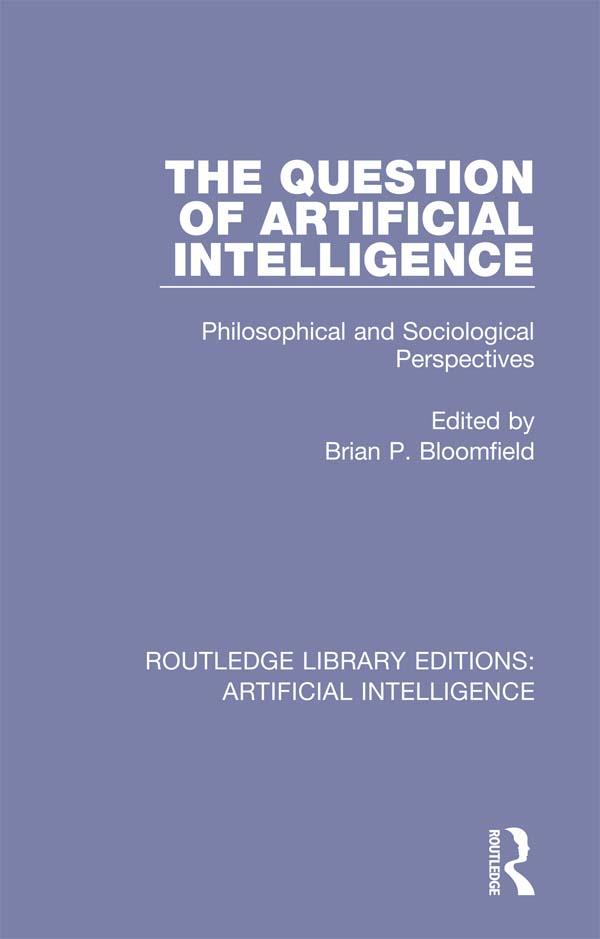
Originally published in 1987 when Artificial Intelligence (AI) was one of the most hotly debated subjects of the moment; there was widespread feeling that it was a field whose ‘time had come’, that intelligent machines lay ‘just around the corner’. Moreover, with the onset of the revolution in information technology and the proclamation from all corners that we were moving into an ‘information society’, developments in AI and advanced computing were seen in many countries as having both strategic and economic importance. Yet, aside from the glare of publicity that tends to surround new scientific ideas or technologies, it must be remembered that AI was a relative newcomer among the sciences; that it had often been the subject of bitter controversy; and that though it had been promising to create intelligent machines for some 40 years prior to publication, many believe that it had actually displayed very little substantive progress.
With this background in mind, the aim of this collection of essays was to take a novel look at AI. Rather than following the path of old well-trodden arguments about definitions of intelligence or the status of computer chess programs, the objective was to bring new perspectives to the subject in order to present it in a different light. Indeed, instead of simply adding to the endless wrangling ‘for’ and ‘against’ AI, the source of such divisions is made a topic for analysis in its own right. Drawing on ideas from the philosophy and sociology of scientific knowledge, this collection therefore broke new ground. Moreover, although a great deal had been written about the social and cultural impact of AI, little had been said of the culture of AI scientists themselves – including their discourse and style of thought, as well as the choices, judgements, negotiations and competitive struggles for resources that had shaped the genesis and development of the paradigmatic structure of their discipline at the time. Yet, sociologists of science have demonstrated that the analysis of factors such as these is a necessary part of understanding the development of scientific knowledge. Hence, it was hoped that this collection would help to redress the imbalance and provide a broader and more interesting picture of AI.
Payez facilement par carte, Klarna, Apple Pay ou Google Pay. Pas satisfait ? Vous avez toujours une garantie de remboursement de 14 jours. En savoir plus dans nos conditions. Si vous avez des questions, envoyez-nous un e-mail à hello@memmo.org.
Memmo facilite tes études, où que tu sois dans le monde. On rassemble tes manuels de cours et des outils d'étude intelligents au même endroit : résumés, quiz, podcasts et flashcards. Et il y a Ted, ton compagnon d'étude qui répond à toutes tes questions. Plus de 50 000 étudiants étudient déjà ici – conçu pour t'aider à apprendre plus vite et à moins stresser.