
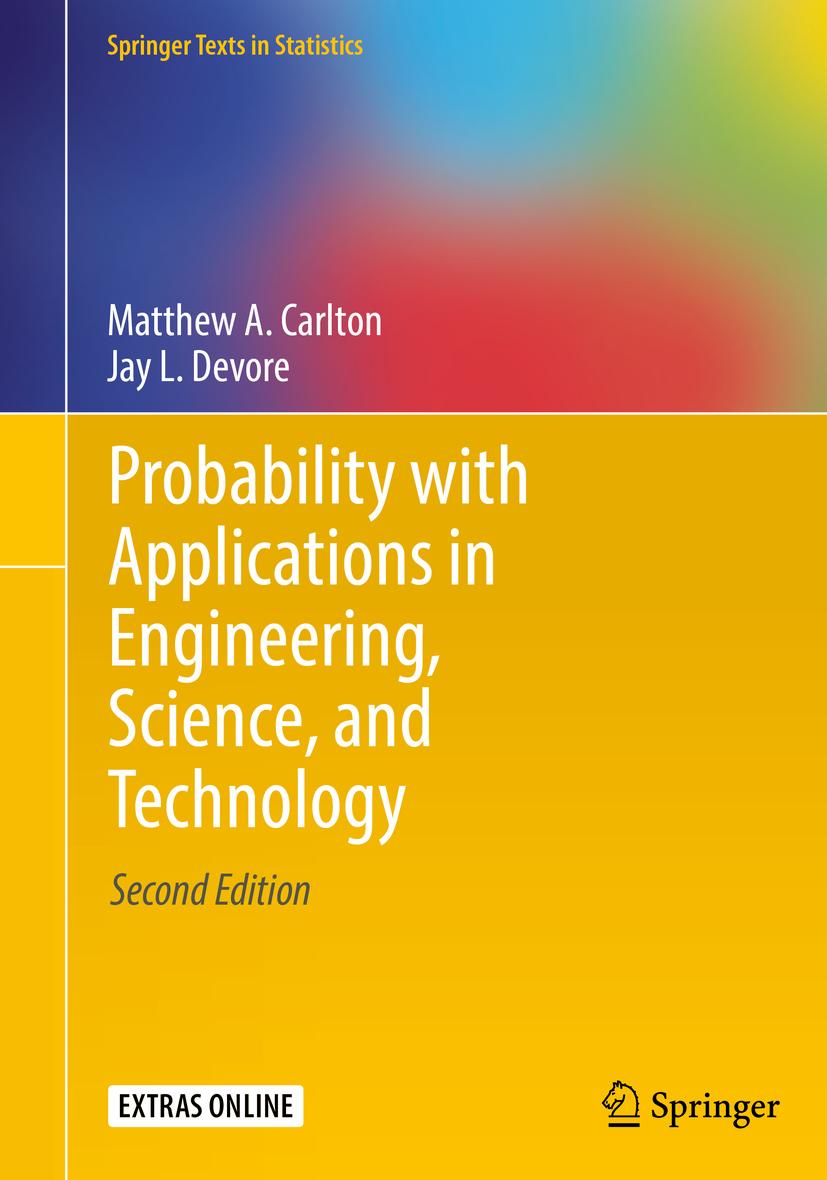
This updated and revised first-course textbook in applied probability provides a contemporary and lively post-calculus introduction to the subject of probability. The exposition reflects a desirable balance between fundamental theory and many applications involving a broad range of real problem scenarios. It is intended to appeal to a wide audience, including mathematics and statistics majors, prospective engineers and scientists, and those business and social science majors interested in the quantitative aspects of their disciplines.
The textbook contains enough material for a year-long course, though many instructors will use it for a single term (one semester or one quarter). As such, three course syllabi with expanded course outlines are now available for download on the book’s page on the Springer website.
A one-term course would cover material in the core chapters (1-4), supplemented by selections from one or more of the remaining chapters on statistical inference (Ch. 5), Markov chains (Ch. 6), stochastic processes (Ch. 7), and signal processing (Ch. 8—available exclusively online and specifically designed for electrical and computer engineers, making the book suitable for a one-term class on random signals and noise).For a year-long course, core chapters (1-4) are accessible to those who have taken a year of univariate differential and integral calculus; matrix algebra, multivariate calculus, and engineering mathematics are needed for the latter, more advanced chapters.
At the heart of the textbook’s pedagogy are 1,100 applied exercises, ranging from straightforward to reasonably challenging, roughly 700 exercises in the first four “core” chapters alone—a self-contained textbook of problems introducing basic theoretical knowledge necessary for solving problems and illustrating how to solve the problems at hand – in R and MATLAB, including code so that students can create simulations.New to this edition
• Extended and revised instructions and solutions to problem sets
• Overhaul of Section 7.7 on continuous-time Markov chains
• Supplementary materials include three sample syllabi and updated solutions manuals for both instructors and students
Betal enkelt med kort, Klarna, Apple Pay eller Google Pay. Ikke fornøyd? Du har alltid 14 dagers angrerett. Les mer i våre vilkår. Har du spørsmål, send oss en e-post på hello@memmo.org.
Memmo gjør det enklere å studere – uansett hvor du er i verden. Hos oss samler du pensumbøker og smarte studieverktøy på ett og samme sted: sammendrag, quizer, podkaster og flashcards. Og så Ted, din studiekompis som svarer på alt du lurer på. Over 50 000 studenter studerer allerede her – bygget for at du skal lære raskere og stresse mindre.