
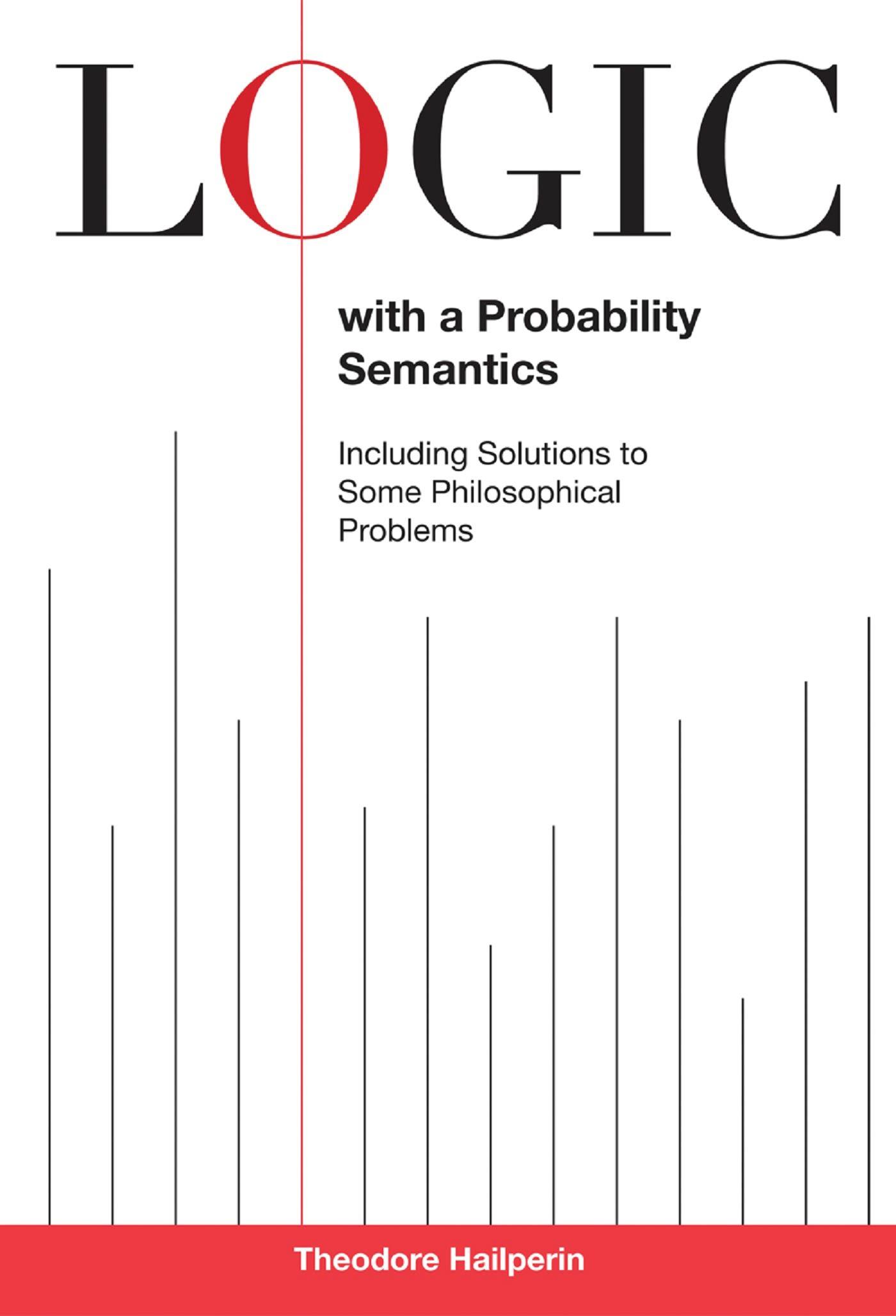
The present study is an extension of the topic introduced in Dr. Hailperin's Sentential Probability Logic, where the usual true-false semantics for logic is replaced with one based more on probability, and where values ranging from 0 to 1 are subject to probability axioms. Moreover, as the word "sentential" in the title of that work indicates, the language there under consideration was limited to sentences constructed from atomic (not inner logical components) sentences, by use of sentential connectives ("no," "and," "or," etc.) but not including quantifiers ("for all," "there is").
An initial introduction presents an overview of the book. In chapter one, Halperin presents a summary of results from his earlier book, some of which extends into this work. It also contains a novel treatment of the problem of combining evidence: how does one combine two items of interest for a conclusion-each of which separately impart a probability for the conclusion-so as to have a probability for the conclusion based on taking both of the two items of interest as evidence?
Chapter two enlarges the Probability Logic from the first chapter in two respects: the language now includes quantifiers ("for all," and "there is") whose variables range over atomic sentences, not entities as with standard quantifier logic. (Hence its designation: ontological neutral logic.) A set of axioms for this logic is presented. A new sentential notion—the suppositional—in essence due to Thomas Bayes, is adjoined to this logic that later becomes the basis for creating a conditional probability logic.
Chapter three opens with a set of four postulates for probability on ontologically neutral quantifier language. Many properties are derived and a fundamental theorem is proved, namely, for any probability model (assignment of probability values to all atomic sentences of the language) there will be a unique extension of the probability values to all closed sentences of the language.
An initial introduction presents an overview of the book. In chapter one, Halperin presents a summary of results from his earlier book, some of which extends into this work. It also contains a novel treatment of the problem of combining evidence: how does one combine two items of interest for a conclusion-each of which separately impart a probability for the conclusion-so as to have a probability for the conclusion based on taking both of the two items of interest as evidence?
Chapter two enlarges the Probability Logic from the first chapter in two respects: the language now includes quantifiers ("for all," and "there is") whose variables range over atomic sentences, not entities as with standard quantifier logic. (Hence its designation: ontological neutral logic.) A set of axioms for this logic is presented. A new sentential notion—the suppositional—in essence due to Thomas Bayes, is adjoined to this logic that later becomes the basis for creating a conditional probability logic.
Chapter three opens with a set of four postulates for probability on ontologically neutral quantifier language. Many properties are derived and a fundamental theorem is proved, namely, for any probability model (assignment of probability values to all atomic sentences of the language) there will be a unique extension of the probability values to all closed sentences of the language.
Betal enkelt med kort, Klarna, Apple Pay eller Google Pay. Ikke fornøyd? Du har alltid 14 dagers angrerett. Les mer i våre vilkår. Har du spørsmål, send oss en e-post på hello@memmo.org.
Memmo gjør det enklere å studere – uansett hvor du er i verden. Hos oss samler du pensumbøker og smarte studieverktøy på ett og samme sted: sammendrag, quizer, podkaster og flashcards. Og så Ted, din studiekompis som svarer på alt du lurer på. Over 50 000 studenter studerer allerede her – bygget for at du skal lære raskere og stresse mindre.