
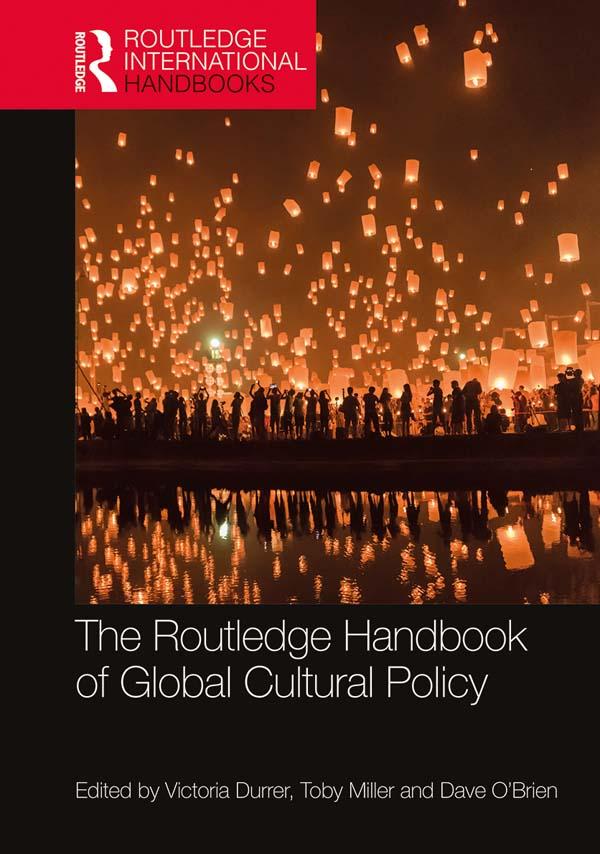
Cultural policy intersects with political, economic, and socio-cultural dynamics at all levels of society, placing high and often contradictory expectations on the capabilities and capacities of the media, the fine, performing, and folk arts, and cultural heritage. These expectations are articulated, mobilised and contested at – and across – a global scale. As a result, the study of cultural policy has firmly established itself as a field that cuts across a range of academic disciplines, including sociology, cultural and media studies, economics, anthropology, area studies, languages, geography, and law. This Routledge Handbook of Global Cultural Policy sets out to broaden the field’s consideration to recognise the necessity for international and global perspectives.
The book explores how cultural policy has become a global phenomenon. It brings together a diverse range of researchers whose work reveals how cultural policy expresses and realises common global concerns, dominant narratives, and geopolitical economic and social inequalities. The sections of the book address cultural policy’s relation to core academic disciplines and core questions, of regulations, rights, development, practice, and global issues.
With a cross-section of country-by-country case studies, this comprehensive volume is a map for academics and students seeking to become more globally orientated cultural policy scholars.
Betal enkelt med kort, Klarna, Apple Pay eller Google Pay. Ikke fornøyd? Du har alltid 14 dagers angrerett. Les mer i våre vilkår. Har du spørsmål, send oss en e-post på hello@memmo.org.
Memmo gjør det enklere å studere – uansett hvor du er i verden. Hos oss samler du pensumbøker og smarte studieverktøy på ett og samme sted: sammendrag, quizer, podkaster og flashcards. Og så Ted, din studiekompis som svarer på alt du lurer på. Over 50 000 studenter studerer allerede her – bygget for at du skal lære raskere og stresse mindre.