
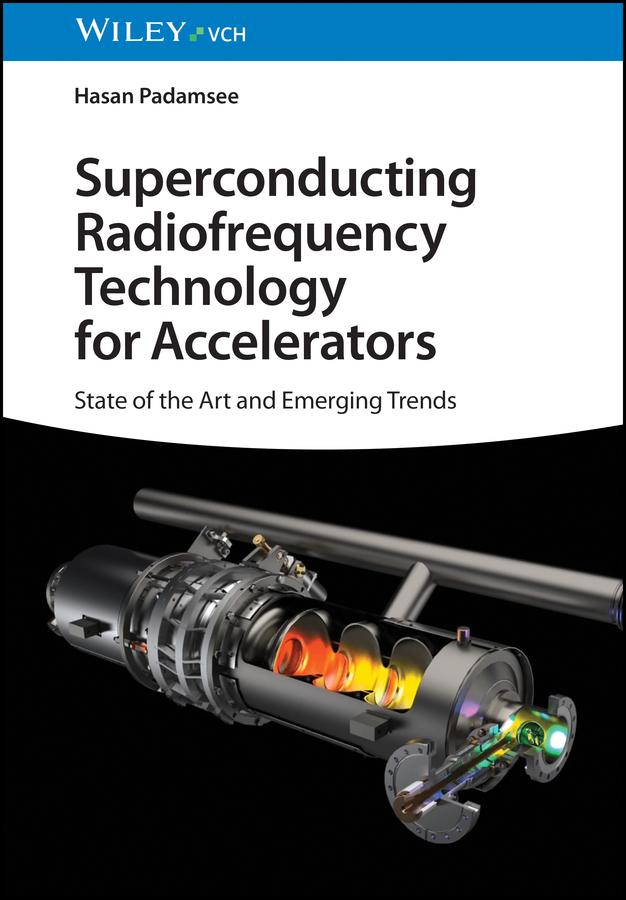
Single source reference enabling readers to understand and master state-of-the-art accelerator technology
Superconducting Radiofrequency Technology for Accelerators provides a quick yet thorough overview of the key technologies for current and future accelerators, including those projected to enable breakthrough developments in materials science, nuclear and astrophysics, high energy physics, neutrino research and quantum computing.
The work is divided into three sections. The first part provides a review of RF superconductivity basics, the second covers new techniques such as nitrogen doping, nitrogen infusion, oxide-free niobium, new surface treatments, and magnetic flux expulsion, high field Q slope, complemented by discussions of the physics of the improvements stemming from diagnostic techniques and surface analysis as well as from theory. The third part reviews the on-going applications of RF superconductivity in already operational facilities and those under construction such as light sources, proton accelerators, neutron and neutrino sources, ion accelerators, and crab cavity facilities. The third part discusses planned accelerator projects such as the International Linear Collider, the Future Circular Collider, the Chinese Electron Positron Collider, and the Proton Improvement Plan-III facility at Fermilab as well as exciting new developments in quantum computing using superconducting niobium cavities.
Written by the leading expert in the field of radiofrequency superconductivity, Superconducting Radiofrequency Technology for Accelerators covers other sample topics such as:
- Fabrication and processing on Nb-based SRF structures, covering cavity fabrication, preparation, and a decade of progress in the field
- SRF physics, covering zero DC resistance, the Meissner effect, surface resistance and surface impedance in RF fields, and non-local response of supercurrent
- N-doping and residual resistance, covering trapped DC flux losses, hydride losses, and tunneling measurements
- Theories for anti-Q-slope, covering the Xiao theory, the Gurevich theory, non-equilibrium superconductivity, and two fluid model based on weak defects
Superconducting Radiofrequency Technology for Accelerators is an essential reference for high energy physicists, power engineers, and electrical engineers who want to understand the latest developments of accelerator technology and be able to harness it to further research interest and practical applications.
Payez facilement par carte, Klarna, Apple Pay ou Google Pay. Pas satisfait ? Vous avez toujours une garantie de remboursement de 14 jours. En savoir plus dans nos conditions. Si vous avez des questions, envoyez-nous un e-mail à hello@memmo.org.
Memmo facilite tes études, où que tu sois dans le monde. On rassemble tes manuels de cours et des outils d'étude intelligents au même endroit : résumés, quiz, podcasts et flashcards. Et il y a Ted, ton compagnon d'étude qui répond à toutes tes questions. Plus de 50 000 étudiants étudient déjà ici – conçu pour t'aider à apprendre plus vite et à moins stresser.