
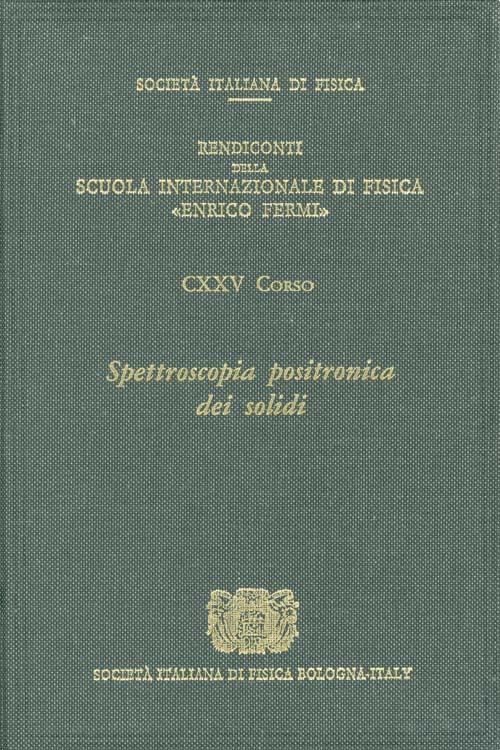
The lifetime of a positron inside a solid is normally less than a fraction of nanosecond. This is a very short time on a human scale, but is long enough to enable the positron to visit an extended region of the material, and to sense the atomic and electronic structure of the environment. Thus, we can inject a positron in a sample to draw from it some signal giving us information on the microscopic properties of the material. This idea has been successfully developed in a number of positron-based techniques of physical analysis, with resolution in energy, momentum, or position. The complex of these techniques is what we call now positron spectroscopy of solids. The field of application of the positron spectroscopy extends from advanced problems of solid-state physics to industrial applications in the area of characterization of high-tech materials. This volume focuses the attention on the physics that can be learned from positron-based methods, but also frames those methods in a wider context including other experimental approaches. It can be considered as a textbook on positron spectroscopy of solids, the sort of book that the newcomer takes for his approach to this field, but also as a useful research tool for the expert.
Payez facilement par carte, Klarna, Apple Pay ou Google Pay. Pas satisfait ? Vous avez toujours une garantie de remboursement de 14 jours. En savoir plus dans nos conditions. Si vous avez des questions, envoyez-nous un e-mail à hello@memmo.org.
Memmo facilite tes études, où que tu sois dans le monde. On rassemble tes manuels de cours et des outils d'étude intelligents au même endroit : résumés, quiz, podcasts et flashcards. Et il y a Ted, ton compagnon d'étude qui répond à toutes tes questions. Plus de 50 000 étudiants étudient déjà ici – conçu pour t'aider à apprendre plus vite et à moins stresser.