
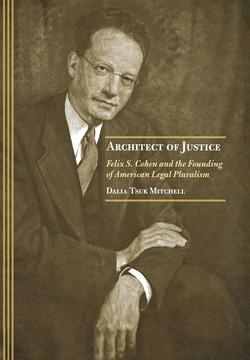
A major figure in American legal history during the first half of the twentieth century, Felix Solomon Cohen (1907–1953) is best known for his realist view of the law and his efforts to grant Native Americans more control over their own cultural, political, and economic affairs. A second-generation Jewish American, Cohen was born in Manhattan, where he attended the College of the City of New York before receiving a Ph.D. in philosophy from Harvard University and a law degree from Columbia University. Between 1933 and 1948 he served in the Solicitor's Office of the Department of the Interior, where he made lasting contributions to federal Indian law, drafting the Indian Reorganization Act of 1934, the Indian Claims Commission Act of 1946, and, as head of the Indian Law Survey, authoring The Handbook of Federal Indian Law (1941), which promoted the protection of tribal rights and continues to serve as the basis for developments in federal Indian law.
In Architect of Justice, Dalia Tsuk Mitchell provides the first intellectual biography of Cohen, whose career and legal philosophy she depicts as being inextricably bound to debates about the place of political, social, and cultural groups within American democracy. Cohen was, she finds, deeply influenced by his own experiences as a Jewish American and discussions within the Jewish community about assimilation and cultural pluralism as well the persecution of European Jews before and during World War II.
Dalia Tsuk Mitchell uses Cohen's scholarship and legal work to construct a history of legal pluralism—a tradition in American legal and political thought that has immense relevance to contemporary debates and that has never been examined before. She traces the many ways in which legal pluralism informed New Deal policymaking and demonstrates the importance of Cohen's work on behalf of Native Americans in this context, thus bringing federal Indian law from the margins of American legal history to its center. By following the development of legal pluralism in Cohen's writings, Architect of Justice demonstrates a largely unrecognized continuity in American legal thought between the Progressive Era and ongoing debates about multiculturalism and minority rights today. A landmark work in American legal history, this biography also makes clear the major contribution Felix S. Cohen made to America's legal and political landscape through his scholarship and his service to the American government.
Payez facilement par carte, Klarna, Apple Pay ou Google Pay. Pas satisfait ? Vous avez toujours une garantie de remboursement de 14 jours. En savoir plus dans nos conditions. Si vous avez des questions, envoyez-nous un e-mail à hello@memmo.org.
Memmo facilite tes études, où que tu sois dans le monde. On rassemble tes manuels de cours et des outils d'étude intelligents au même endroit : résumés, quiz, podcasts et flashcards. Et il y a Ted, ton compagnon d'étude qui répond à toutes tes questions. Plus de 50 000 étudiants étudient déjà ici – conçu pour t'aider à apprendre plus vite et à moins stresser.