
A 2024 CHOICE OUTSTANDING ACADEMIC TITLE
PROSE AWARDS MEDIA AND CULTURAL STUDIES FINALIST 2024
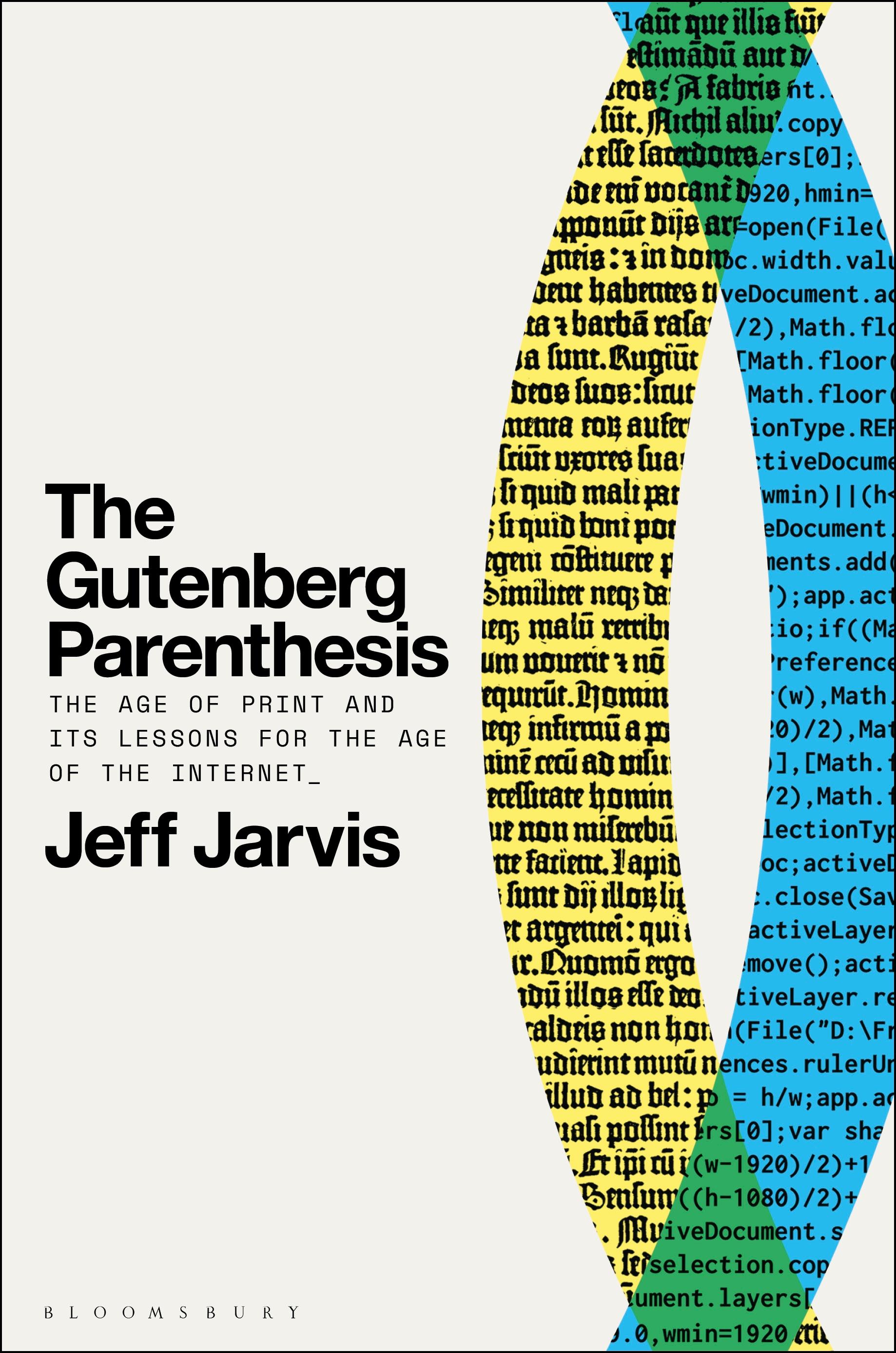
The Gutenberg Parenthesis traces the epoch of print from its fateful beginnings to our digital present – and draws out lessons for the age to come.
The age of print is a grand exception in history. For five centuries it fostered what some call print culture – a worldview shaped by the completeness, permanence, and authority of the printed word. As a technology, print at its birth was as disruptive as the digital migration of today. Now, as the internet ushers us past print culture, journalist Jeff Jarvis offers important lessons from the era we leave behind.
To understand our transition out of the Gutenberg Age, Jarvis first examines the transition into it. Tracking Western industrialized print to its origins, he explores its invention, spread, and evolution, as well as the bureaucracy and censorship that followed. He also reveals how print gave rise to the idea of the mass – mass media, mass market, mass culture, mass politics, and so on – that came to dominate the public sphere.
What can we glean from the captivating, profound, and challenging history of our devotion to print? Could it be that we are returning to a time before mass media, to a society built on conversation, and that we are relearning how to hold that conversation with ourselves? Brimming with broader implications for today's debates over communication, authorship, and ownership, Jarvis' exploration of print on a grand scale is also a complex, compelling history of technology and power.
PROSE AWARDS MEDIA AND CULTURAL STUDIES FINALIST 2024
The Gutenberg Parenthesis traces the epoch of print from its fateful beginnings to our digital present – and draws out lessons for the age to come.
The age of print is a grand exception in history. For five centuries it fostered what some call print culture – a worldview shaped by the completeness, permanence, and authority of the printed word. As a technology, print at its birth was as disruptive as the digital migration of today. Now, as the internet ushers us past print culture, journalist Jeff Jarvis offers important lessons from the era we leave behind.
To understand our transition out of the Gutenberg Age, Jarvis first examines the transition into it. Tracking Western industrialized print to its origins, he explores its invention, spread, and evolution, as well as the bureaucracy and censorship that followed. He also reveals how print gave rise to the idea of the mass – mass media, mass market, mass culture, mass politics, and so on – that came to dominate the public sphere.
What can we glean from the captivating, profound, and challenging history of our devotion to print? Could it be that we are returning to a time before mass media, to a society built on conversation, and that we are relearning how to hold that conversation with ourselves? Brimming with broader implications for today's debates over communication, authorship, and ownership, Jarvis' exploration of print on a grand scale is also a complex, compelling history of technology and power.
Payez facilement par carte, Klarna, Apple Pay ou Google Pay. Pas satisfait ? Vous avez toujours une garantie de remboursement de 14 jours. En savoir plus dans nos conditions. Si vous avez des questions, envoyez-nous un e-mail à hello@memmo.org.
Memmo facilite tes études, où que tu sois dans le monde. On rassemble tes manuels de cours et des outils d'étude intelligents au même endroit : résumés, quiz, podcasts et flashcards. Et il y a Ted, ton compagnon d'étude qui répond à toutes tes questions. Plus de 50 000 étudiants étudient déjà ici – conçu pour t'aider à apprendre plus vite et à moins stresser.