
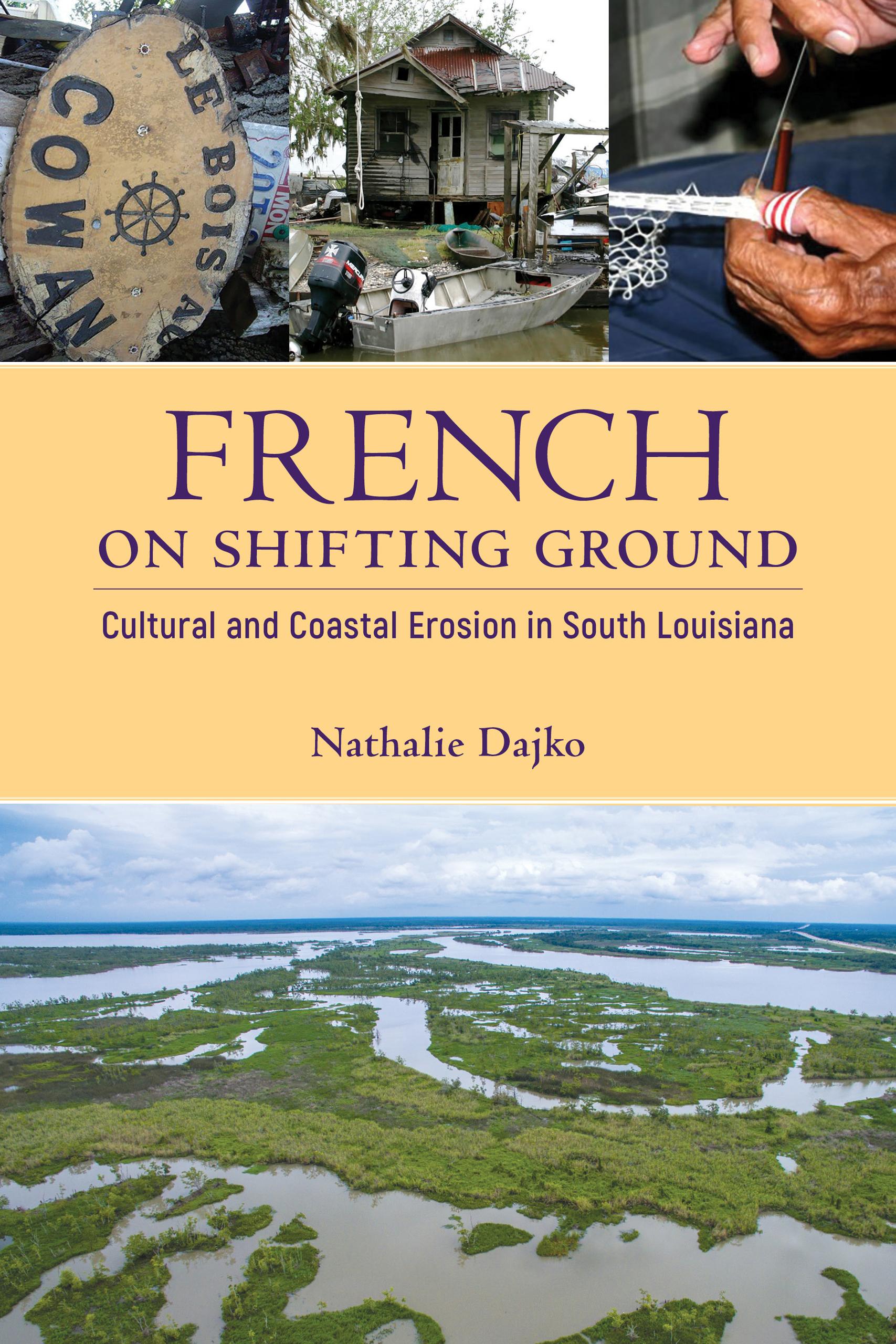
In French on Shifting Ground: Cultural and Coastal Erosion in South Louisiana, Nathalie Dajko introduces readers to the lower Lafourche Basin, Louisiana, where the land, a language, and a way of life are at risk due to climate change, environmental disaster, and coastal erosion. Louisiana French is endangered all around the state, but in the lower Lafourche Basin the shift to English is accompanied by the equally rapid disappearance of the land on which its speakers live.
French on Shifting Ground allows both scholars and the general public to get an overview of how rich and diverse the French language in Louisiana is, and serves as a key reminder that Louisiana serves as a prime repository for Native and heritage languages, ranking among the strongest preservation regions in the southern and eastern US. Nathalie Dajko outlines the development of French in the region, highlighting the features that make it unique in the world and including the first published comparison of the way it is spoken by the local American Indian and Cajun populations.
She then weaves together evidence from multiple lines of linguistic research, years of extensive participant observation, and personal narratives from the residents themselves to illustrate the ways in which language—in this case French—is as fundamental to the creation of place as is the physical landscape. It is a story at once scholarly and personal: the loss of the land and the concomitant loss of the language have implications for the academic community as well as for the people whose cultures—and identities—are literally at stake.
French on Shifting Ground allows both scholars and the general public to get an overview of how rich and diverse the French language in Louisiana is, and serves as a key reminder that Louisiana serves as a prime repository for Native and heritage languages, ranking among the strongest preservation regions in the southern and eastern US. Nathalie Dajko outlines the development of French in the region, highlighting the features that make it unique in the world and including the first published comparison of the way it is spoken by the local American Indian and Cajun populations.
She then weaves together evidence from multiple lines of linguistic research, years of extensive participant observation, and personal narratives from the residents themselves to illustrate the ways in which language—in this case French—is as fundamental to the creation of place as is the physical landscape. It is a story at once scholarly and personal: the loss of the land and the concomitant loss of the language have implications for the academic community as well as for the people whose cultures—and identities—are literally at stake.
Payez facilement par carte, Klarna, Apple Pay ou Google Pay. Pas satisfait ? Vous avez toujours une garantie de remboursement de 14 jours. En savoir plus dans nos conditions. Si vous avez des questions, envoyez-nous un e-mail à hello@memmo.org.
Memmo facilite tes études, où que tu sois dans le monde. On rassemble tes manuels de cours et des outils d'étude intelligents au même endroit : résumés, quiz, podcasts et flashcards. Et il y a Ted, ton compagnon d'étude qui répond à toutes tes questions. Plus de 50 000 étudiants étudient déjà ici – conçu pour t'aider à apprendre plus vite et à moins stresser.
Tu pourrais aussi aimer
Acheter le livre0