
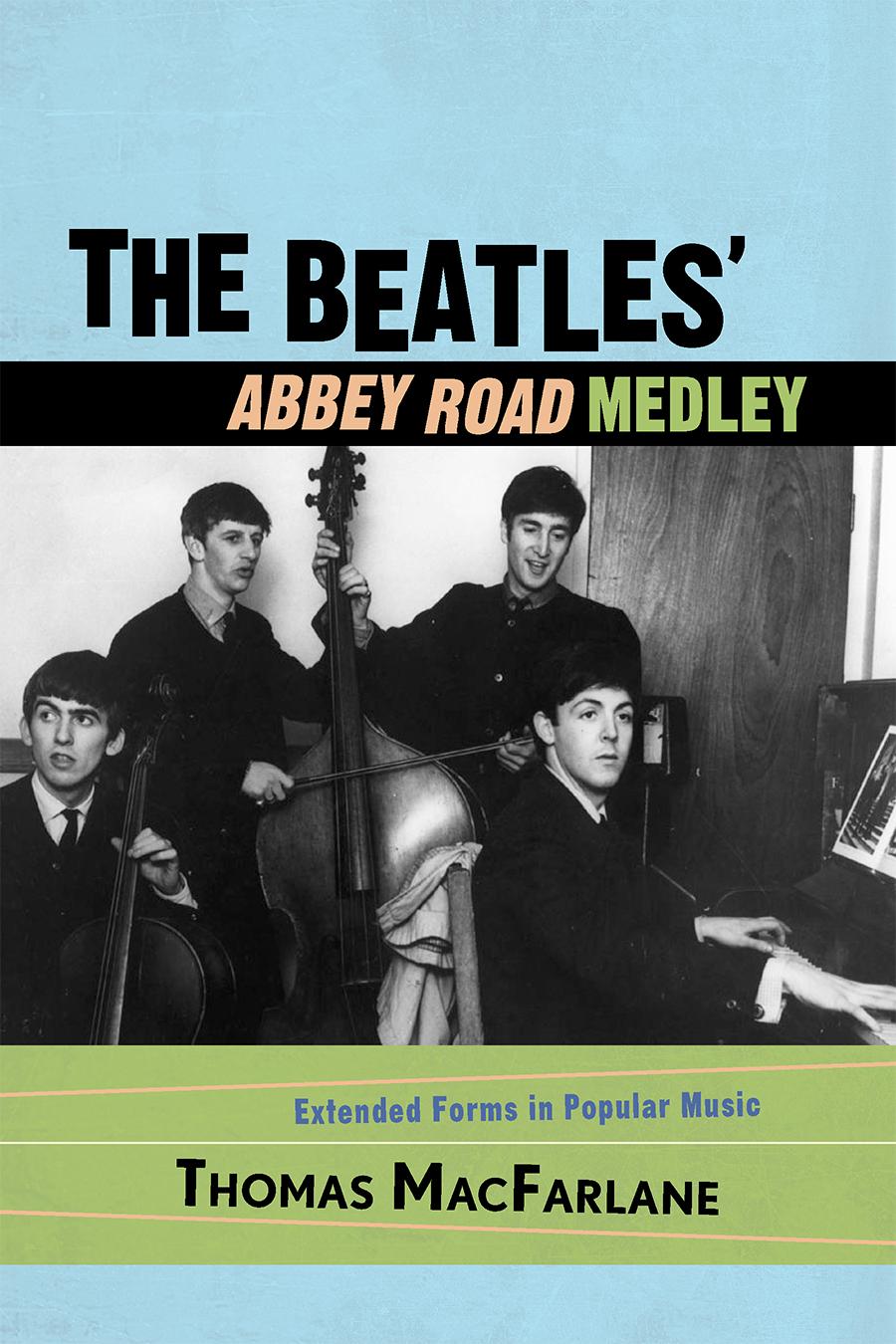
In September 1969, the Beatles released their final recorded work, Abbey Road, using a variety of progressive musical ideas that expressed the group's approach to multi-track recording and offering songs that constituted a highpoint in the Beatles' musical corpus. Of particular interest is the concluding sequence of songs (tracks 8-17): seemingly unrelated fragments woven together into a musical form that has thus far defied attempts at categorization. The Beatles' Abbey Road Medley: Extended Forms in Popular Music offers an analysis of these fragments, commonly known as the Abbey Road Medley, in order to understand and explain the emergent musical form and to clarify the relationships between music recording and music composition.
Thomas MacFarlane provides an overview of the Beatles-their history and their music-within the context of popular music and culture between 1962 and 1970, paying particular attention to the production of the album Abbey Road and the pivotal role of producer George Martin on the Abbey Road Medley. After explaining his method of analysis, MacFarlane applies it to the recording and transcription of the Abbey Road Medley, examining the implications of the work's structure and demonstrating how the Beatles expanded the parameters of the popular music form by incorporating recording technology directly into the compositional process. Drawing conclusions about musical form and practice in the recording process of the 1970s and beyond, MacFarlane also suggests other examples of rock music that were influenced by Abbey Road. An appendix transcribing the author's interview with the Beatles' de facto manager Peter Brown, a selected discography, a bibliography, and a selection of photos conclude the book, which will be of particular interest to musicians and Beatles fans alike.
Thomas MacFarlane provides an overview of the Beatles-their history and their music-within the context of popular music and culture between 1962 and 1970, paying particular attention to the production of the album Abbey Road and the pivotal role of producer George Martin on the Abbey Road Medley. After explaining his method of analysis, MacFarlane applies it to the recording and transcription of the Abbey Road Medley, examining the implications of the work's structure and demonstrating how the Beatles expanded the parameters of the popular music form by incorporating recording technology directly into the compositional process. Drawing conclusions about musical form and practice in the recording process of the 1970s and beyond, MacFarlane also suggests other examples of rock music that were influenced by Abbey Road. An appendix transcribing the author's interview with the Beatles' de facto manager Peter Brown, a selected discography, a bibliography, and a selection of photos conclude the book, which will be of particular interest to musicians and Beatles fans alike.
Payez facilement par carte, Klarna, Apple Pay ou Google Pay. Pas satisfait ? Vous avez toujours une garantie de remboursement de 14 jours. En savoir plus dans nos conditions. Si vous avez des questions, envoyez-nous un e-mail à hello@memmo.org.
Memmo facilite tes études, où que tu sois dans le monde. On rassemble tes manuels de cours et des outils d'étude intelligents au même endroit : résumés, quiz, podcasts et flashcards. Et il y a Ted, ton compagnon d'étude qui répond à toutes tes questions. Plus de 50 000 étudiants étudient déjà ici – conçu pour t'aider à apprendre plus vite et à moins stresser.