
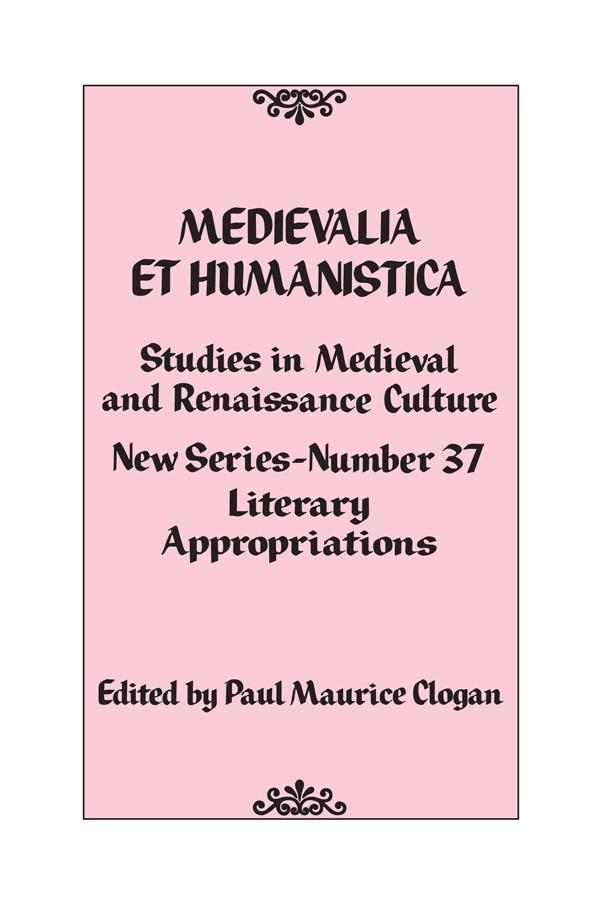
Volume 37- Literary Appropriations-examines medieval literature in a different light. This volume features six original articles, focusing on the art of appropriation, as well as fourteen reviews of recent scholarly publications.
The first article “The Oldest Manuscript Witness of the First Life of Blessed Francis of Assisi” by Jacques Dalarun reveals the oldest known source of the writings of Francis of Assisi, until of late only found in an Italian church publication. Lisa Bansen-Harp's essay “Ironic Patterning and Numerical Composition in the Vie de saint Alexis: Form and Effect/Affect” takes an ironic look at the oppositions used throughout the work to offer a rich analysis of patterns. Reexamining genealogy as spiritual rather than biological is Nicole Leapley's essay “Rewriting Paternity: The Meaning of Renovating Westminster in La Esoire de seint Aedward le rei.” David Lummus's essay “Boccaccio's Three Venuses: On the Convergence of Celestial and Transgressive Love in the Genealogie Deorum Gentilium Libri” provides a comparative look of how love-celestial and transgressive-can be seen in the Decameron. “Dante's Justinian, Cino's Corpus: The Hermeneutics of Poetry and Law” by Lorenzo Valterza compares and contrasts Dante's own view of law versus that of his friend Cino da Pistoia. Lastly, editor Paul Clogan contributes his own article “Dante's Appropriation of Lucan's Cato and Erichtho” to demonstrate the importance of Lucan's characters in Dante's own work Along with these articles, fourteen reviews, from the United States and all over the world, are included, truly making Medievalia et Humanistica an international publication.
To reflect the submissions and audience for Medievalia et Humanistica, the editorial and review boards include ten members from the United States and ten international members, making thisa truly international publication.
Please submit books for review consideration to:
Attention: Reinhold F. Glei
Medievalia et Humanistica
Ruhr-University Bochum
Seminar fuer Klassische Philologie
D-44780 Bochum, Germany
The first article “The Oldest Manuscript Witness of the First Life of Blessed Francis of Assisi” by Jacques Dalarun reveals the oldest known source of the writings of Francis of Assisi, until of late only found in an Italian church publication. Lisa Bansen-Harp's essay “Ironic Patterning and Numerical Composition in the Vie de saint Alexis: Form and Effect/Affect” takes an ironic look at the oppositions used throughout the work to offer a rich analysis of patterns. Reexamining genealogy as spiritual rather than biological is Nicole Leapley's essay “Rewriting Paternity: The Meaning of Renovating Westminster in La Esoire de seint Aedward le rei.” David Lummus's essay “Boccaccio's Three Venuses: On the Convergence of Celestial and Transgressive Love in the Genealogie Deorum Gentilium Libri” provides a comparative look of how love-celestial and transgressive-can be seen in the Decameron. “Dante's Justinian, Cino's Corpus: The Hermeneutics of Poetry and Law” by Lorenzo Valterza compares and contrasts Dante's own view of law versus that of his friend Cino da Pistoia. Lastly, editor Paul Clogan contributes his own article “Dante's Appropriation of Lucan's Cato and Erichtho” to demonstrate the importance of Lucan's characters in Dante's own work Along with these articles, fourteen reviews, from the United States and all over the world, are included, truly making Medievalia et Humanistica an international publication.
To reflect the submissions and audience for Medievalia et Humanistica, the editorial and review boards include ten members from the United States and ten international members, making thisa truly international publication.
Please submit books for review consideration to:
Attention: Reinhold F. Glei
Medievalia et Humanistica
Ruhr-University Bochum
Seminar fuer Klassische Philologie
D-44780 Bochum, Germany
Payez facilement par carte, Klarna, Apple Pay ou Google Pay. Pas satisfait ? Vous avez toujours une garantie de remboursement de 14 jours. En savoir plus dans nos conditions. Si vous avez des questions, envoyez-nous un e-mail à hello@memmo.org.
Memmo facilite tes études, où que tu sois dans le monde. On rassemble tes manuels de cours et des outils d'étude intelligents au même endroit : résumés, quiz, podcasts et flashcards. Et il y a Ted, ton compagnon d'étude qui répond à toutes tes questions. Plus de 50 000 étudiants étudient déjà ici – conçu pour t'aider à apprendre plus vite et à moins stresser.