
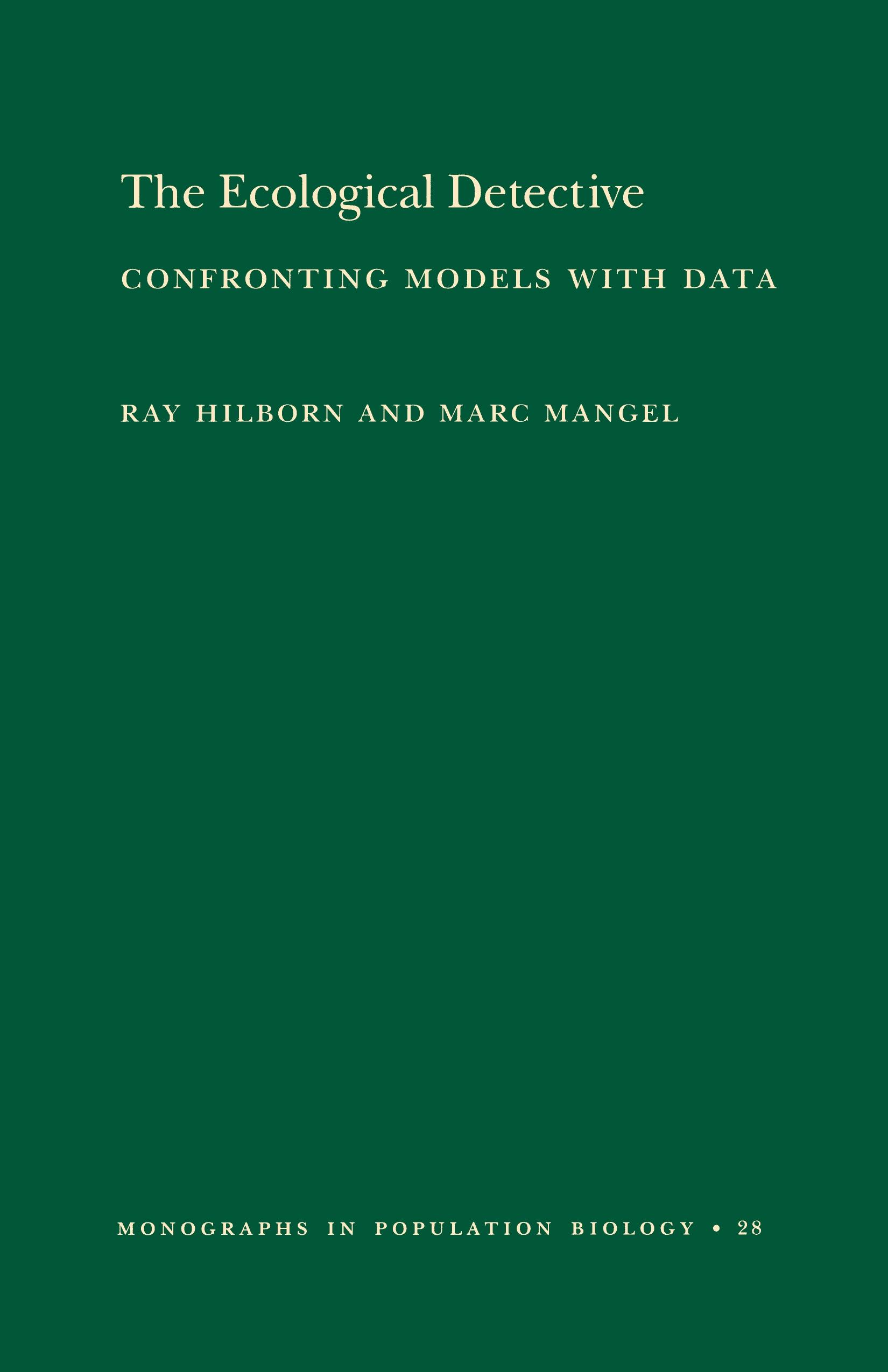
The modern ecologist usually works in both the field and laboratory, uses statistics and computers, and often works with ecological concepts that are model-based, if not model-driven. How do we make the field and laboratory coherent? How do we link models and data? How do we use statistics to help experimentation? How do we integrate modeling and statistics? How do we confront multiple hypotheses with data and assign degrees of belief to different hypotheses? How do we deal with time series (in which data are linked from one measurement to the next) or put multiple sources of data into one inferential framework? These are the kinds of questions asked and answered by The Ecological Detective.
Ray Hilborn and Marc Mangel investigate ecological data much as a detective would investigate a crime scene by trying different hypotheses until a coherent picture emerges. The book is not a set of pat statistical procedures but rather an approach. The Ecological Detective makes liberal use of computer programming for the generation of hypotheses, exploration of data, and the comparison of different models. The authors' attitude is one of exploration, both statistical and graphical. The background required is minimal, so that students with an undergraduate course in statistics and ecology can profitably add this work to their tool-kit for solving ecological problems.
Payez facilement par carte, Klarna, Apple Pay ou Google Pay. Pas satisfait ? Vous avez toujours une garantie de remboursement de 14 jours. En savoir plus dans nos conditions. Si vous avez des questions, envoyez-nous un e-mail à hello@memmo.org.
Memmo facilite tes études, où que tu sois dans le monde. On rassemble tes manuels de cours et des outils d'étude intelligents au même endroit : résumés, quiz, podcasts et flashcards. Et il y a Ted, ton compagnon d'étude qui répond à toutes tes questions. Plus de 50 000 étudiants étudient déjà ici – conçu pour t'aider à apprendre plus vite et à moins stresser.