
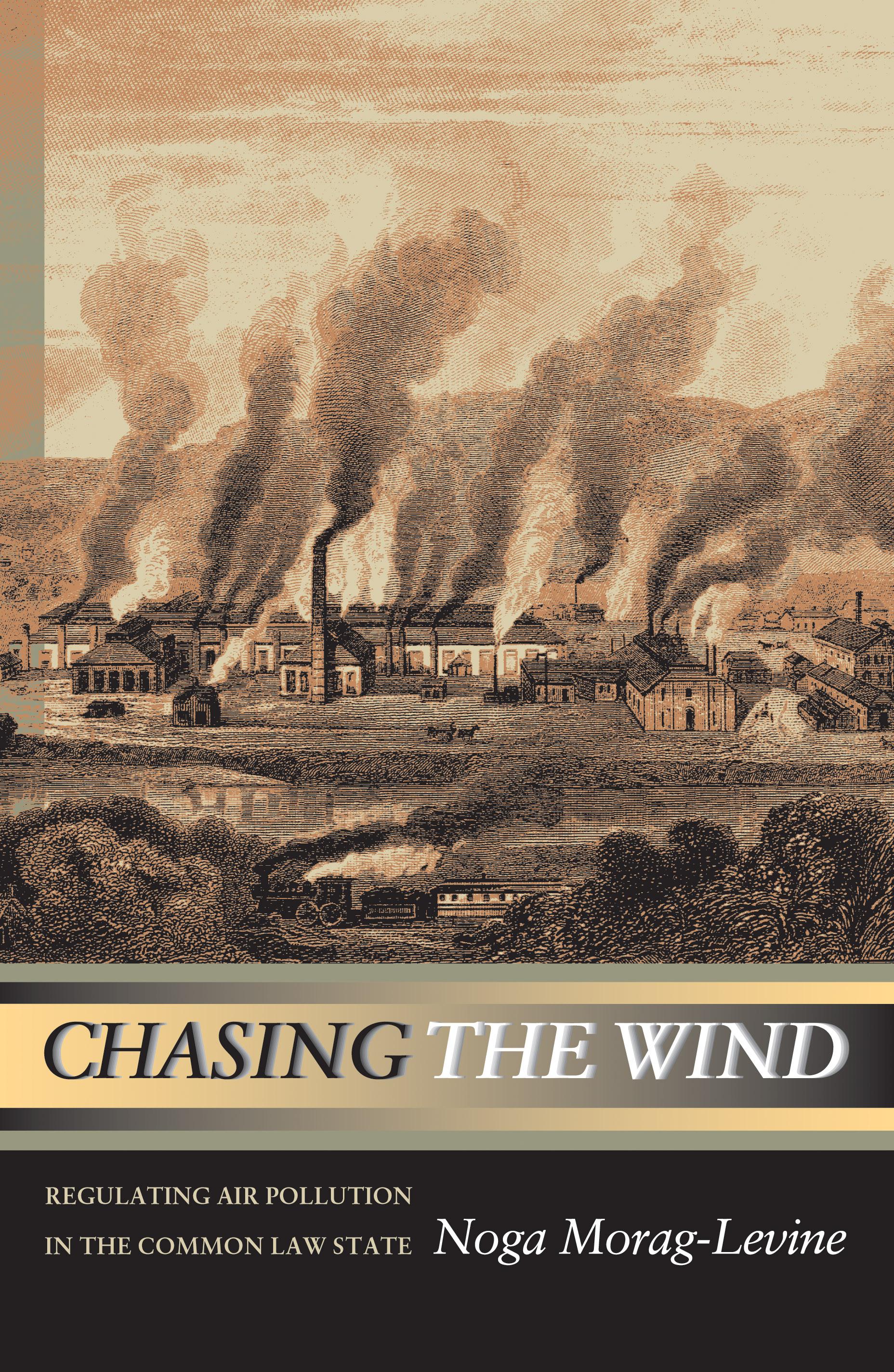
The Federal Clean Air Act of 1970 is widely seen as a revolutionary legal response to the failures of the earlier common law regime, which had governed air pollution in the United States for more than a century. Noga Morag-Levine challenges this view, highlighting striking continuities between the assumptions governing current air pollution regulation in the United States and the principles that had guided the earlier nuisance regime. Most importantly, this continuity is evident in the centrality of risk-based standards within contemporary American air pollution regulatory policy. Under the European approach, by contrast, the feasibility-based technology standard is the regulatory instrument of choice.
Through historical analysis of the evolution of Anglo-American air pollution law and contemporary case studies of localized pollution disputes, Chasing the Wind argues for an overhaul in U.S. air pollution policy. This reform, following the European model, would forgo the unrealizable promise of complete, perfectly tailored protection--a hallmark of both nuisance law and the Clean Air Act--in favor of incremental, across-the-board pollution reductions. The author argues that prevailing critiques of technology standards as inefficient and undemocratic instruments of "command and control" fit with a longstanding pattern of American suspicion of civil law modeled interventions. This distrust, she concludes, has impeded the development of environmental regulation that would be less adversarial in process and more equitable in outcome.
Payez facilement par carte, Klarna, Apple Pay ou Google Pay. Pas satisfait ? Vous avez toujours une garantie de remboursement de 14 jours. En savoir plus dans nos conditions. Si vous avez des questions, envoyez-nous un e-mail à hello@memmo.org.
Memmo facilite tes études, où que tu sois dans le monde. On rassemble tes manuels de cours et des outils d'étude intelligents au même endroit : résumés, quiz, podcasts et flashcards. Et il y a Ted, ton compagnon d'étude qui répond à toutes tes questions. Plus de 50 000 étudiants étudient déjà ici – conçu pour t'aider à apprendre plus vite et à moins stresser.