
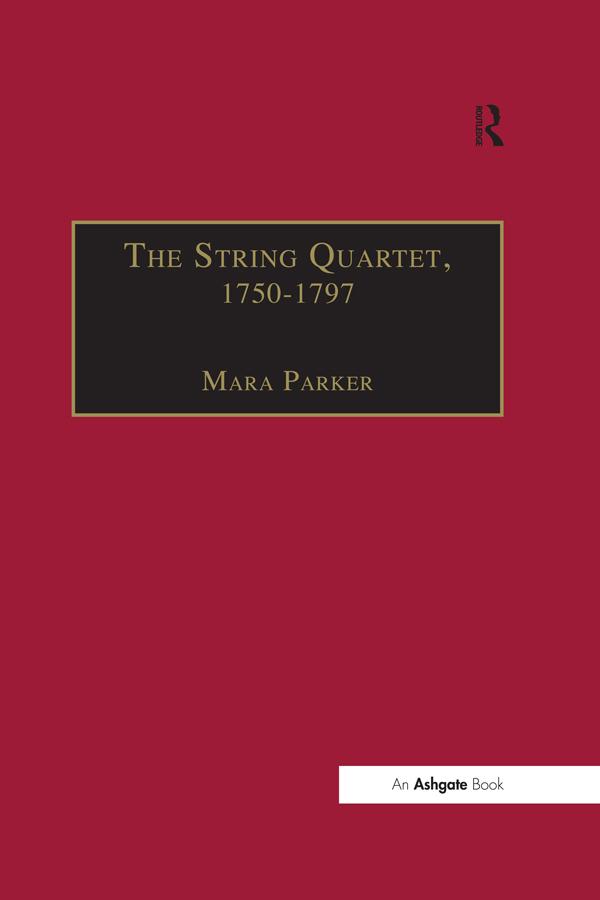
The second half of the eighteenth century witnessed a flourishing of the string quartet, often represented as a smooth and logical progression from first violin-dominated homophony to a more equal conversation between the four voices. Yet this progression was neither as smooth nor as linear as previously thought, as Mara Parker illustrates in her examination of the string quartet during this period. Looking at a wide variety of string quartets by composers such as Pleyel, Distler and Filtz, in addition to Haydn and Mozart, the book proposes a new way of describing the relationships between the four instruments in different works. Broadly speaking, these relationships follow one of four patterns: the 'lecture', the 'polite conversation', the 'debate', and the 'conversation'. In focusing on these musical discourses, it becomes apparent that each work is the product of its composer's stylistic choices, location, intended performers and intended audience. Instead of evolving in a strict and universal sequence, the string quartet in the latter half of the eighteenth century was a complex genre with composers mixing and matching musical discourses as circumstances and their own creative impulses required.
Payez facilement par carte, Klarna, Apple Pay ou Google Pay. Pas satisfait ? Vous avez toujours une garantie de remboursement de 14 jours. En savoir plus dans nos conditions. Si vous avez des questions, envoyez-nous un e-mail à hello@memmo.org.
Memmo facilite tes études, où que tu sois dans le monde. On rassemble tes manuels de cours et des outils d'étude intelligents au même endroit : résumés, quiz, podcasts et flashcards. Et il y a Ted, ton compagnon d'étude qui répond à toutes tes questions. Plus de 50 000 étudiants étudient déjà ici – conçu pour t'aider à apprendre plus vite et à moins stresser.
Tu pourrais aussi aimer
Acheter le livre0