
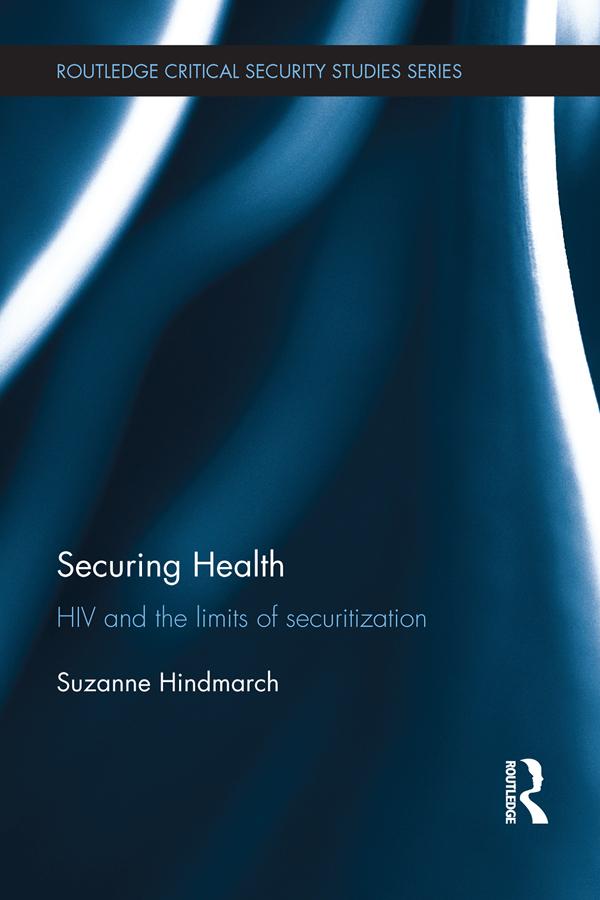
This book offers a critical inquiry into the framing of health and disease as a security issue.
In particular, the book examines what happens in the United Nations when the ostensibly ‘low’ politics of global health meet the ‘high’ politics of security, and when the logic of security comes to shape global health initiatives. It offers a critical re-assessment of efforts in the United Nations system to position HIV as a security threat with the hope that this would attract greater attention and resources for the global HIV response. The book advances securitization theory by presenting a new framework for studying HIV as a policy process, uniting several theoretical strands into a single, powerful model for empirical application. It uses this model to draw attention to important, understudied aspects of HIV securitization, including the role played by discourses about Africa, and the evolution of ideas about HIV and security as actors learned over time. On the basis of this empirically grounded assessment of how securitization works as a theory and a political strategy, the book suggests that securitization is inherently limited, and perhaps dangerous, as a strategy for ‘securing’ social change.
This book will be of much interest to students of critical security studies, global health, development studies, and IR in general.
Payez facilement par carte, Klarna, Apple Pay ou Google Pay. Pas satisfait ? Vous avez toujours une garantie de remboursement de 14 jours. En savoir plus dans nos conditions. Si vous avez des questions, envoyez-nous un e-mail à hello@memmo.org.
Memmo facilite tes études, où que tu sois dans le monde. On rassemble tes manuels de cours et des outils d'étude intelligents au même endroit : résumés, quiz, podcasts et flashcards. Et il y a Ted, ton compagnon d'étude qui répond à toutes tes questions. Plus de 50 000 étudiants étudient déjà ici – conçu pour t'aider à apprendre plus vite et à moins stresser.