
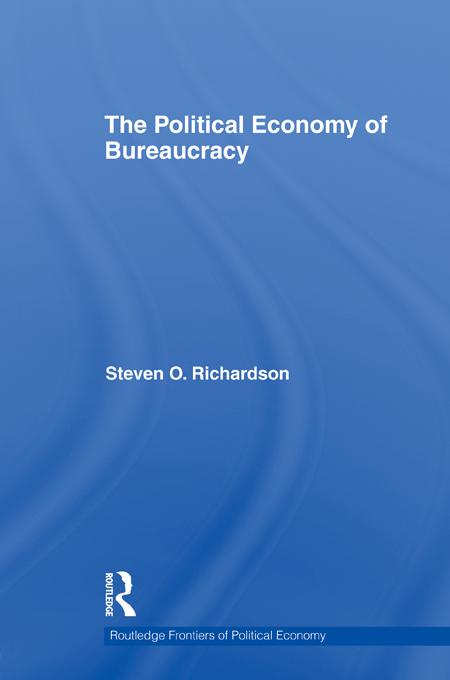
The Political Economy of Bureaucracy applies Public Choice theory and a complex systems view of government institutions to analyze policy implementation as an economic process. It addresses the common and vexing question of why managing federal agencies for results is so difficult by challenging traditional assumptions of institutional design and policy analysis. Using creative methods that focus on relationships that constrain the choices of executives and managers in a political hierarchy, the author reveals control and coordination as goals that are imperfectly achieved and often conflicting with one another.
Despite decades of intense study, serious reform efforts and impressive technological advances, the U.S. government remains a typical bureaucracy that fails to meet citizens’ expectations. Clearly, policy analysis is missing something. The problem may rest with "machine" models of government. Rules, especially those governing expenditures, are assumed to be feasible and effective. Analysis of the federal government as a complex system of relationships between semi-autonomous agents helps explain the disconnect between policy and results. The solution is to roll back micro-management of ends and means; policymakers should focus on objectives and facilitate implementation by selectively relaxing constraints that prevent experimentation needed to determine the most effective methods.
This book devotes unusual attention to the interaction between executive and legislative branches of government and between political appointees and career civil servants. Most studies of government policy take existing institutional structure for granted. Different conclusions emerge from this analysis by virtue of the systems view that accepts status quo hierarchies but questions the effectiveness of the rules that govern policy implementation. This book will be of interest to postgraduates and researchers focussing on Economic Theory, Public Choice, Institutional Economics and Political Science, as well as to those working in the public sector interested in Public Administration, Public Policy, and Organizational Behavior.
Payez facilement par carte, Klarna, Apple Pay ou Google Pay. Pas satisfait ? Vous avez toujours une garantie de remboursement de 14 jours. En savoir plus dans nos conditions. Si vous avez des questions, envoyez-nous un e-mail à hello@memmo.org.
Memmo facilite tes études, où que tu sois dans le monde. On rassemble tes manuels de cours et des outils d'étude intelligents au même endroit : résumés, quiz, podcasts et flashcards. Et il y a Ted, ton compagnon d'étude qui répond à toutes tes questions. Plus de 50 000 étudiants étudient déjà ici – conçu pour t'aider à apprendre plus vite et à moins stresser.