
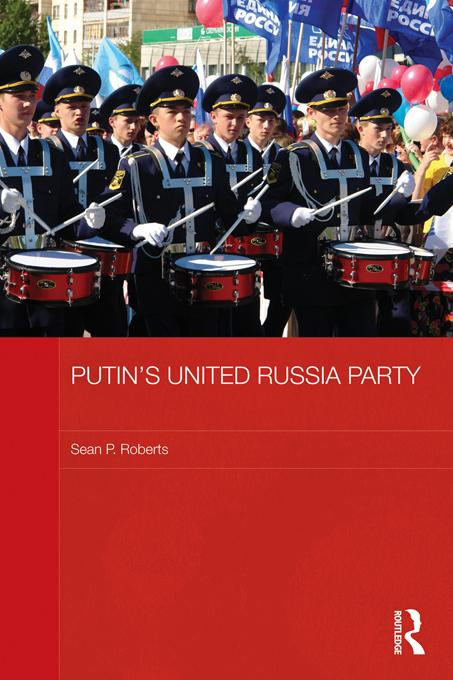
From its inception in 2001, the United Russia Party has rapidly developed into a hugely successful, organisationally-complex political party and key component of power. This book provides a much needed analysis on United Russia by exploring the role of the party in the Russian political system, from 2000 to 2010. It explores the party empirically, as an impressive organisation in its own right, but also theoretically, as an independent or explanatory variable able to illumine the larger development of dominant-power politics in Russia in the same period.
The book creates a model to understand the role of political parties in electorally-based political systems and shows how United Russia conforms to this model, and importantly, how the party also has unique features that affect its place in the political system. The book goes on to argue that United Russia represents a ‘virtual’ party hegemony, an outcome of political changes occurring elsewhere, and so a reversal of the typical relationship between parties and power found in comparative literature. This has potentially far reaching implications for our understanding of party dominance in the twenty-first century and also the sources of regime stability and instability.
Payez facilement par carte, Klarna, Apple Pay ou Google Pay. Pas satisfait ? Vous avez toujours une garantie de remboursement de 14 jours. En savoir plus dans nos conditions. Si vous avez des questions, envoyez-nous un e-mail à hello@memmo.org.
Memmo facilite tes études, où que tu sois dans le monde. On rassemble tes manuels de cours et des outils d'étude intelligents au même endroit : résumés, quiz, podcasts et flashcards. Et il y a Ted, ton compagnon d'étude qui répond à toutes tes questions. Plus de 50 000 étudiants étudient déjà ici – conçu pour t'aider à apprendre plus vite et à moins stresser.