
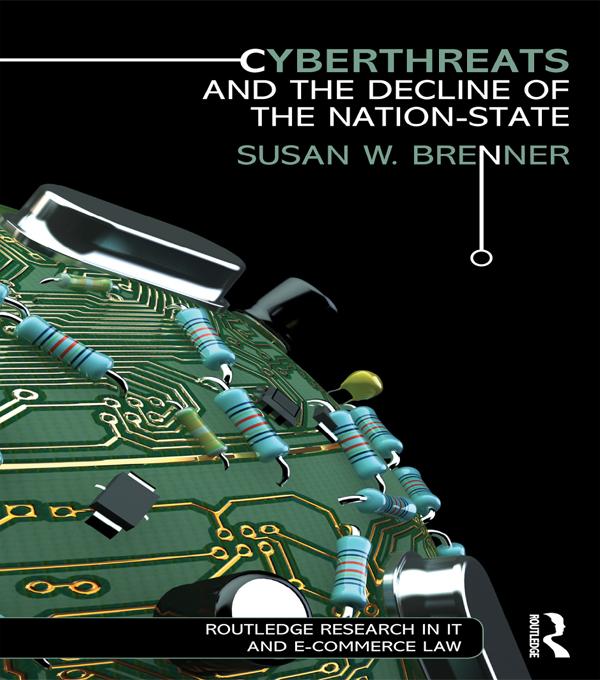
This book explores the extraordinary difficulties a nation-state’s law enforcement and military face in attempting to prevent cyber-attacks. In the wake of recent assaults including the denial of service attack on Estonia in 2007 and the widespread use of the Zeus Trojan Horse software, Susan W. Brenner explores how traditional categories and procedures inherent in law enforcement and military agencies can obstruct efforts to respond to cyberthreats. Brenner argues that the use of a territorially-based system of sovereignty to combat cyberthreats is ineffective, as cyberspace erodes the import of territory. This problem is compounded by the nature of cybercrime as a continually evolving phenomenon driven by rapid and complex technological change.
Following an evaluation of the efficacy of the nation-state, the book goes on to explore how individuals and corporations could be integrated into a more decentralized, distributed system of cyberthreat control. Looking at initiatives in Estonia and Sweden which have attempted to incorporate civilians into their cyber-response efforts, Brenner suggests that civilian involvement may mediate the rigid hierarchies that exist among formal agencies and increase the flexibility of any response. This book will be of great interest to students and researchers of information technological law and security studies.
Payez facilement par carte, Klarna, Apple Pay ou Google Pay. Pas satisfait ? Vous avez toujours une garantie de remboursement de 14 jours. En savoir plus dans nos conditions. Si vous avez des questions, envoyez-nous un e-mail à hello@memmo.org.
Memmo facilite tes études, où que tu sois dans le monde. On rassemble tes manuels de cours et des outils d'étude intelligents au même endroit : résumés, quiz, podcasts et flashcards. Et il y a Ted, ton compagnon d'étude qui répond à toutes tes questions. Plus de 50 000 étudiants étudient déjà ici – conçu pour t'aider à apprendre plus vite et à moins stresser.