
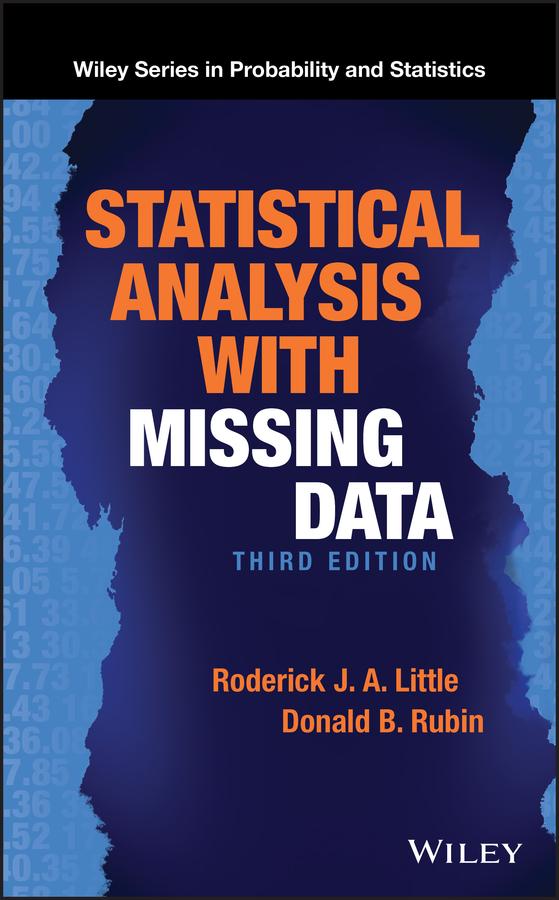
An up-to-date, comprehensive treatment of a classic text on missing data in statistics
The topic of missing data has gained considerable attention in recent decades. This new edition by two acknowledged experts on the subject offers an up-to-date account of practical methodology for handling missing data problems. Blending theory and application, authors Roderick Little and Donald Rubin review historical approaches to the subject and describe simple methods for multivariate analysis with missing values. They then provide a coherent theory for analysis of problems based on likelihoods derived from statistical models for the data and the missing data mechanism, and then they apply the theory to a wide range of important missing data problems.
Statistical Analysis with Missing Data, Third Edition starts by introducing readers to the subject and approaches toward solving it. It looks at the patterns and mechanisms that create the missing data, as well as a taxonomy of missing data. It then goes on to examine missing data in experiments, before discussing complete-case and available-case analysis, including weighting methods. The new edition expands its coverage to include recent work on topics such as nonresponse in sample surveys, causal inference, diagnostic methods, and sensitivity analysis, among a host of other topics.
The authors were awarded The Karl Pearson Prize in 2017 by the International Statistical Institute, for a research contribution that has had profound influence on statistical theory, methodology or applications. Their work "has been no less than defining and transforming." (ISI)
Statistical Analysis with Missing Data, Third Edition is an ideal textbook for upper undergraduate and/or beginning graduate level students of the subject. It is also an excellent source of information for applied statisticians and practitioners in government and industry.
The topic of missing data has gained considerable attention in recent decades. This new edition by two acknowledged experts on the subject offers an up-to-date account of practical methodology for handling missing data problems. Blending theory and application, authors Roderick Little and Donald Rubin review historical approaches to the subject and describe simple methods for multivariate analysis with missing values. They then provide a coherent theory for analysis of problems based on likelihoods derived from statistical models for the data and the missing data mechanism, and then they apply the theory to a wide range of important missing data problems.
Statistical Analysis with Missing Data, Third Edition starts by introducing readers to the subject and approaches toward solving it. It looks at the patterns and mechanisms that create the missing data, as well as a taxonomy of missing data. It then goes on to examine missing data in experiments, before discussing complete-case and available-case analysis, including weighting methods. The new edition expands its coverage to include recent work on topics such as nonresponse in sample surveys, causal inference, diagnostic methods, and sensitivity analysis, among a host of other topics.
- An updated “classic” written by renowned authorities on the subject
- Features over 150 exercises (including many new ones)
- Covers recent work on important methods like multiple imputation, robust alternatives to weighting, and Bayesian methods
- Revises previous topics based on past student feedback and class experience
- Contains an updated and expanded bibliography
The authors were awarded The Karl Pearson Prize in 2017 by the International Statistical Institute, for a research contribution that has had profound influence on statistical theory, methodology or applications. Their work "has been no less than defining and transforming." (ISI)
Statistical Analysis with Missing Data, Third Edition is an ideal textbook for upper undergraduate and/or beginning graduate level students of the subject. It is also an excellent source of information for applied statisticians and practitioners in government and industry.
Payez facilement par carte, Klarna, Apple Pay ou Google Pay. Pas satisfait ? Vous avez toujours une garantie de remboursement de 14 jours. En savoir plus dans nos conditions. Si vous avez des questions, envoyez-nous un e-mail à hello@memmo.org.
Memmo facilite tes études, où que tu sois dans le monde. On rassemble tes manuels de cours et des outils d'étude intelligents au même endroit : résumés, quiz, podcasts et flashcards. Et il y a Ted, ton compagnon d'étude qui répond à toutes tes questions. Plus de 50 000 étudiants étudient déjà ici – conçu pour t'aider à apprendre plus vite et à moins stresser.