
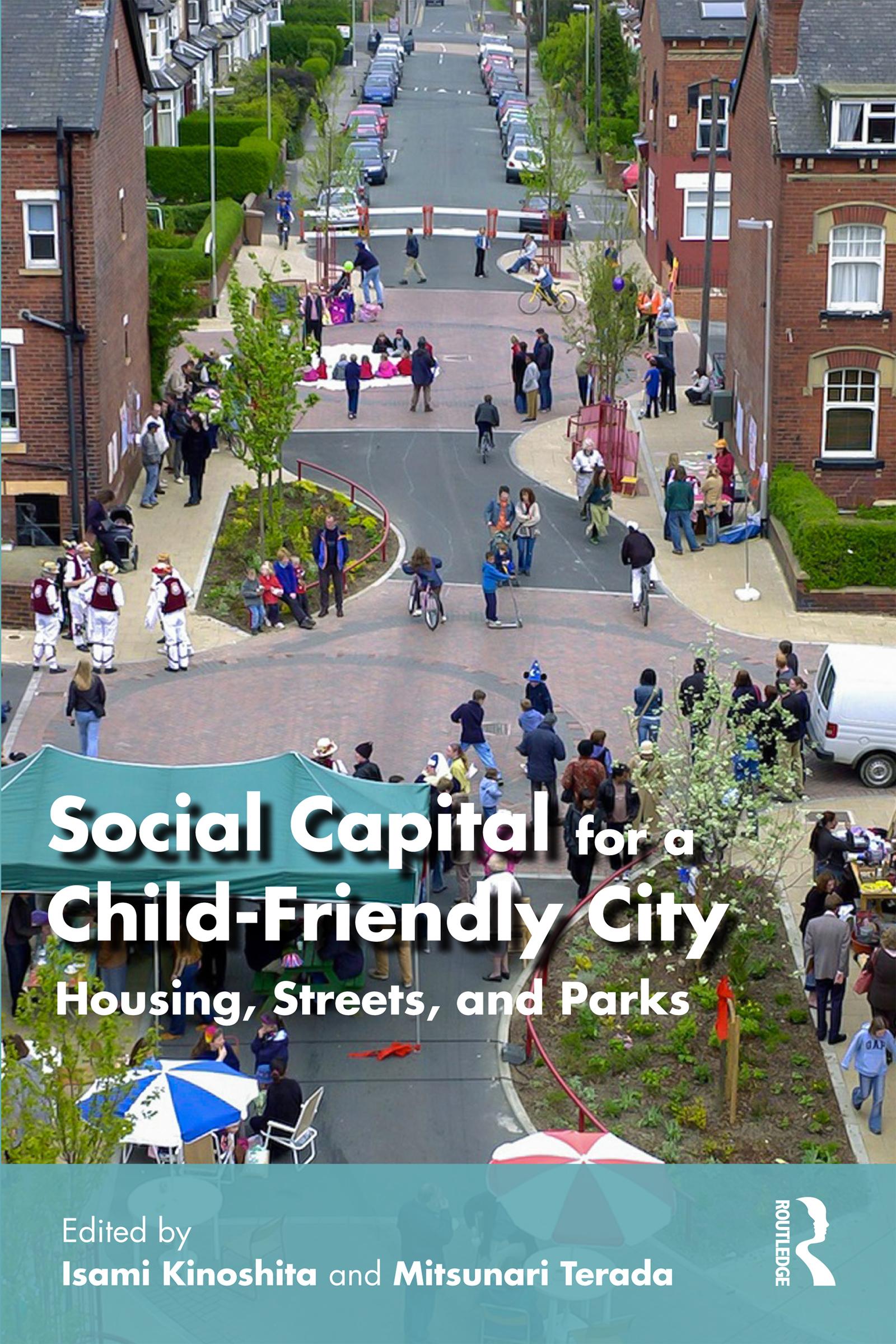
Social Capital for a Child-Friendly City argues for the importance of relationship networks (social capital) in children’s growth and socialization, and explores how child-friendly social capital can be cultivated through urban planning and community development. As outdoor play decreases and children spend more time online, Kinoshita and Terada return to John Dewey’s proposal that social capital is essential for nurturing the next generation and establish a democratic and sustainable society. The book features examples from Sweden, Finland, Germany, Switzerland, the UK, and Japan, exploring methods for cultivating social capital and spaces for children to play and develop in cooperative housing, outdoor play spaces, streets, parks, and neighbourhoods. We express our gratitude to Dr. Marketta Kytta, Professor of Aalto University, who gave valuable suggestions about the key term ‘bullerby’ and ‘social capital’.
This book will be of use to students and practitioners of urban planning and landscape architecture, as well as any community leaders or developers seeking to foster a nurturing environment where children can flourish.
Payez facilement par carte, Klarna, Apple Pay ou Google Pay. Pas satisfait ? Vous avez toujours une garantie de remboursement de 14 jours. En savoir plus dans nos conditions. Si vous avez des questions, envoyez-nous un e-mail à hello@memmo.org.
Memmo facilite tes études, où que tu sois dans le monde. On rassemble tes manuels de cours et des outils d'étude intelligents au même endroit : résumés, quiz, podcasts et flashcards. Et il y a Ted, ton compagnon d'étude qui répond à toutes tes questions. Plus de 50 000 étudiants étudient déjà ici – conçu pour t'aider à apprendre plus vite et à moins stresser.