
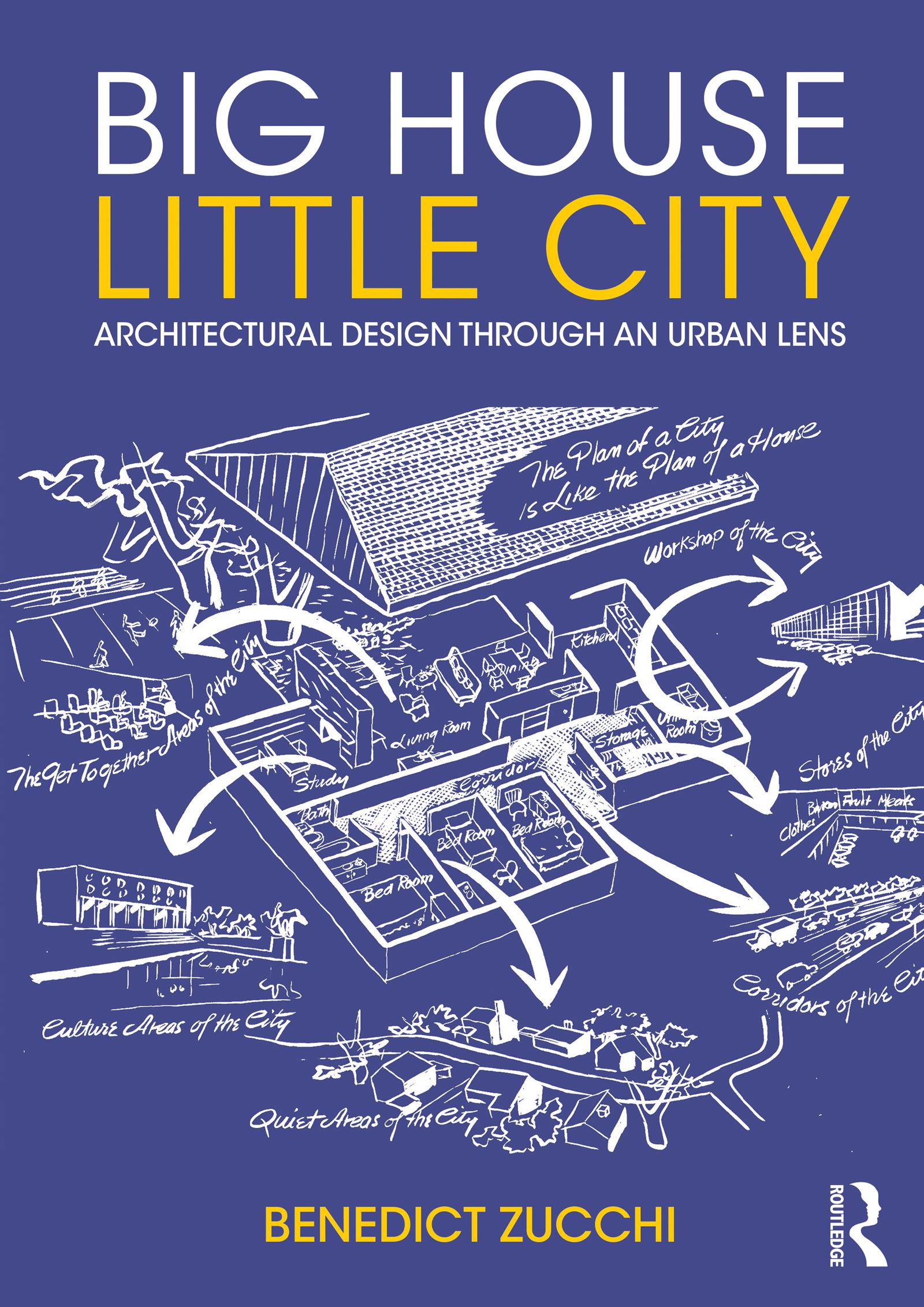
***Shortlisted for the Architectural Book Awards 2024***
Combining architectural and urban thinking in an unusual and engaging way, this book presents an integrated approach to architectural theory and design. Leon Battista Alberti’s assertion in his famous Renaissance treatise that ‘the city is like a big house, and the house is in turn like a little city’ forms the springboard for a series of reflections on architecture’s relationship with urbanism and how their once intimate symbiosis, unravelled by International Style Modernism, can be recovered.
Explicit references to Alberti’s house-city phrase have been made by figures as diverse as the architects Louis Kahn, Aldo Van Eyck, Denys Lasdun and Niels Torp and novelist Italo Calvino. But, as the book shows, thinking of buildings as little cities provides a new lens through which to reappraise the contributions of many other architects, including Le Corbusier, Frank Lloyd Wright, Alvar Aalto, Eliel Saarinen, Bernard Rudofsky, Hans Scharoun, Leon Krier, Fumihiko Maki, Charles Correa and Team 10.
In doing so, the author identifies common themes that form an unexpected bridgehead between the urban and architectural approaches of Antiquity, the Middle Ages, Renaissance and 20th century. The book explores buildings from across the globe, including lesser-known projects, such as Wright’s unbuilt house in Italy or Saarinen’s master plan for Cranbrook Academy, as well as more recent projects by Niels Torp, Behnisch Architekten, Sou Fujimoto, Peter Barber and WOHA.
It concludes with practical case studies of residential, health, education and workplace projects from different countries, fulsomely illustrated with many drawings and photographs. These show how architectural design viewed through an urban lens provides a conceptual framework for breaking down the scale of large buildings and integrating them with their context. And crucially, these also show a very accessible way of explaining evolving designs to the intended users and eliciting their participation in the design process.
The book offers a compelling approach to the design of projects at all scales, within an ecological perspective: the sense that big and small, cities and buildings must be approached holistically if we are to reverse the degradation and depletion of our habitat, both natural and man-made.
Payez facilement par carte, Klarna, Apple Pay ou Google Pay. Pas satisfait ? Vous avez toujours une garantie de remboursement de 14 jours. En savoir plus dans nos conditions. Si vous avez des questions, envoyez-nous un e-mail à hello@memmo.org.
Memmo facilite tes études, où que tu sois dans le monde. On rassemble tes manuels de cours et des outils d'étude intelligents au même endroit : résumés, quiz, podcasts et flashcards. Et il y a Ted, ton compagnon d'étude qui répond à toutes tes questions. Plus de 50 000 étudiants étudient déjà ici – conçu pour t'aider à apprendre plus vite et à moins stresser.