
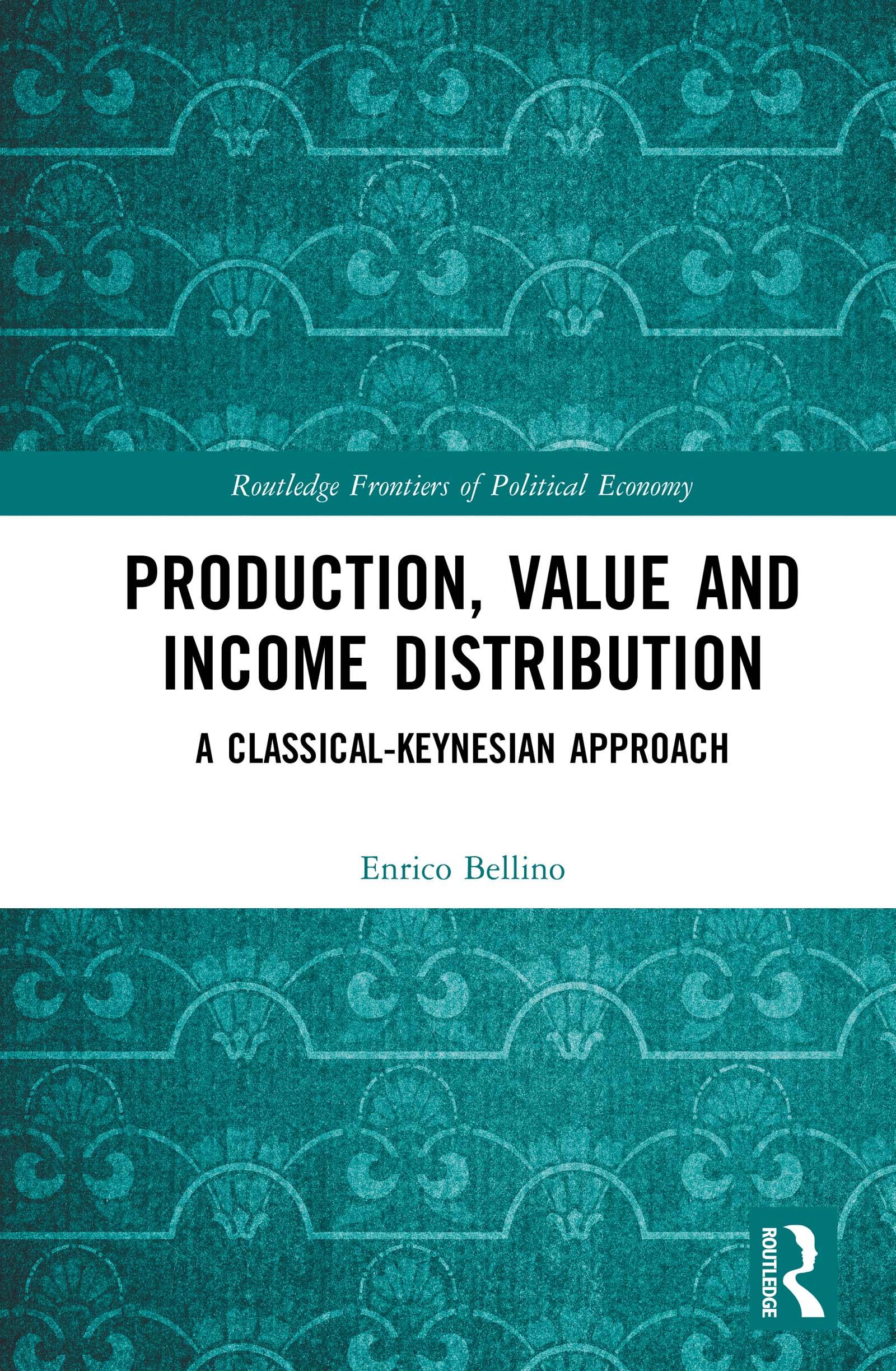
This book investigates the relationship between wages, profits, values and labour employment from a classical-Keynesian perspective. The starting point of this approach is classical political economy (in particular, Smith, Ricardo and Marx), suitably reformulated in modern terms by Sraffa and then integrated with the Keynesian theory of employment. Such an approach proves to be more appropriate in understanding the complexities of current economies and in identifying the instruments to pursue the final goal of economic systems: putting each person in a position to earn what is necessary to live with dignity.
The approach undertaken by these chapters is in contrast to the ‘marginalist’ or ‘neoclassical’ school, which constitutes the mainstream of economic analysis. Especially in recent decades, several critical analyses of the present state of economic research have emerged due to the failure of contemporary economic analysis to acutely penetrate and guide the workings of actual economic systems. But these analyses have not always been effectively presented in a coordinated manner. This work presents one possible unifying framework—grounded in a solid tradition of economic thought—which aims to describe the basic forces operating in capitalistic economies and to identify the main objectives to pursue in production economies in order to fully exploit their potential. Most importantly, the focus of such classical-Keyensian analysis concerns the production of goods and services, and this book shows how several factors typical of contemporary (post-)industrial societies thus can be understood in a way that the standard economic theory has not been able to explicate (due to the reduction of everything to a question of exchange).
The book provides key reading for those on master level economics courses. Moreover, it constitutes a solid introduction to modern classical-Keynesian analysis. It may also be of interest to readers who are keen to develop a critical view of economics, political economy and history of economic thought.
Payez facilement par carte, Klarna, Apple Pay ou Google Pay. Pas satisfait ? Vous avez toujours une garantie de remboursement de 14 jours. En savoir plus dans nos conditions. Si vous avez des questions, envoyez-nous un e-mail à hello@memmo.org.
Memmo facilite tes études, où que tu sois dans le monde. On rassemble tes manuels de cours et des outils d'étude intelligents au même endroit : résumés, quiz, podcasts et flashcards. Et il y a Ted, ton compagnon d'étude qui répond à toutes tes questions. Plus de 50 000 étudiants étudient déjà ici – conçu pour t'aider à apprendre plus vite et à moins stresser.