
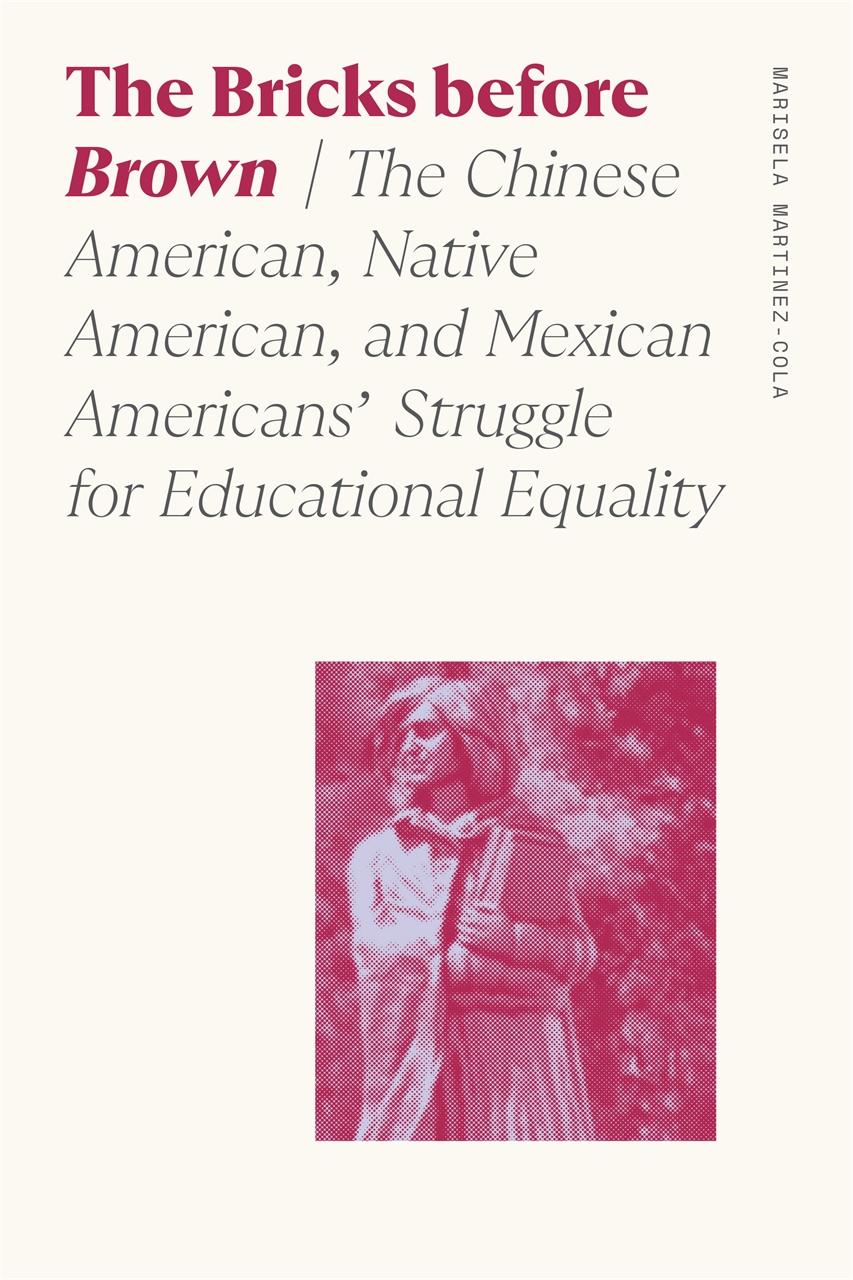
In 1954 the U.S. Supreme Court ruled that state laws establishing racial segregation are unconstitutional, declaring “separate is inherently unequal.” Known as a seminal Supreme Court case and civil rights victory, Brown v. Board of Education resulted from many legal battles that predicated its existence. Marisela Martinez-Cola writes about the many important cases that led to the culmination of Brown. She reveals that the road to Brown is lined with “bricks” representing at least one hundred other families who legally challenged segregated schooling in state and federal courts across the country, eleven of which involved Chinese American, Native American, and Mexican American plaintiffs.
By revealing the significance of Chinese American, Native American, and Mexican American segregation cases, Martinez-Cola provides an opportunity for an increasingly diverse America to be fully invested in the complete grand narrative of the civil rights movement. To illustrate the evolution of these cases, she focuses on three court cases from California, including these stories as part of the “long civil rights movement,” and thus expands our understanding of the scope of that movement along racial, gender, and class lines. Comparing and discussing the meaning of the other court cases that led to the Brown decision strengthens the standing of Brown while revealing all the twists and turns inherent in the struggle for equality.
Payez facilement par carte, Klarna, Apple Pay ou Google Pay. Pas satisfait ? Vous avez toujours une garantie de remboursement de 14 jours. En savoir plus dans nos conditions. Si vous avez des questions, envoyez-nous un e-mail à hello@memmo.org.
Memmo facilite tes études, où que tu sois dans le monde. On rassemble tes manuels de cours et des outils d'étude intelligents au même endroit : résumés, quiz, podcasts et flashcards. Et il y a Ted, ton compagnon d'étude qui répond à toutes tes questions. Plus de 50 000 étudiants étudient déjà ici – conçu pour t'aider à apprendre plus vite et à moins stresser.