
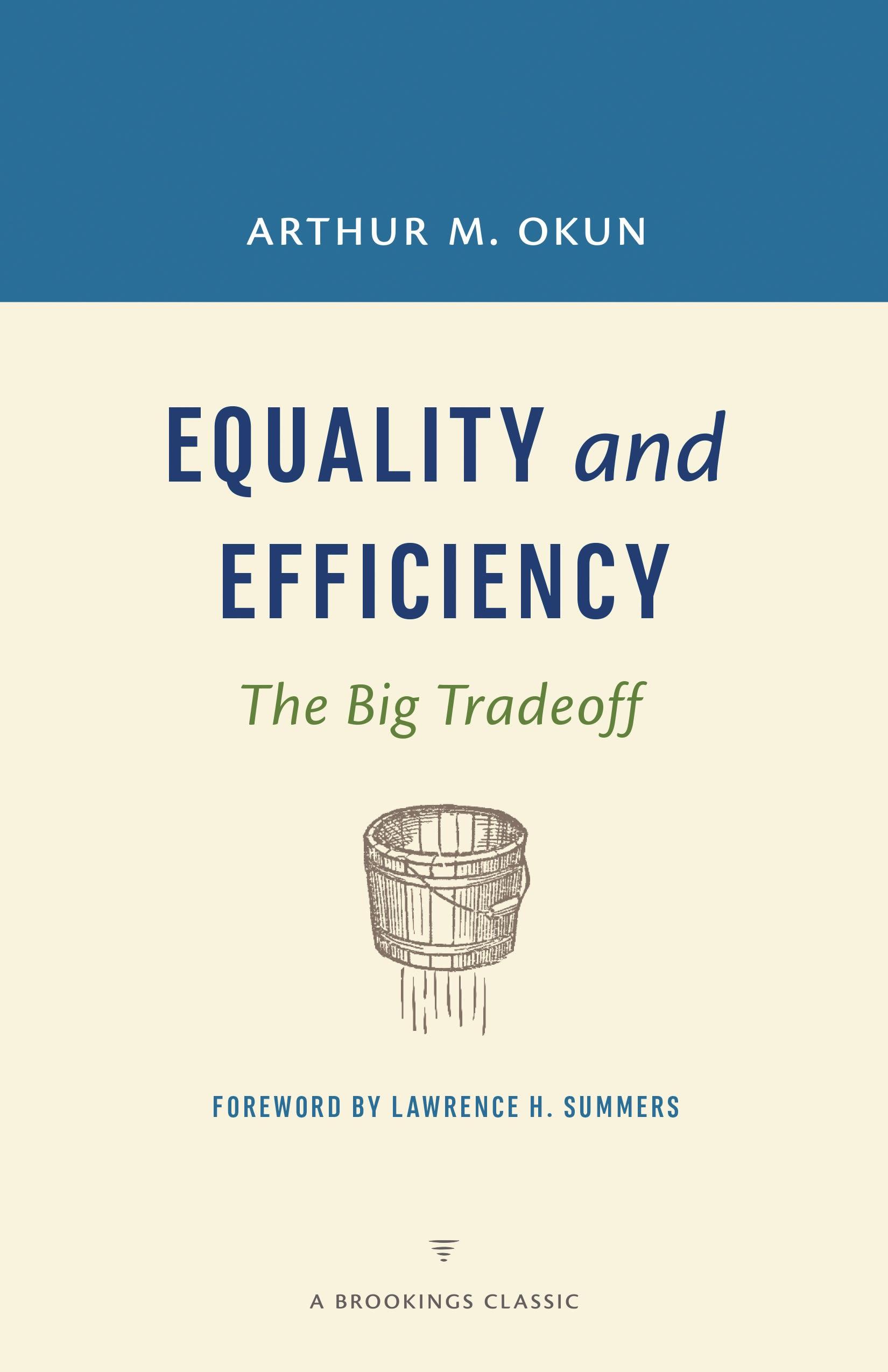
Originally published in 1975, Equality and Efficiency: The Big Tradeoff is a very personal work from one of the most important macroeconomists of the last hundred years. And this new edition includes ""Further Thoughts on Equality and Efficiency,"" a paper published by the author two years later.
In classrooms Arthur M. Okun may be best remembered for Okun's Law, but his lasting legacy is the respect and admiration he earned from economists, practitioners, and policymakers. Equality and Efficiency is the perfect embodiment of that legacy, valued both by professional economists and those readers with a keen interest in social policy. To his fellow economists, Okun presents messages, in the form of additional comments and select citations, in his footnotes. To all readers, Okun presents an engaging dual theme: the market needs a place, and the market needs to be kept in its place.
As Okun puts it: Institutions in a capitalist democracy prod us to get ahead of our neighbors economically after telling us to stay in line socially. This double standard professes and pursues an egalitarian political and social system while simultaneously generating gaping disparities in economic well-being.
Today, Okun's dual theme feels incredibly prescient as we grapple with the hot-button topic of income inequality. In his foreword, Lawrence H. Summers declares: On what one might think of as questions of ""economic philosophy,"" I doubt that Okun has been improved on in the subsequent interval. His discussion of how societies rely on rights as well as markets should be required reading for all young economists who are enamored with market solutions to all problems.
With a new foreword by Lawrence H. Summers
In classrooms Arthur M. Okun may be best remembered for Okun's Law, but his lasting legacy is the respect and admiration he earned from economists, practitioners, and policymakers. Equality and Efficiency is the perfect embodiment of that legacy, valued both by professional economists and those readers with a keen interest in social policy. To his fellow economists, Okun presents messages, in the form of additional comments and select citations, in his footnotes. To all readers, Okun presents an engaging dual theme: the market needs a place, and the market needs to be kept in its place.
As Okun puts it: Institutions in a capitalist democracy prod us to get ahead of our neighbors economically after telling us to stay in line socially. This double standard professes and pursues an egalitarian political and social system while simultaneously generating gaping disparities in economic well-being.
Today, Okun's dual theme feels incredibly prescient as we grapple with the hot-button topic of income inequality. In his foreword, Lawrence H. Summers declares: On what one might think of as questions of ""economic philosophy,"" I doubt that Okun has been improved on in the subsequent interval. His discussion of how societies rely on rights as well as markets should be required reading for all young economists who are enamored with market solutions to all problems.
With a new foreword by Lawrence H. Summers
Payez facilement par carte, Klarna, Apple Pay ou Google Pay. Pas satisfait ? Vous avez toujours une garantie de remboursement de 14 jours. En savoir plus dans nos conditions. Si vous avez des questions, envoyez-nous un e-mail à hello@memmo.org.
Memmo facilite tes études, où que tu sois dans le monde. On rassemble tes manuels de cours et des outils d'étude intelligents au même endroit : résumés, quiz, podcasts et flashcards. Et il y a Ted, ton compagnon d'étude qui répond à toutes tes questions. Plus de 50 000 étudiants étudient déjà ici – conçu pour t'aider à apprendre plus vite et à moins stresser.