
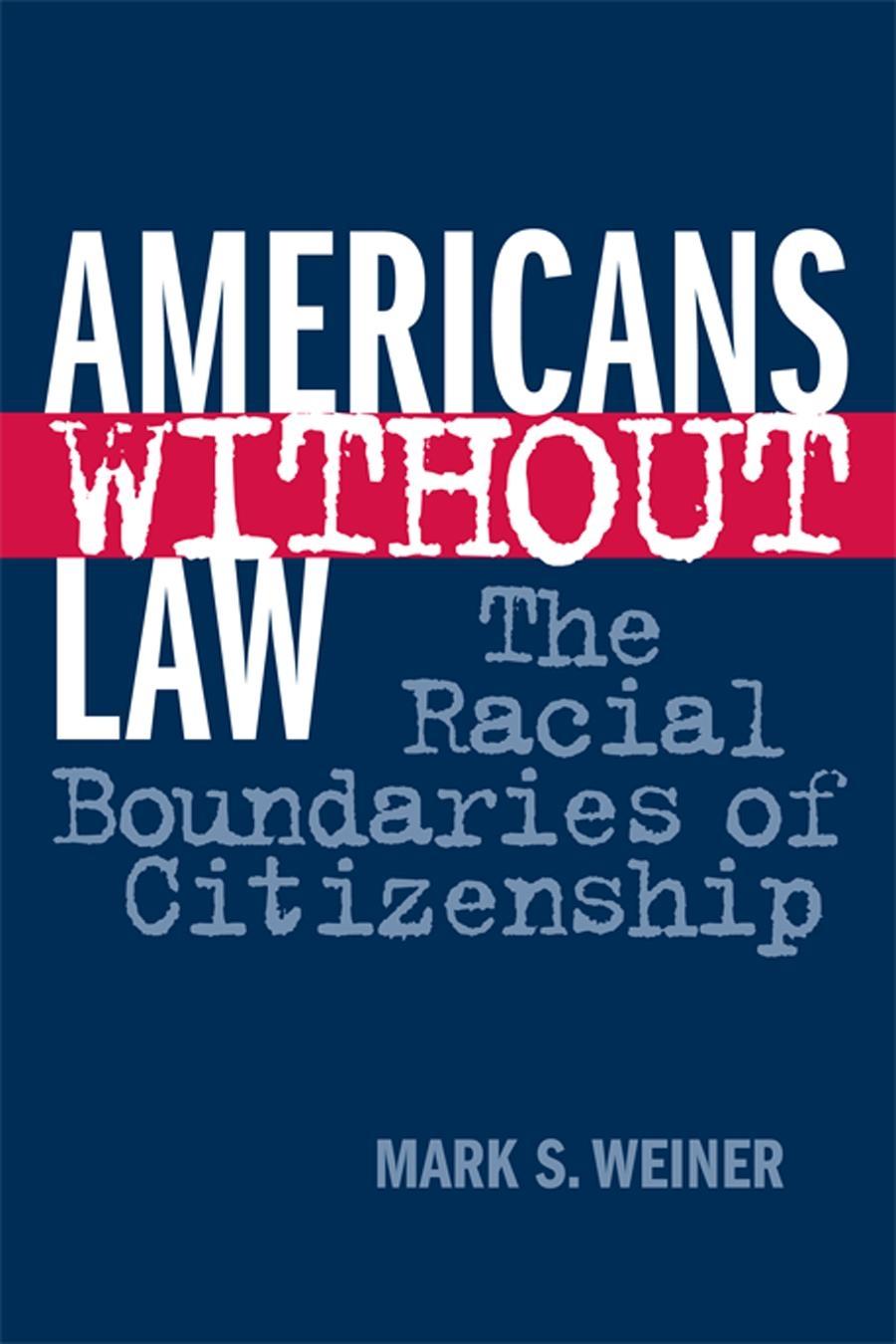
Americans Without Law shows how the racial boundaries of civic life are based on widespread perceptions about the relative capacity of minority groups for legal behavior, which Mark S. Weiner calls “juridical racialism.” The book follows the history of this civic discourse by examining the legal status of four minority groups in four successive historical periods: American Indians in the 1880s, Filipinos after the Spanish-American War, Japanese immigrants in the 1920s, and African Americans in the 1940s and 1950s.
Weiner reveals the significance of juridical racialism for each group and, in turn, Americans as a whole by examining the work of anthropological social scientists who developed distinctive ways of understanding racial and legal identity, and through decisions of the U.S. Supreme Court that put these ethno-legal views into practice. Combining history, anthropology, and legal analysis, the book argues that the story of juridical racialism shows how race and citizenship served as a nexus for the professionalization of the social sciences, the growth of national state power, economic modernization, and modern practices of the self.
Payez facilement par carte, Klarna, Apple Pay ou Google Pay. Pas satisfait ? Vous avez toujours une garantie de remboursement de 14 jours. En savoir plus dans nos conditions. Si vous avez des questions, envoyez-nous un e-mail à hello@memmo.org.
Memmo facilite tes études, où que tu sois dans le monde. On rassemble tes manuels de cours et des outils d'étude intelligents au même endroit : résumés, quiz, podcasts et flashcards. Et il y a Ted, ton compagnon d'étude qui répond à toutes tes questions. Plus de 50 000 étudiants étudient déjà ici – conçu pour t'aider à apprendre plus vite et à moins stresser.