
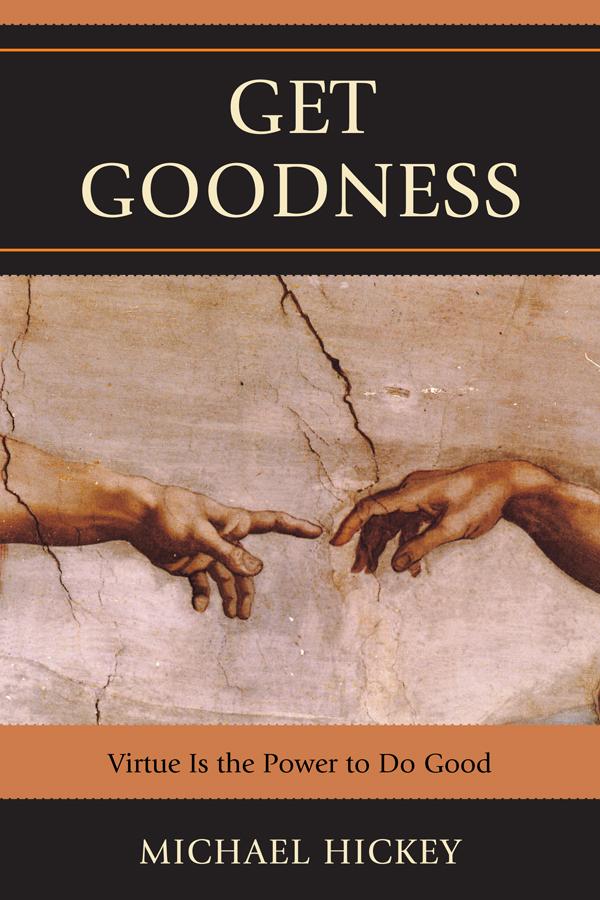
From the preface:
This book looks at virtue as "the power to do good" from the theological, philosophical, and poetic perspective. From a theological perspective: Long ago, Anselm defined theology as "faith seeking understanding," (f. 1) a definition which has endured to the present day. It would be difficult, if not impossible, for anyone to try to understand virtue or goodness without looking through some lens of faith.…Get Goodness was written, in part, because my own faith was seeking understanding.
Second, this book will look at virtue and goodness from a philosophical perspective because the word "philosophy" (from the Greek philos + sophia) means "love of wisdom." (f.2)…As we will find in this book, the virtue of love has been understood by most theologians and philosophers before me to be the essence of each and every virtue. Therefore, we must first love wisdom before we are able to practically discern, distinguish, deliberate and decide prudently in any effort to understand how virtue is the power to do good.…
Third, this book will be suffused with poetry….because poetry is a language that goes beyond logic, thought, and reason…. It is a language of the spirit and a language of human life, love, observation, and experience….Any poem is an attempt to try to understand the experience of the world and the universe around us in spiritual terms.
None of us should be seeking virtuous perfection in orienting ourselves to the good in this life; we should only be seeking change. The journey is the goal.
This book looks at virtue as "the power to do good" from the theological, philosophical, and poetic perspective. From a theological perspective: Long ago, Anselm defined theology as "faith seeking understanding," (f. 1) a definition which has endured to the present day. It would be difficult, if not impossible, for anyone to try to understand virtue or goodness without looking through some lens of faith.…Get Goodness was written, in part, because my own faith was seeking understanding.
Second, this book will look at virtue and goodness from a philosophical perspective because the word "philosophy" (from the Greek philos + sophia) means "love of wisdom." (f.2)…As we will find in this book, the virtue of love has been understood by most theologians and philosophers before me to be the essence of each and every virtue. Therefore, we must first love wisdom before we are able to practically discern, distinguish, deliberate and decide prudently in any effort to understand how virtue is the power to do good.…
Third, this book will be suffused with poetry….because poetry is a language that goes beyond logic, thought, and reason…. It is a language of the spirit and a language of human life, love, observation, and experience….Any poem is an attempt to try to understand the experience of the world and the universe around us in spiritual terms.
None of us should be seeking virtuous perfection in orienting ourselves to the good in this life; we should only be seeking change. The journey is the goal.
Payez facilement par carte, Klarna, Apple Pay ou Google Pay. Pas satisfait ? Vous avez toujours une garantie de remboursement de 14 jours. En savoir plus dans nos conditions. Si vous avez des questions, envoyez-nous un e-mail à hello@memmo.org.
Memmo facilite tes études, où que tu sois dans le monde. On rassemble tes manuels de cours et des outils d'étude intelligents au même endroit : résumés, quiz, podcasts et flashcards. Et il y a Ted, ton compagnon d'étude qui répond à toutes tes questions. Plus de 50 000 étudiants étudient déjà ici – conçu pour t'aider à apprendre plus vite et à moins stresser.