
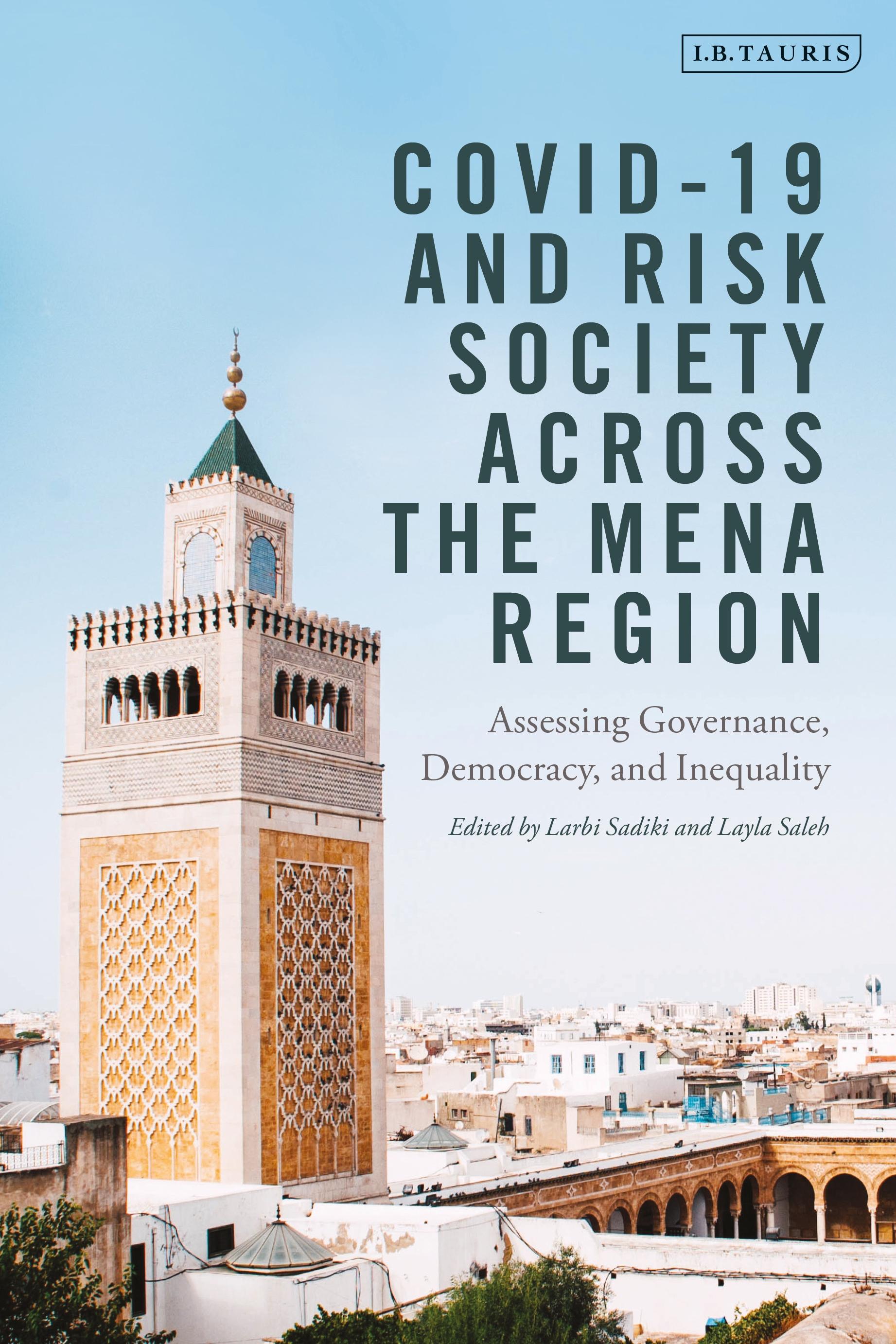
The impact of the COVID-19 pandemic – at the interlocking levels of politics, economy, and society – have been different across regions, states, and societies. In the case of the Middle East and North Africa, which was already in the throes of intense tumult following the onset of the 2011 Arab Spring, COVID's blows have on the one hand followed the trajectory of some global patterns, while at the same time playing out in regionally specific ways.
Based on empirical country-level analysis, this volume brings together an international team of contributors seeking to untangle how COVID-19 unfolds across the MENA. The analyses are framed through a contextual adaptation of Ulrich Beck's famous concept of “risk society” that pinpointed the negative consequences of modernity and its unbridled capitalism. The book traces how this has come home in full force in the COVID-19 pandemic. The editors, Larbi Sadiki and Layla Saleh, use the term "Arab risk society". They highlight short-term and long-term repercussions across the MENA. These include socio-economic inequality, a revitalized state of authoritarianism challenged by relentless democratic struggles.
But the analyses are attuned to problem-solving research. The "ethnographies of the pandemic" included in this book investigate transformations and coping mechanisms within each country case study. They provide an ethically-informed research praxis that can respond to the manifold crises crashing down upon MENA polities and societies
Based on empirical country-level analysis, this volume brings together an international team of contributors seeking to untangle how COVID-19 unfolds across the MENA. The analyses are framed through a contextual adaptation of Ulrich Beck's famous concept of “risk society” that pinpointed the negative consequences of modernity and its unbridled capitalism. The book traces how this has come home in full force in the COVID-19 pandemic. The editors, Larbi Sadiki and Layla Saleh, use the term "Arab risk society". They highlight short-term and long-term repercussions across the MENA. These include socio-economic inequality, a revitalized state of authoritarianism challenged by relentless democratic struggles.
But the analyses are attuned to problem-solving research. The "ethnographies of the pandemic" included in this book investigate transformations and coping mechanisms within each country case study. They provide an ethically-informed research praxis that can respond to the manifold crises crashing down upon MENA polities and societies
Payez facilement par carte, Klarna, Apple Pay ou Google Pay. Pas satisfait ? Vous avez toujours une garantie de remboursement de 14 jours. En savoir plus dans nos conditions. Si vous avez des questions, envoyez-nous un e-mail à hello@memmo.org.
Memmo facilite tes études, où que tu sois dans le monde. On rassemble tes manuels de cours et des outils d'étude intelligents au même endroit : résumés, quiz, podcasts et flashcards. Et il y a Ted, ton compagnon d'étude qui répond à toutes tes questions. Plus de 50 000 étudiants étudient déjà ici – conçu pour t'aider à apprendre plus vite et à moins stresser.