
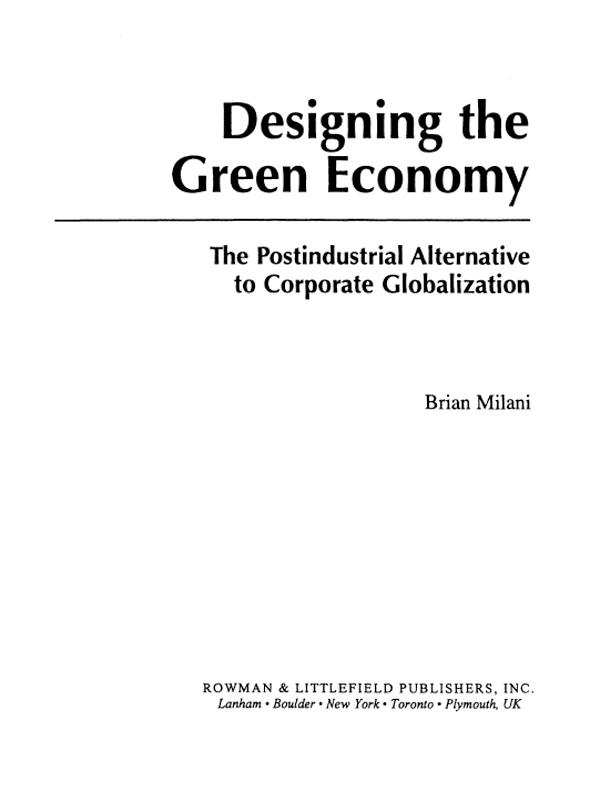
Designing the Green Economy explores realistically, and in detail, the world's enormous potential for human and ecological regeneration. It also explains why this potential has been suppressed or distorted by industrial institutions-thus creating economic crisis, growing inequality, and environmental destruction. The first half of the book looks at the challenge ecological change has represented to capitalism, as well as capitalism's repressive response: the waste economy, as expressed in postwar Fordist capitalism and current trends toward a globalized economy. But today “the great divide” between waste and green economies can be narrowed by emerging legal, institutional, and market approaches to production and environmentalism. In Part II, Milani explores the practical and theoretical implications of fully unleashing these new productive forces to create community-based ecological economies. Milani argues that neither sustainability, social justice nor economic stability can be secured without comprehensive redesign of the economy along ecological principles. It looks at key sectors of the economy-including manufacturing, energy, and money and finance-to illustrate how this redesign can, and is, taking place through both incremental grassroots initiatives and transformative politics.
Payez facilement par carte, Klarna, Apple Pay ou Google Pay. Pas satisfait ? Vous avez toujours une garantie de remboursement de 14 jours. En savoir plus dans nos conditions. Si vous avez des questions, envoyez-nous un e-mail à hello@memmo.org.
Memmo facilite tes études, où que tu sois dans le monde. On rassemble tes manuels de cours et des outils d'étude intelligents au même endroit : résumés, quiz, podcasts et flashcards. Et il y a Ted, ton compagnon d'étude qui répond à toutes tes questions. Plus de 50 000 étudiants étudient déjà ici – conçu pour t'aider à apprendre plus vite et à moins stresser.