
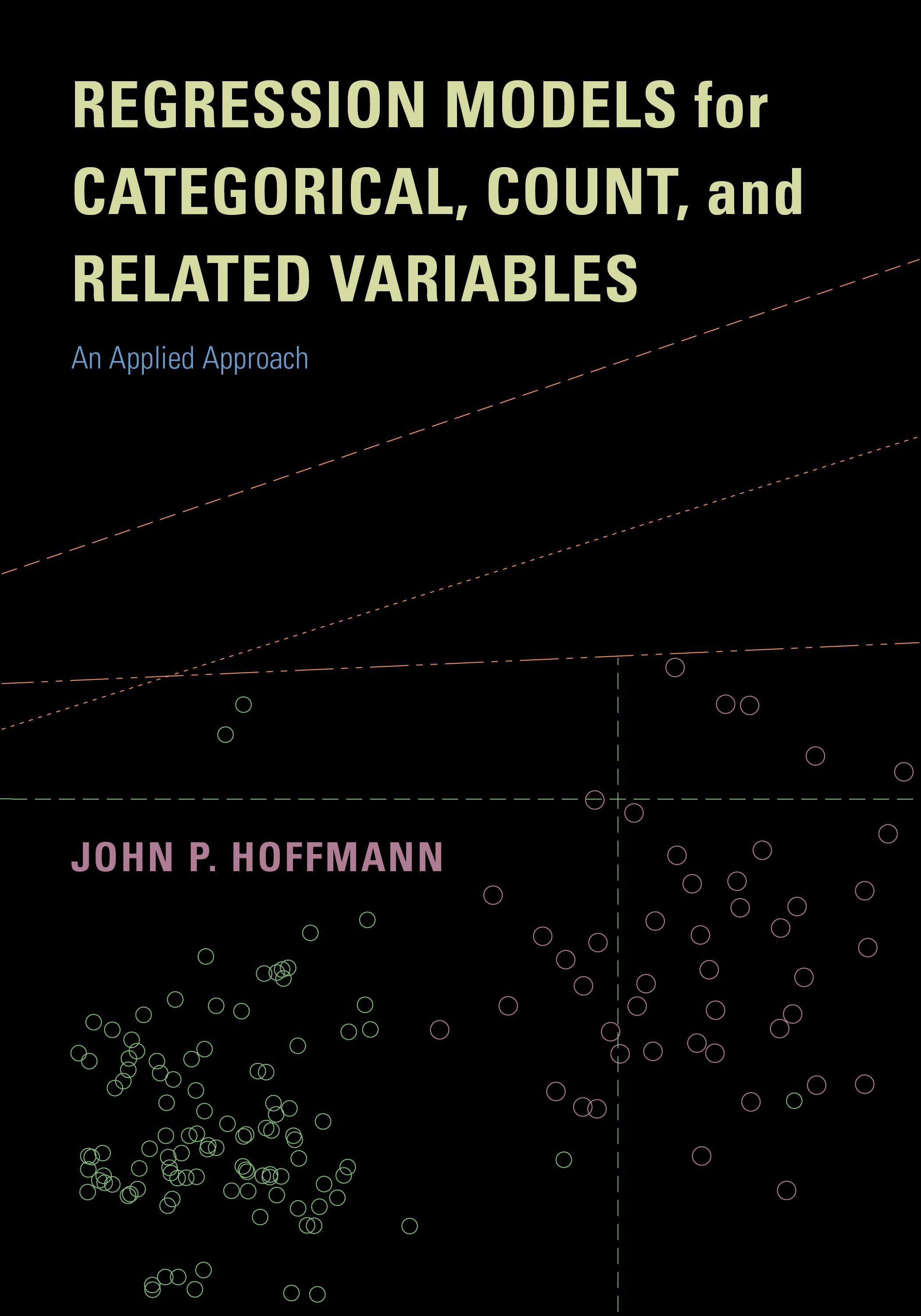
Social science and behavioral science students and researchers are often confronted with data that are categorical, count a phenomenon, or have been collected over time. Sociologists examining the likelihood of interracial marriage, political scientists studying voting behavior, criminologists counting the number of offenses people commit, health scientists studying the number of suicides across neighborhoods, and psychologists modeling mental health treatment success are all interested in outcomes that are not continuous. Instead, they must measure and analyze these events and phenomena in a discrete manner.
This book provides an introduction and overview of several statistical models designed for these types of outcomes—all presented with the assumption that the reader has only a good working knowledge of elementary algebra and has taken introductory statistics and linear regression analysis.
Numerous examples from the social sciences demonstrate the practical applications of these models. The chapters address logistic and probit models, including those designed for ordinal and nominal variables, regular and zero-inflated Poisson and negative binomial models, event history models, models for longitudinal data, multilevel models, and data reduction techniques such as principal components and factor analysis.
Each chapter discusses how to utilize the models and test their assumptions with the statistical software Stata, and also includes exercise sets so readers can practice using these techniques. Appendices show how to estimate the models in SAS, SPSS, and R; provide a review of regression assumptions using simulations; and discuss missing data.
A companion website includes downloadable versions of all the data sets used in the book.
This book provides an introduction and overview of several statistical models designed for these types of outcomes—all presented with the assumption that the reader has only a good working knowledge of elementary algebra and has taken introductory statistics and linear regression analysis.
Numerous examples from the social sciences demonstrate the practical applications of these models. The chapters address logistic and probit models, including those designed for ordinal and nominal variables, regular and zero-inflated Poisson and negative binomial models, event history models, models for longitudinal data, multilevel models, and data reduction techniques such as principal components and factor analysis.
Each chapter discusses how to utilize the models and test their assumptions with the statistical software Stata, and also includes exercise sets so readers can practice using these techniques. Appendices show how to estimate the models in SAS, SPSS, and R; provide a review of regression assumptions using simulations; and discuss missing data.
A companion website includes downloadable versions of all the data sets used in the book.
Payez facilement par carte, Klarna, Apple Pay ou Google Pay. Pas satisfait ? Vous avez toujours une garantie de remboursement de 14 jours. En savoir plus dans nos conditions. Si vous avez des questions, envoyez-nous un e-mail à hello@memmo.org.
Memmo facilite tes études, où que tu sois dans le monde. On rassemble tes manuels de cours et des outils d'étude intelligents au même endroit : résumés, quiz, podcasts et flashcards. Et il y a Ted, ton compagnon d'étude qui répond à toutes tes questions. Plus de 50 000 étudiants étudient déjà ici – conçu pour t'aider à apprendre plus vite et à moins stresser.
Tu pourrais aussi aimer
Acheter le livre0