
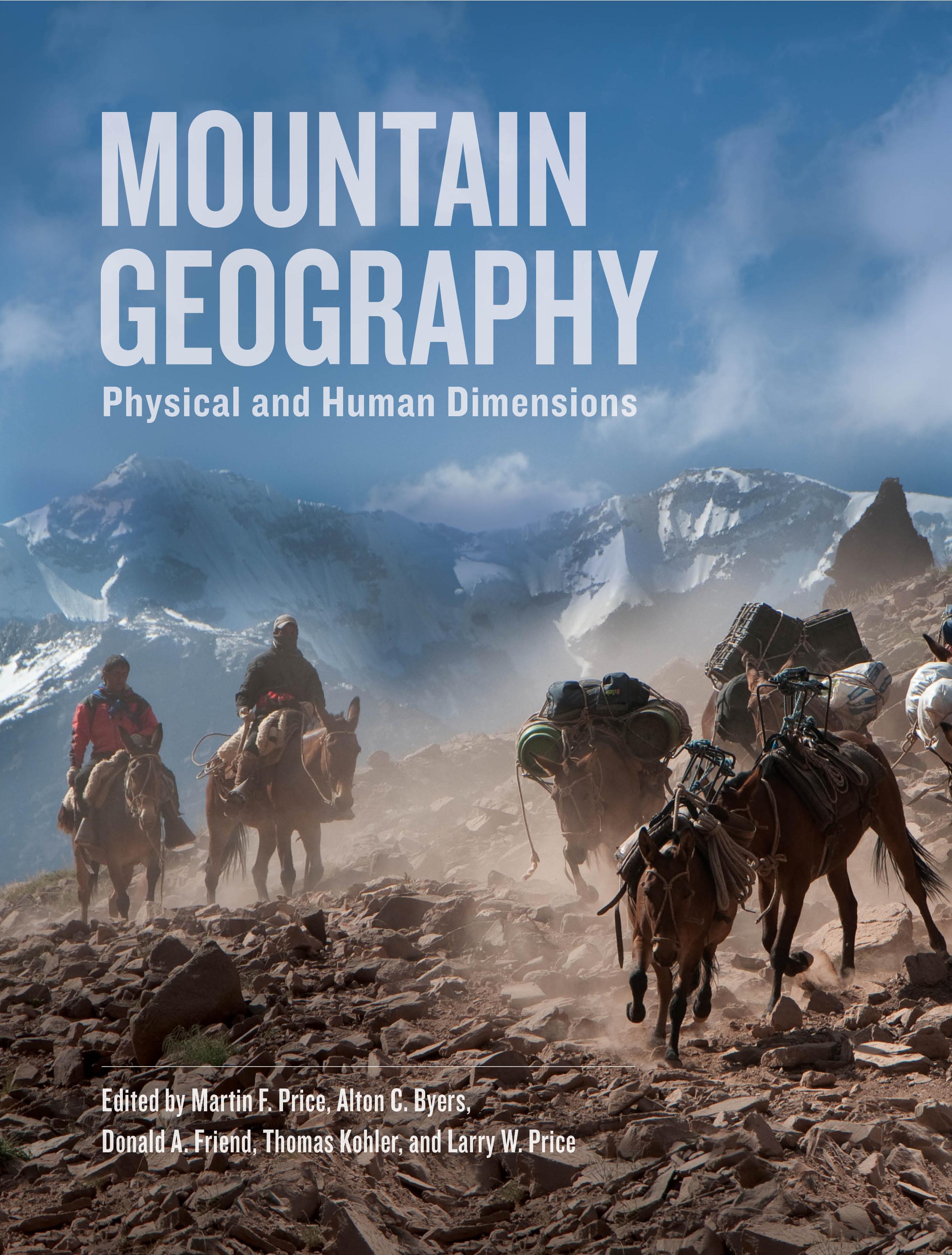
Mountains cover a quarter of the Earth’s land surface and a quarter of the global population lives in or adjacent to these areas. The global importance of mountains is recognized particularly because they provide critical resources, such as water, food and wood; contain high levels of biological and cultural diversity; and are often places for tourism and recreation and/or of sacred significance.
This major revision of Larry Price’s book Mountains and Man (1981) is both timely and highly appropriate. The past three decades have been a period of remarkable progress in our understanding of mountains from an academic point of view. Of even greater importance is that society at large now realizes that mountains and the people who reside in them are not isolated from the mainstream of world affairs, but are vital if we are to achieve an environmentally sustainable future.
Mountain Geography is a comprehensive resource that gives readers an in-depth understanding of the geographical processes occurring in the world’s mountains and the overall impact of these regions on culture and society as a whole. The volume begins with an introduction to how mountains are defined, followed by a comprehensive treatment of their physical geography: origins, climatology, snow and ice, landforms and geomorphic processes, soils, vegetation, and wildlife. The concluding chapters provide an introduction to the human geography of mountains: attitudes toward mountains, people living in mountain regions and their livelihoods and interactions within dynamic environments, the diverse types of mountain agriculture, and the challenges of sustainable mountain development.
This major revision of Larry Price’s book Mountains and Man (1981) is both timely and highly appropriate. The past three decades have been a period of remarkable progress in our understanding of mountains from an academic point of view. Of even greater importance is that society at large now realizes that mountains and the people who reside in them are not isolated from the mainstream of world affairs, but are vital if we are to achieve an environmentally sustainable future.
Mountain Geography is a comprehensive resource that gives readers an in-depth understanding of the geographical processes occurring in the world’s mountains and the overall impact of these regions on culture and society as a whole. The volume begins with an introduction to how mountains are defined, followed by a comprehensive treatment of their physical geography: origins, climatology, snow and ice, landforms and geomorphic processes, soils, vegetation, and wildlife. The concluding chapters provide an introduction to the human geography of mountains: attitudes toward mountains, people living in mountain regions and their livelihoods and interactions within dynamic environments, the diverse types of mountain agriculture, and the challenges of sustainable mountain development.
Payez facilement par carte, Klarna, Apple Pay ou Google Pay. Pas satisfait ? Vous avez toujours une garantie de remboursement de 14 jours. En savoir plus dans nos conditions. Si vous avez des questions, envoyez-nous un e-mail à hello@memmo.org.
Memmo facilite tes études, où que tu sois dans le monde. On rassemble tes manuels de cours et des outils d'étude intelligents au même endroit : résumés, quiz, podcasts et flashcards. Et il y a Ted, ton compagnon d'étude qui répond à toutes tes questions. Plus de 50 000 étudiants étudient déjà ici – conçu pour t'aider à apprendre plus vite et à moins stresser.
Tu pourrais aussi aimer
Acheter le livre0