
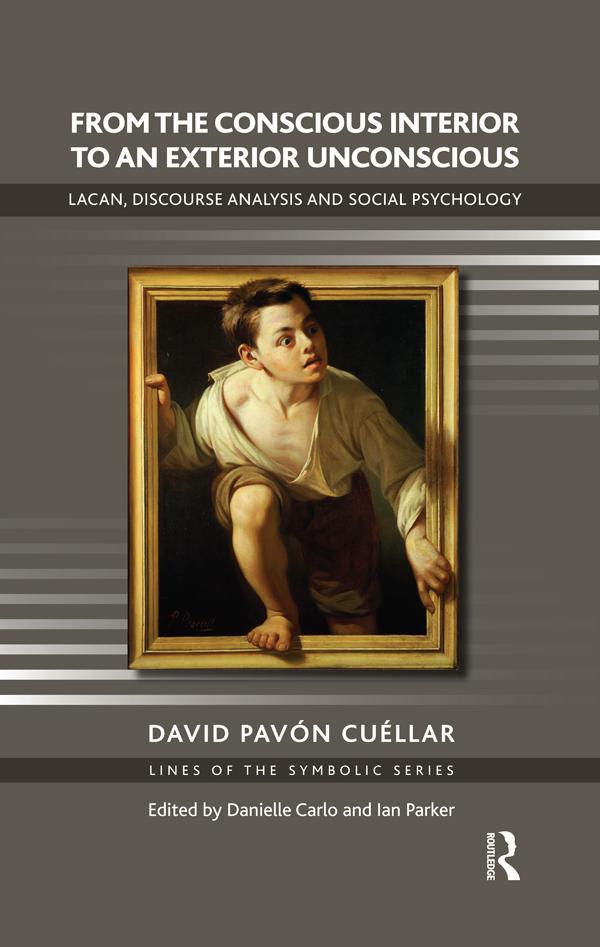
This striking Lacanian contribution to discourse analysis is also a critique of contemporary psychological abstraction, as well as a reassessment of the radical opposition between psychology and psychoanalysis. This original introduction to Lacan’s work bridges the gap between discourseanalytical debates in social psychology and the social-theoretical extensions of discourse theory. David Pavón Cuéllar provides a precise definition and a detailed explanation of key Lacanian concepts, and illustrates how they may be put to work on a concrete discourse, in this case a fragment of an interview obtained by the author from the Mexican underground Popular Revolutionary Forces (EPR). Throughout the book, Lacanian concepts are compared to their counterparts in psychology. Such a comparison reveals insuperable incompatibilities between the two series of concepts. The author shows that Lacan’s psychoanalytical terminology can neither be translated nor assimilated to the terms of current psychology. Among the notions in actual or potential competition with Lacanian concepts, the book deals with those proposed by semiology, Marxism, phenomenology, constructionism, deconstruction, and hermeneutics. Taking a stand on those theoretical positions, each chapter includes detailed discussion of the contribution of classical approaches to language; including Barthes, Bakhtin, Althusser, Politzer, Wittgenstein, Berger and Luckmann, Derrida, and Ricoeur. There is sustained reference in the body of the text to the arguments of Lacan and Lacanians, of Miller, Milner, Soler, and Žižek. At the same time, in the extensive notes accompanying the text, there is a systematic reappraisal and reinterpretation of debates and pieces of research work in social psychology, especially in a discursive and critical domain that has incorporated elements of psychoanalytic theory.
Payez facilement par carte, Klarna, Apple Pay ou Google Pay. Pas satisfait ? Vous avez toujours une garantie de remboursement de 14 jours. En savoir plus dans nos conditions. Si vous avez des questions, envoyez-nous un e-mail à hello@memmo.org.
Memmo facilite tes études, où que tu sois dans le monde. On rassemble tes manuels de cours et des outils d'étude intelligents au même endroit : résumés, quiz, podcasts et flashcards. Et il y a Ted, ton compagnon d'étude qui répond à toutes tes questions. Plus de 50 000 étudiants étudient déjà ici – conçu pour t'aider à apprendre plus vite et à moins stresser.
Tu pourrais aussi aimer
Acheter le livre0