
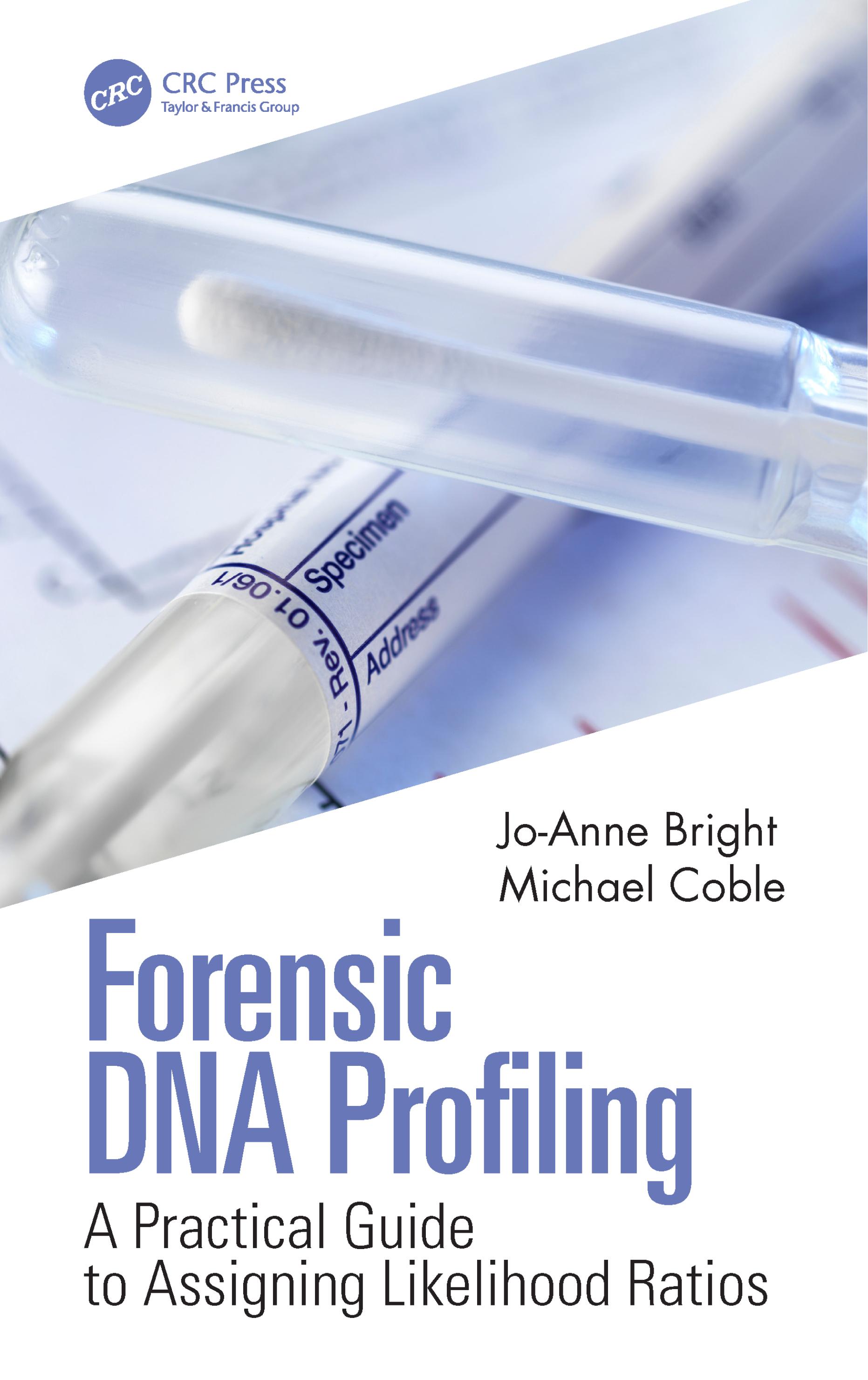
DNA testing and its forensic analysis are recognized as the “gold standard” in forensic identification science methods. However, there is a great need for a hands-on step-by-step guide to teach the forensic DNA community how to interpret DNA mixtures, how to assign a likelihood ratio, and how to use the subsequent likelihood ratio when reporting interpretation conclusions.
Forensic DNA Profiling: A Practical Guide to Assigning Likelihood Ratios will provide a roadmap for labs all over the world and the next generation of analysts who need this foundational understanding. The techniques used in forensic DNA analysis are based upon the accepted principles of molecular biology. The interpretation of a good-quality DNA profile generated from a crime scene stain from a single-source donor provides an unambiguous result when using the most modern forensic DNA methods. Unfortunately, many crime scene profiles are not single source. They are described as mixed since they contain DNA from two or more individuals.
Interpretation of DNA mixtures represents one of the greatest challenges to the forensic DNA analyst. As such, the book introduces terms used to describe DNA profiles and profile interpretation. Chapters explain DNA extraction methods, the polymerase chain reaction (PCR), capillary electrophoresis (CE), likelihood ratios (LRs) and their interpretation, and population genetic models—including Mendelian inheritance and Hardy-Weinberg equilibrium. It is important that analysts understand how LRs are generated in a probabilistic framework, ideally with an appreciation of both semicontinuous and fully continuous probabilistic approaches.
KEY FEATURES:
• The first book to focus entirely on DNA mixtures and the complexities involved with interpreting the results
• Takes a hands-on approach offering theory with worked examples and exercises to be easily understood and implementable by laboratory personnel
• New methods, heretofore unpublished previously, provide a means to innovate deconvoluting a mixed DNA profile, assign an LR, and appropriately report the weight of evidence
• Includes a chapter on assigning LRs for close relatives (i.e., “It’s not me, it was my brother”), and discusses strategies for the validation of probabilistic genotyping software
Forensic DNA Profiling fills the void for labs unfamiliar with LRs, and moving to probabilistic solutions, and for labs already familiar with LRs, but wishing to understand how they are calculated in more detail. The book will be a welcome read for lab professionals and technicians, students, and legal professionals seeking to understand and apply the techniques covered.
Payez facilement par carte, Klarna, Apple Pay ou Google Pay. Pas satisfait ? Vous avez toujours une garantie de remboursement de 14 jours. En savoir plus dans nos conditions. Si vous avez des questions, envoyez-nous un e-mail à hello@memmo.org.
Memmo facilite tes études, où que tu sois dans le monde. On rassemble tes manuels de cours et des outils d'étude intelligents au même endroit : résumés, quiz, podcasts et flashcards. Et il y a Ted, ton compagnon d'étude qui répond à toutes tes questions. Plus de 50 000 étudiants étudient déjà ici – conçu pour t'aider à apprendre plus vite et à moins stresser.