
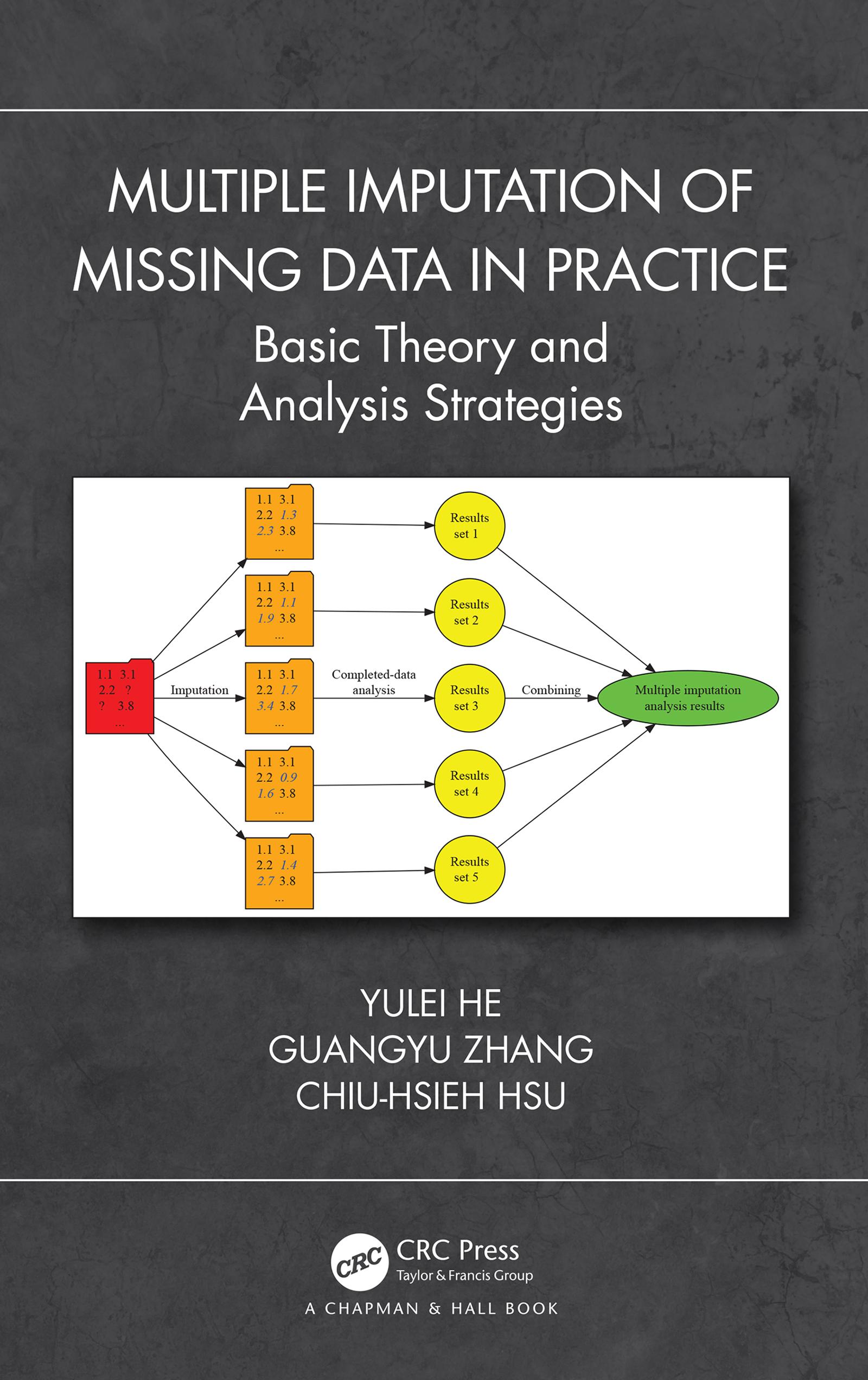
Multiple Imputation of Missing Data in Practice: Basic Theory and Analysis Strategies provides a comprehensive introduction to the multiple imputation approach to missing data problems that are often encountered in data analysis. Over the past 40 years or so, multiple imputation has gone through rapid development in both theories and applications. It is nowadays the most versatile, popular, and effective missing-data strategy that is used by researchers and practitioners across different fields. There is a strong need to better understand and learn about multiple imputation in the research and practical community.
Accessible to a broad audience, this book explains statistical concepts of missing data problems and the associated terminology. It focuses on how to address missing data problems using multiple imputation. It describes the basic theory behind multiple imputation and many commonly-used models and methods. These ideas are illustrated by examples from a wide variety of missing data problems. Real data from studies with different designs and features (e.g., cross-sectional data, longitudinal data, complex surveys, survival data, studies subject to measurement error, etc.) are used to demonstrate the methods. In order for readers not only to know how to use the methods, but understand why multiple imputation works and how to choose appropriate methods, simulation studies are used to assess the performance of the multiple imputation methods. Example datasets and sample programming code are either included in the book or available at a github site (https://github.com/he-zhang-hsu/multiple_imputation_book).
Key Features
- Provides an overview of statistical concepts that are useful for better understanding missing data problems and multiple imputation analysis
- Provides a detailed discussion on multiple imputation models and methods targeted to different types of missing data problems (e.g., univariate and multivariate missing data problems, missing data in survival analysis, longitudinal data, complex surveys, etc.)
- Explores measurement error problems with multiple imputation
- Discusses analysis strategies for multiple imputation diagnostics
- Discusses data production issues when the goal of multiple imputation is to release datasets for public use, as done by organizations that process and manage large-scale surveys with nonresponse problems
- For some examples, illustrative datasets and sample programming code from popular statistical packages (e.g., SAS, R, WinBUGS) are included in the book. For others, they are available at a github site (https://github.com/he-zhang-hsu/multiple_imputation_book)
Payez facilement par carte, Klarna, Apple Pay ou Google Pay. Pas satisfait ? Vous avez toujours une garantie de remboursement de 14 jours. En savoir plus dans nos conditions. Si vous avez des questions, envoyez-nous un e-mail à hello@memmo.org.
Memmo facilite tes études, où que tu sois dans le monde. On rassemble tes manuels de cours et des outils d'étude intelligents au même endroit : résumés, quiz, podcasts et flashcards. Et il y a Ted, ton compagnon d'étude qui répond à toutes tes questions. Plus de 50 000 étudiants étudient déjà ici – conçu pour t'aider à apprendre plus vite et à moins stresser.