
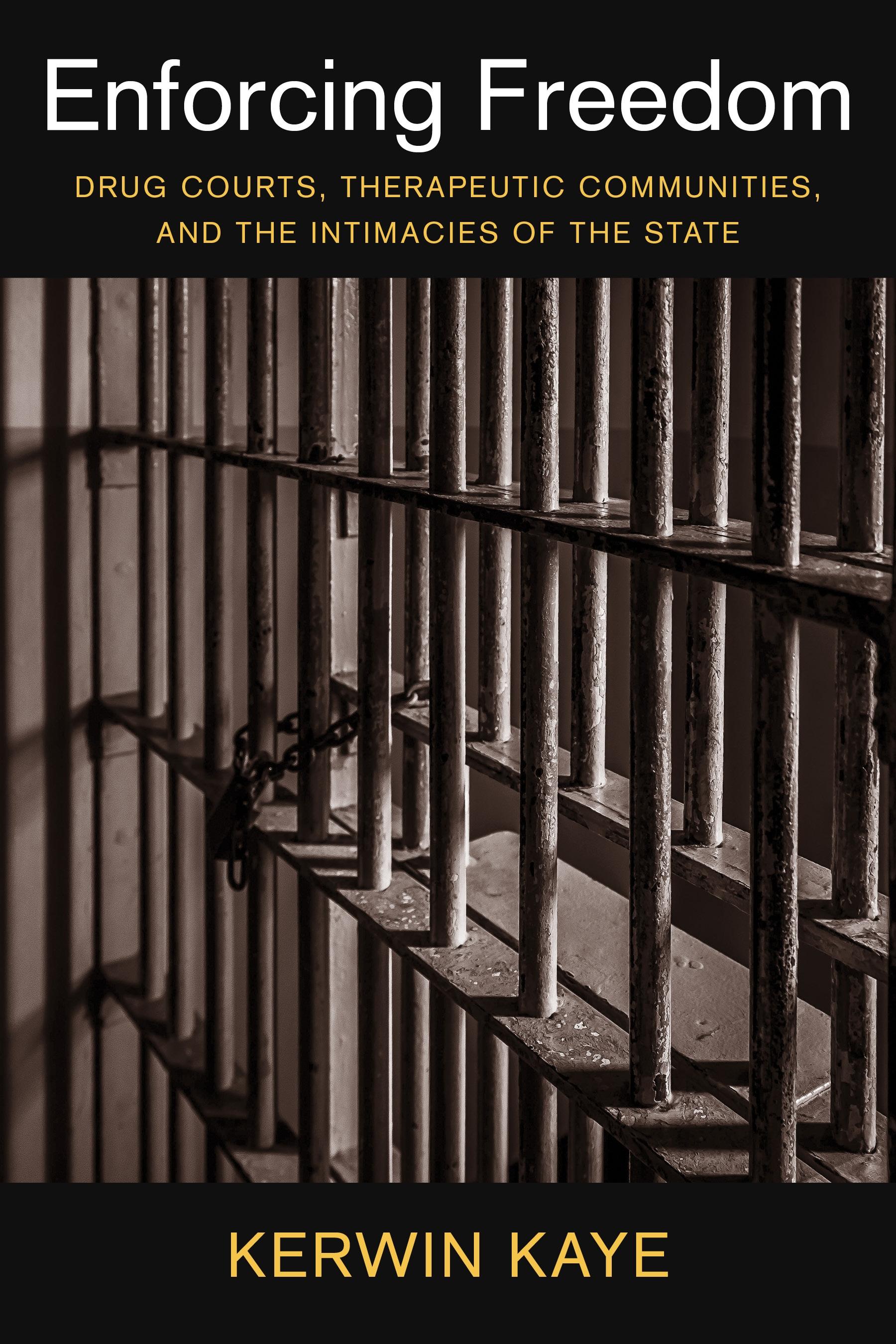
In 1989, the first drug-treatment court was established in Florida, inaugurating an era of state-supervised rehabilitation. Such courts have frequently been seen as a humane alternative to incarceration and the war on drugs. Enforcing Freedom offers an ethnographic account of drug courts and mandatory treatment centers as a system of coercion, demonstrating how the state uses notions of rehabilitation as a means of social regulation.
Situating drug courts in a long line of state projects of race and class control, Kerwin Kaye details the ways in which the violence of the state is framed as beneficial for those subjected to it. He explores how courts decide whether to release or incarcerate participants using nominally colorblind criteria that draw on racialized imagery. Rehabilitation is defined as preparation for low-wage labor and the destruction of community ties with “bad influences,” a process that turns participants against one another. At the same time, Kaye points toward the complex ways in which participants negotiate state control in relation to other forms of constraint in their lives, sometimes embracing the state’s salutary violence as a means of countering their impoverishment. Simultaneously sensitive to ethnographic detail and theoretical implications, Enforcing Freedom offers a critical perspective on the punitive side of criminal-justice reform and points toward alternative paths forward.
Payez facilement par carte, Klarna, Apple Pay ou Google Pay. Pas satisfait ? Vous avez toujours une garantie de remboursement de 14 jours. En savoir plus dans nos conditions. Si vous avez des questions, envoyez-nous un e-mail à hello@memmo.org.
Memmo facilite tes études, où que tu sois dans le monde. On rassemble tes manuels de cours et des outils d'étude intelligents au même endroit : résumés, quiz, podcasts et flashcards. Et il y a Ted, ton compagnon d'étude qui répond à toutes tes questions. Plus de 50 000 étudiants étudient déjà ici – conçu pour t'aider à apprendre plus vite et à moins stresser.