
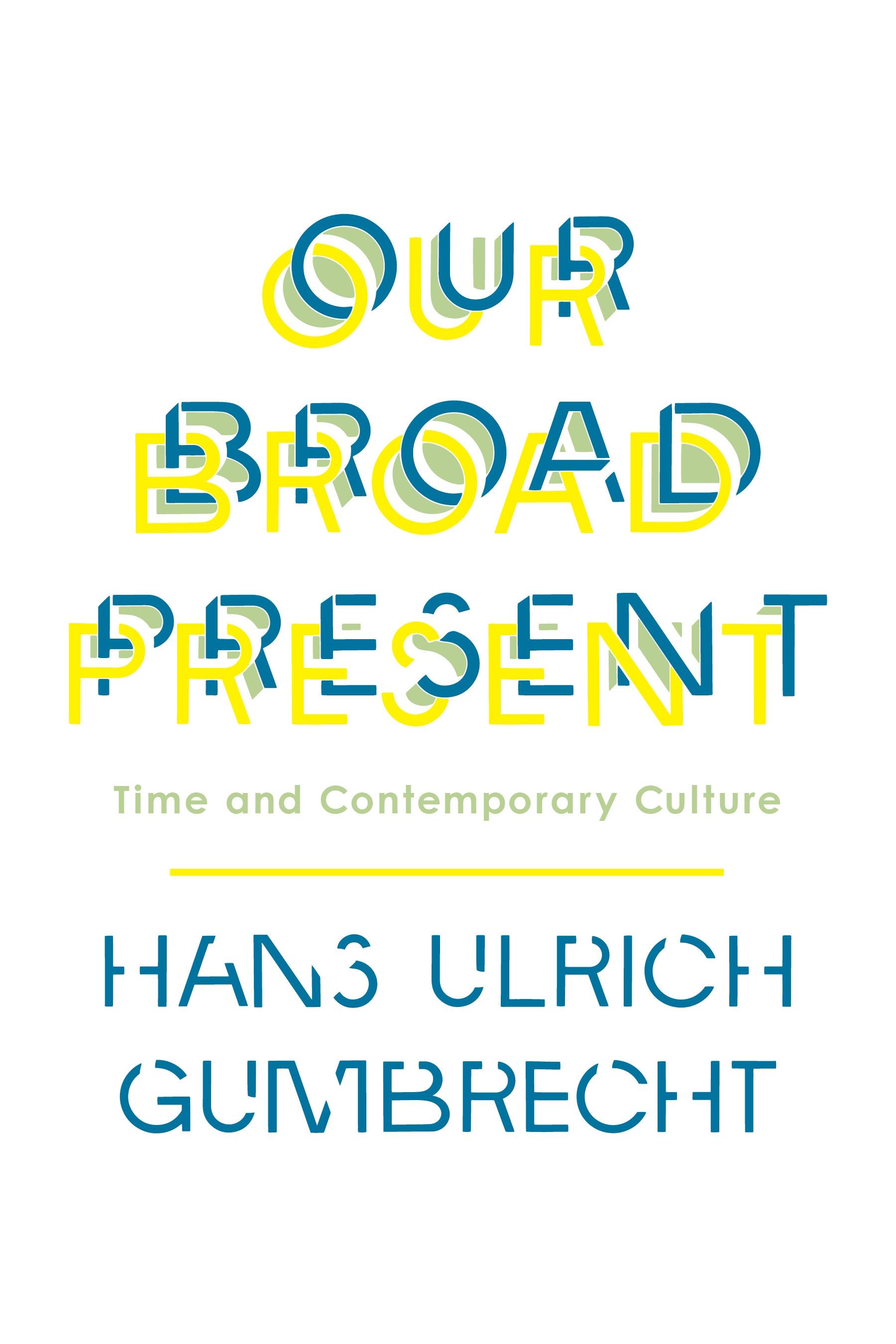
Considering a range of present-day phenomena, from the immediacy effects of literature to the impact of hypercommunication, globalization, and sports, Hans Ulrich Gumbrecht notes an important shift in our relationship to history and the passage of time. Although we continue to use concepts inherited from a "historicist" viewpoint, a notion of time articulated in the eighteenth and nineteenth centuries, the actual construction of time in which we live in today, which shapes our perceptions, experiences, and actions, is no longer historicist. Without fully realizing it, we now inhabit a new, unnamed space in which the "closed future" and "ever-available past" (a past we have not managed to leave behind) converge to produce an "ever-broadening present of simultaneities."
This profound change to a key dimension of our existence has complex consequences for the way in which we think about ourselves and our relation to the material world. At the same time, the ubiquity of digital media has eliminated our tactile sense of physical space, altering our perception of our world. Gumbrecht draws on his mastery of the philosophy of language to enrich his everyday observations, traveling to Disneyland, a small town in Louisiana, and the center of Vienna to produce striking sketches of our broad presence in the world.
Payez facilement par carte, Klarna, Apple Pay ou Google Pay. Pas satisfait ? Vous avez toujours une garantie de remboursement de 14 jours. En savoir plus dans nos conditions. Si vous avez des questions, envoyez-nous un e-mail à hello@memmo.org.
Memmo facilite tes études, où que tu sois dans le monde. On rassemble tes manuels de cours et des outils d'étude intelligents au même endroit : résumés, quiz, podcasts et flashcards. Et il y a Ted, ton compagnon d'étude qui répond à toutes tes questions. Plus de 50 000 étudiants étudient déjà ici – conçu pour t'aider à apprendre plus vite et à moins stresser.