
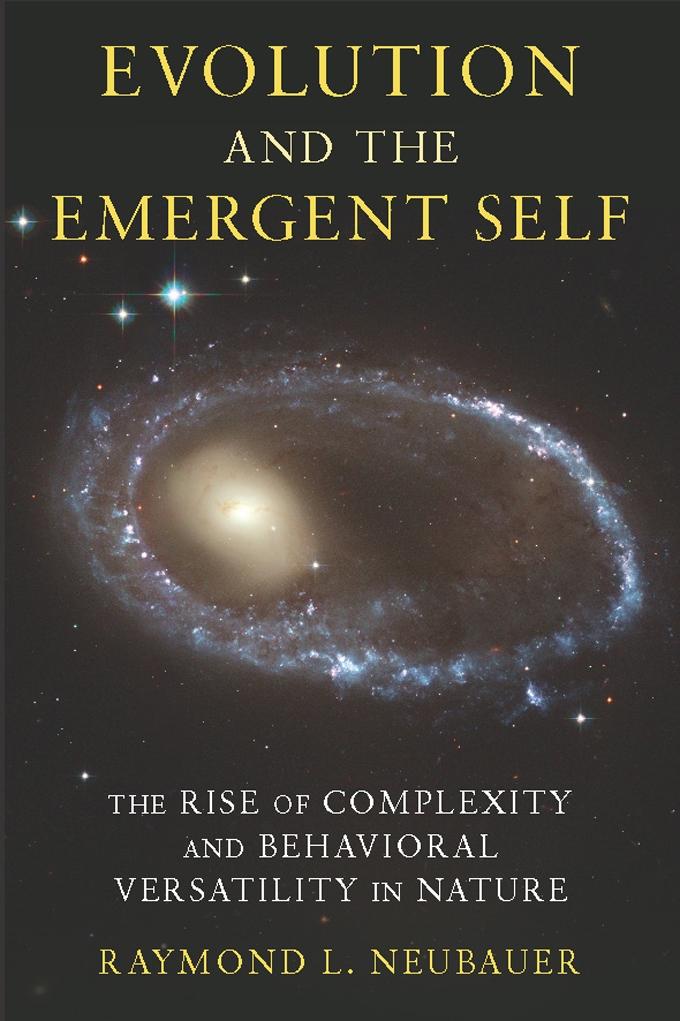
Evolution and the Emergent Self is an eloquent and evocative new synthesis that explores how the human species emerged from the cosmic dust. Lucidly presenting ideas about the rise of complexity in our genetic, neuronal, ecological, and ultimately cosmological settings, the author takes readers on a provocative tour of modern science's quest to understand our place in nature and in our universe. Readers fascinated with "Big History" and drawn to examine big ideas will be challenged and enthralled by Raymond L. Neubauer's ambitious narrative.
How did humans emerge from the cosmos and the pre-biotic Earth, and what mechanisms of biological, chemical, and physical sciences drove this increasingly complex process? Neubauer presents a view of nature that describes the rising complexity of life in terms of increasing information content, first in genes and then in brains. The evolution of the nervous system expanded the capacity of organisms to store information, making learning possible. In key chapters, the author portrays four species with high brain:body ratios—chimpanzees, elephants, ravens, and dolphins—showing how each species shares with humans the capacity for complex communication, elaborate social relationships, flexible behavior, tool use, and powers of abstraction. A large brain can have a hierarchical arrangement of circuits that facilitates higher levels of abstraction.
Neubauer describes this constellation of qualities as an emergent self, arguing that self-awareness is nascent in several species besides humans and that potential human characteristics are embedded in the evolutionary process and have emerged repeatedly in a variety of lineages on our planet. He ultimately demonstrates that human culture is not a unique offshoot of a language-specialized primate, but an analogue of fundamental mechanisms that organisms have used since the beginning of life on Earth to gather and process information in order to buffer themselves from fluctuations in the environment.
Neubauer also views these developments in a cosmic setting, detailing open thermodynamic systems that grow more complex as the energy flowing through them increases. Similar processes of increasing complexity can be found in the "self-organizing" structures of both living and nonliving forms. Recent evidence from astronomy indicates that planet formation may be nearly as frequent as star formation. Since life makes use of the elements commonly seeded into space by burning and expiring stars, it is reasonable to speculate that the evolution of life and intelligence that happened on our planet may be found across the universe.
Payez facilement par carte, Klarna, Apple Pay ou Google Pay. Pas satisfait ? Vous avez toujours une garantie de remboursement de 14 jours. En savoir plus dans nos conditions. Si vous avez des questions, envoyez-nous un e-mail à hello@memmo.org.
Memmo facilite tes études, où que tu sois dans le monde. On rassemble tes manuels de cours et des outils d'étude intelligents au même endroit : résumés, quiz, podcasts et flashcards. Et il y a Ted, ton compagnon d'étude qui répond à toutes tes questions. Plus de 50 000 étudiants étudient déjà ici – conçu pour t'aider à apprendre plus vite et à moins stresser.