
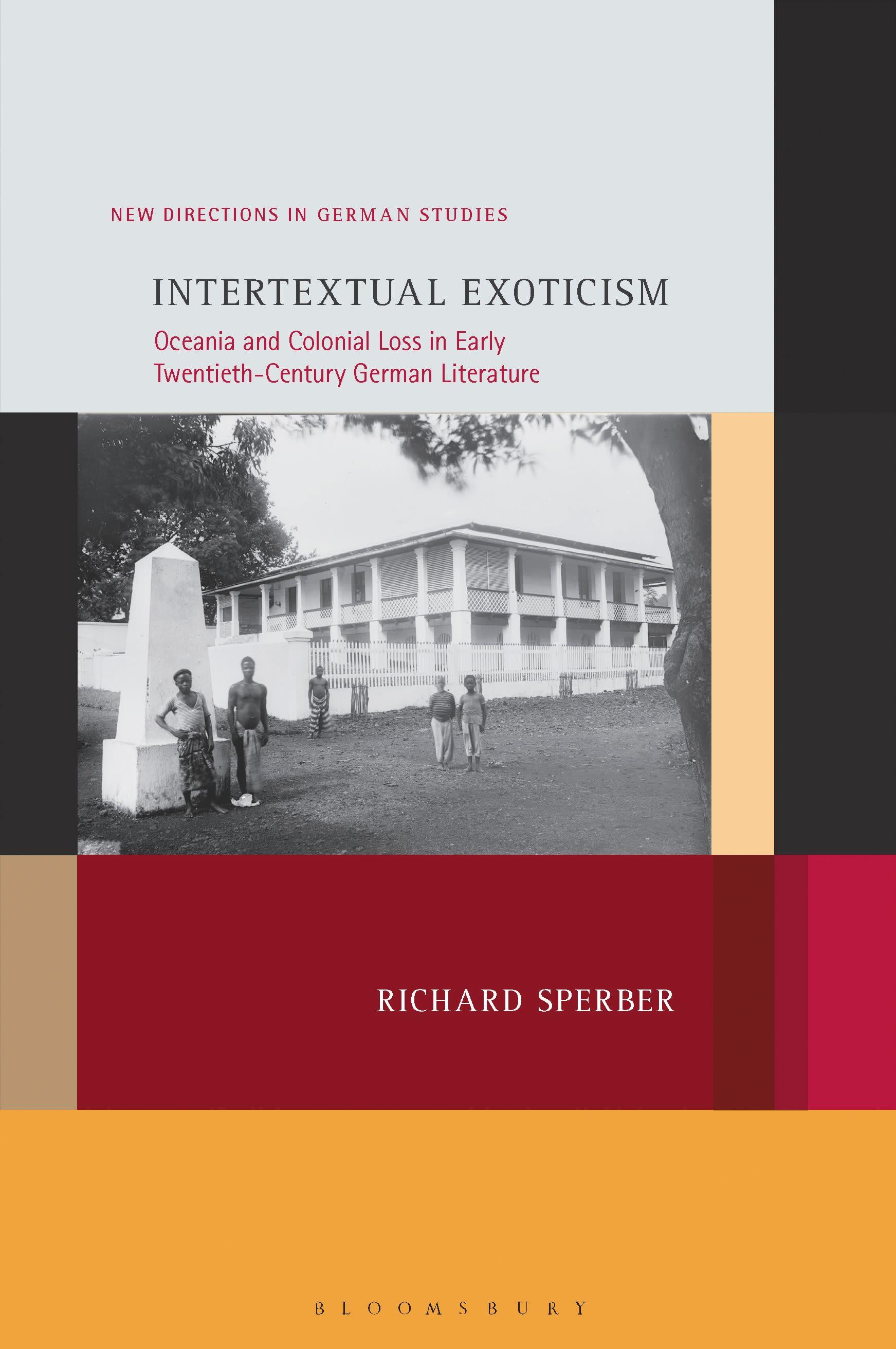
Intertextual Exoticism reads a body of non-canonical German exoticist literature published after imperial Germany's loss of colonial Oceania in 1914, applying theories of "intertextuality" (Kristeva) and recent scholarship on literary exoticism to explore Germany's postwar crises of psychology, masculinity, and national identity mapped onto Oceanic spaces.
Many readers are familiar with late Victorian texts expressing imperial Britain's anxieties. Richard Sperber expands the scope of these texts in the context of a post-imperial Europe, examining how German exoticist literature, published after German colonial loss in Oceania in 1914, intensifies the gothic themes and subjectivities of these Victorian texts.
The first part of this volume examines eight adventure narratives of Oceania, demonstrating how they do not necessarily present or represent a single, unified German colonial project. They take place on islands owned by Australia and Britain, and the unprepared German protagonists-amateur naturalists and bungling traders-are compared unfavourably to resolute Anglophone adventurers. The second part then pairs five well-known exoticist texts, including Conrad's Heart of Darkness, Stevenson's The Beach of Falesá, Haggard's She, Hitchens' The Garden of Allah, and Wilde's Salomé, with five non-canonical exoticist German texts. Sperber shows through these pairings how German literary exoticism becomes a transnational and intertextual literature that rereads dominant themes in 20th-century Europe's greater literatures of exoticism and colonial loss.
Many readers are familiar with late Victorian texts expressing imperial Britain's anxieties. Richard Sperber expands the scope of these texts in the context of a post-imperial Europe, examining how German exoticist literature, published after German colonial loss in Oceania in 1914, intensifies the gothic themes and subjectivities of these Victorian texts.
The first part of this volume examines eight adventure narratives of Oceania, demonstrating how they do not necessarily present or represent a single, unified German colonial project. They take place on islands owned by Australia and Britain, and the unprepared German protagonists-amateur naturalists and bungling traders-are compared unfavourably to resolute Anglophone adventurers. The second part then pairs five well-known exoticist texts, including Conrad's Heart of Darkness, Stevenson's The Beach of Falesá, Haggard's She, Hitchens' The Garden of Allah, and Wilde's Salomé, with five non-canonical exoticist German texts. Sperber shows through these pairings how German literary exoticism becomes a transnational and intertextual literature that rereads dominant themes in 20th-century Europe's greater literatures of exoticism and colonial loss.
Pages: 376
Category: Litteraturvetenskap & Teori
e-ISBN: 9798765135495
Shipping weight: 1.2 kg
Ships in: 1-2 days
Pay easily by card, Klarna, Apple Pay or Google Pay. Not happy? You always have a 14-day money-back guarantee. Read more in our terms. If you have any questions, email us at hello@memmo.org.
Memmo makes studying easier – wherever you are in the world. We bring your course books and smart study tools together in one place: summaries, quizzes, podcasts and flashcards. Plus Ted, your study buddy who answers anything you wonder. Over 50,000 students already study here – built to help you learn faster and stress less.