
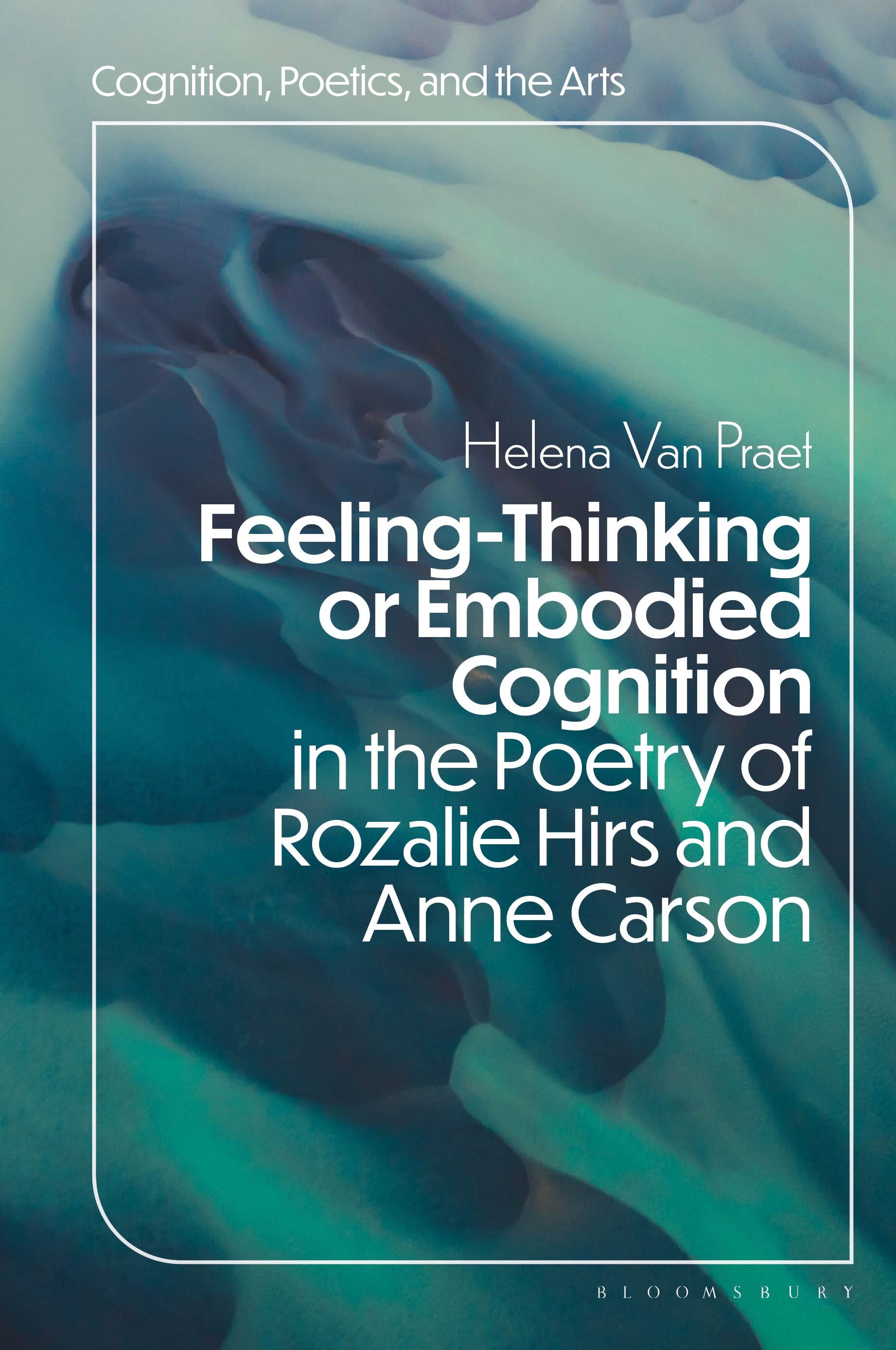
A stimulating cross-disciplinary study of how poetry taps into an embodied cognition at its various levels of signification.
Feeling-Thinking or Embodied Cognition in the Poetry of Rozalie Hirs and Anne Carson asks: How can we feel-think in poetry and what are the effects of this embodied cognition for the resulting poetic epistemology? Combining a new materialist approach with insights from psychology, philosophy, and cognitive science, Helena Van Praet argues that such poetry is not only about felt knowledge but that it also invites readers to feel-think on a formal, sensory-material, and discursive level.
Using a comparative corpus focused on the contemporary writing of Dutch poet Rozalie Hirs and Canadian poet Anne Carson, this study uses experimental strategies such as situated conceptualizations, word streams, poetic metalepsis, networked configurations, screen thinking, and discursive cues to explore how knowledge and meaning are bodily mediated in poetry. It demonstrates that meaning is not just propositional but rather something that you do with your entire body and that poetry is the prime genre to show such an embodied cognition at work.
While earlier accounts tend to be limited to the physicality of the mind or mainly focus on either feeling or thinking, this book develops a full-bodied theory of embodied cognition in poetry. Through close readings, Feeling-Thinking shows how poetry can offer us alternative conceptions of knowledge that transcend purely rational accounts, inviting us to find joy in such cognitive creation.
Feeling-Thinking or Embodied Cognition in the Poetry of Rozalie Hirs and Anne Carson asks: How can we feel-think in poetry and what are the effects of this embodied cognition for the resulting poetic epistemology? Combining a new materialist approach with insights from psychology, philosophy, and cognitive science, Helena Van Praet argues that such poetry is not only about felt knowledge but that it also invites readers to feel-think on a formal, sensory-material, and discursive level.
Using a comparative corpus focused on the contemporary writing of Dutch poet Rozalie Hirs and Canadian poet Anne Carson, this study uses experimental strategies such as situated conceptualizations, word streams, poetic metalepsis, networked configurations, screen thinking, and discursive cues to explore how knowledge and meaning are bodily mediated in poetry. It demonstrates that meaning is not just propositional but rather something that you do with your entire body and that poetry is the prime genre to show such an embodied cognition at work.
While earlier accounts tend to be limited to the physicality of the mind or mainly focus on either feeling or thinking, this book develops a full-bodied theory of embodied cognition in poetry. Through close readings, Feeling-Thinking shows how poetry can offer us alternative conceptions of knowledge that transcend purely rational accounts, inviting us to find joy in such cognitive creation.
Pages: 312
Category: Litteraturvetenskap & Teori
e-ISBN: 9798216396406
Shipping weight: 1.2 kg
Ships in: 1-2 days
Pay easily by card, Klarna, Apple Pay or Google Pay. Not happy? You always have a 14-day money-back guarantee. Read more in our terms. If you have any questions, email us at hello@memmo.org.
Memmo makes studying easier – wherever you are in the world. We bring your course books and smart study tools together in one place: summaries, quizzes, podcasts and flashcards. Plus Ted, your study buddy who answers anything you wonder. Over 50,000 students already study here – built to help you learn faster and stress less.