
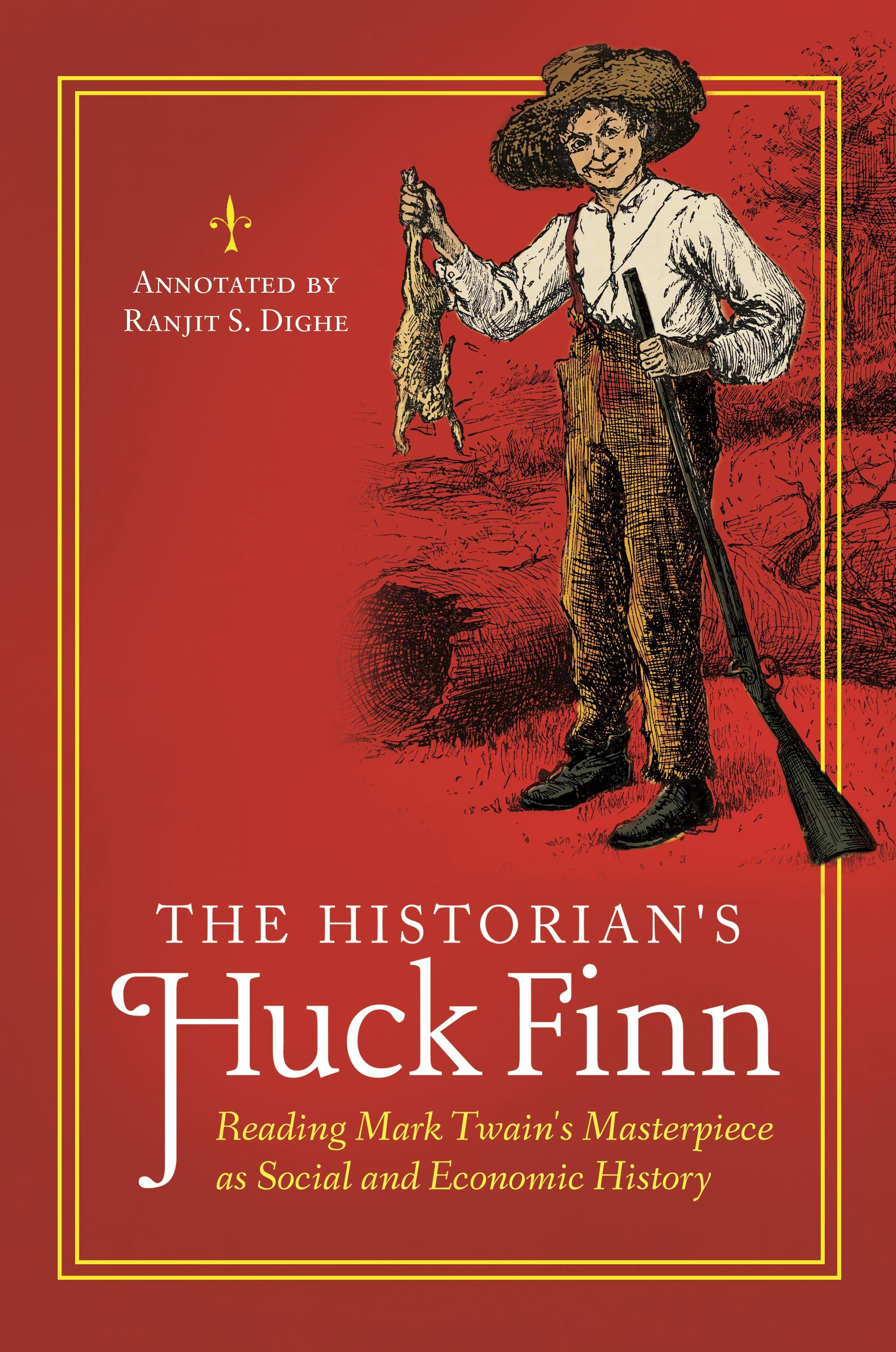
Putting Mark Twain's Adventures of Huckleberry Finn in historical context, connecting it to pivotal issues like slavery, class, money, and American economic expansion, this book engages readers by presenting American history through the lens of a great novel.
Adventures of Huckleberry Finn is widely regarded as a classic American novel—a groundbreaking one in which the author attempts to accurately portray society through the use of at-times coarse vernacular English. In this book, readers can experience the full text of Twain's Huckleberry Finn accompanied by annotations in footnote form throughout. As a result, this classic is transformed into a fascinating historical documentation of 19th-century American life and society that touches on topics like slavery, the transportation revolution, race, class, and confidence men.
Bringing the perspective of a social and economic historian, Ranjit S. Dighe offers more than 150 annotations as well as supporting essays that put the characters, incidents, and settings of the book into their historical context. First-time readers get to experience a great American novel with memorable characters, vivid imagery, and a great narrative voice while simultaneously learning about American history; teachers and students who have read Huckleberry Finn before will enjoy re-reading it, especially with insightful annotations that connect the story to the historical timeline. This book exposes the subtle lessons Twain's tale has to teach us about America's growth, development, conflicts, and mass movements in the nation's first century.
Adventures of Huckleberry Finn is widely regarded as a classic American novel—a groundbreaking one in which the author attempts to accurately portray society through the use of at-times coarse vernacular English. In this book, readers can experience the full text of Twain's Huckleberry Finn accompanied by annotations in footnote form throughout. As a result, this classic is transformed into a fascinating historical documentation of 19th-century American life and society that touches on topics like slavery, the transportation revolution, race, class, and confidence men.
Bringing the perspective of a social and economic historian, Ranjit S. Dighe offers more than 150 annotations as well as supporting essays that put the characters, incidents, and settings of the book into their historical context. First-time readers get to experience a great American novel with memorable characters, vivid imagery, and a great narrative voice while simultaneously learning about American history; teachers and students who have read Huckleberry Finn before will enjoy re-reading it, especially with insightful annotations that connect the story to the historical timeline. This book exposes the subtle lessons Twain's tale has to teach us about America's growth, development, conflicts, and mass movements in the nation's first century.
Pay easily by card, Klarna, Apple Pay or Google Pay. Not happy? You always have a 14-day money-back guarantee. Read more in our terms. If you have any questions, email us at hello@memmo.org.
Memmo makes studying easier – wherever you are in the world. We bring your course books and smart study tools together in one place: summaries, quizzes, podcasts and flashcards. Plus Ted, your study buddy who answers anything you wonder. Over 50,000 students already study here – built to help you learn faster and stress less.