
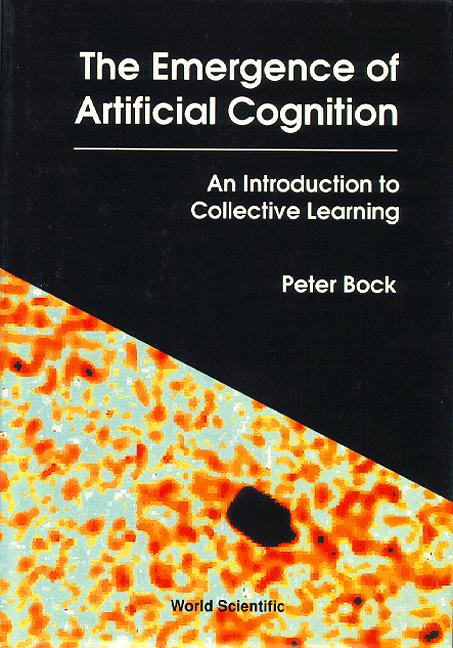
In this extraordinary new book, a pioneer in the research on Collective Learning Systems (an adaptive learning paradigm for artificial intelligence) describes the processes and mechanisms of human and artificial cognition, defines a fundamental building block for assembling large-scale adaptive systems (the learning cell) and proposes a design for the ultimate machine: a hierarchical network of 100 million learning cells that could exhibit the full range of cognitive capabilities of the human cerebral cortex.
The author demonstrates that using the classical “expert system” approach to create such a vast knowledge base would require thousands of years to program all the necessary rules. He then explains how an adaptive Collective Learning System could achieve this goal in a matter of 20 years, much as humans do. Based on natural anatomical and behavioral precedents, Collective Learning enables a machine to learn the appropriate rules through trial-and-error interaction with the real world.
In the course of explaining the principles of Collective Learning and his design for the ultimate machine, the author introduces a new theory of games for modelling the processes of the universe and discusses the philosophical issues raised by the prospect of creating machines that exhibit human-like intelligence. In addition to a number of small-scale software illustrations of Collective Learning, the final chapter presents the remarkable results of a large-scale research project directed by the author: a hardware and software simulation of the sub-symbolic image-processing functions of the primary visual cortex of the brain.
To make the content palatable to a wide variety of readers, the book is written in a conversational style and laced with humor.
Lengthy mathematical derivations and proofs have been omitted or abbreviated. Bibliographical references to scholarly journal papers and books are included to guide theoreticians to the attendant formalisms.
Pay easily by card, Klarna, Apple Pay or Google Pay. Not happy? You always have a 14-day money-back guarantee. Read more in our terms. If you have any questions, email us at hello@memmo.org.
Memmo makes studying easier – wherever you are in the world. We bring your course books and smart study tools together in one place: summaries, quizzes, podcasts and flashcards. Plus Ted, your study buddy who answers anything you wonder. Over 50,000 students already study here – built to help you learn faster and stress less.