
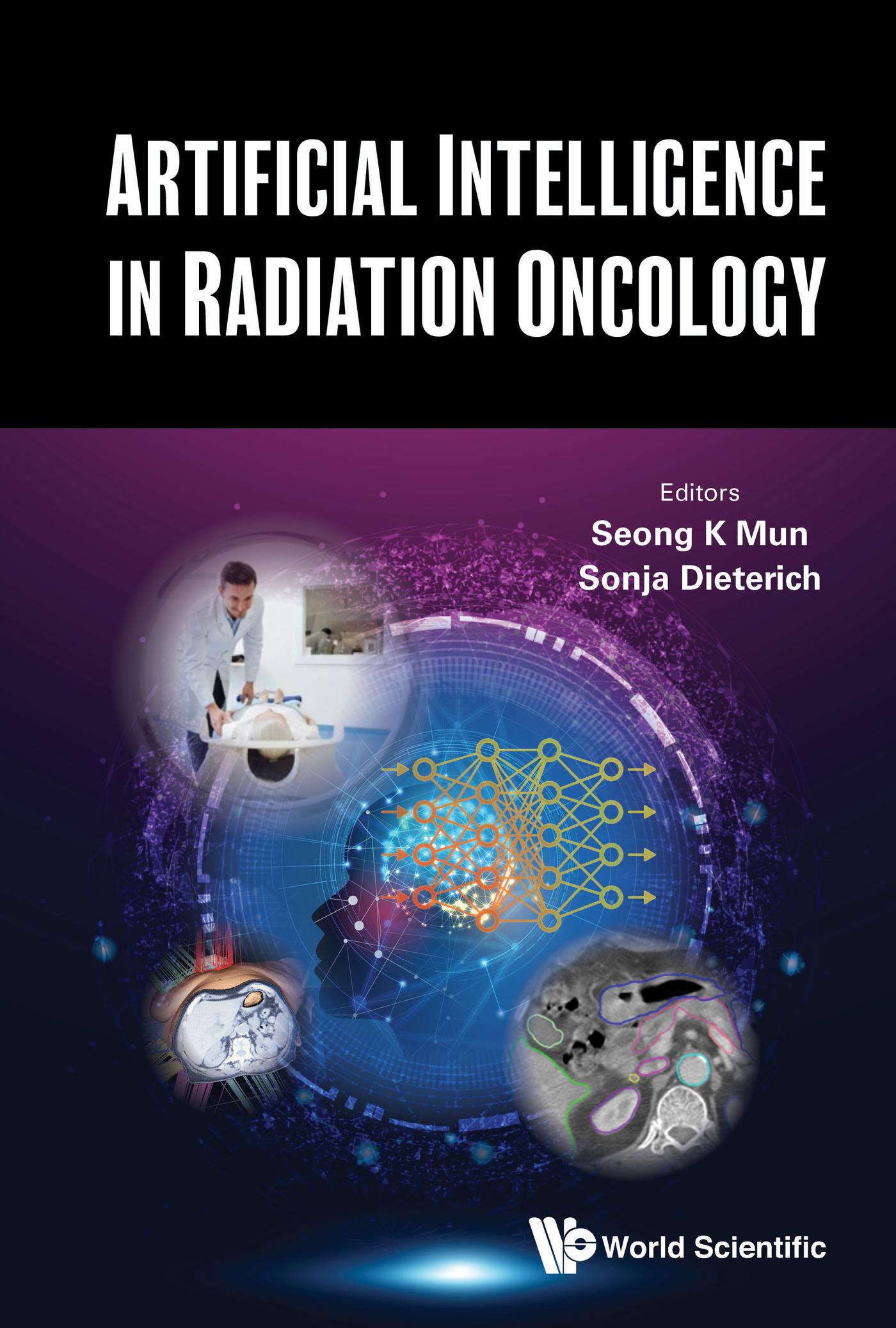
The clinical use of Artificial Intelligence (AI) in radiation oncology is in its infancy. However, it is certain that AI is capable of making radiation oncology more precise and personalized with improved outcomes. Radiation oncology deploys an array of state-of-the-art technologies for imaging, treatment, planning, simulation, targeting, and quality assurance while managing the massive amount of data involving therapists, dosimetrists, physicists, nurses, technologists, and managers. AI consists of many powerful tools which can process a huge amount of inter-related data to improve accuracy, productivity, and automation in complex operations such as radiation oncology.
This book offers an array of AI scientific concepts, and AI technology tools with selected examples of current applications to serve as a one-stop AI resource for the radiation oncology community. The clinical adoption, beyond research, will require ethical considerations and a framework for an overall assessment of AI as a set of powerful tools.
30 renowned experts contributed to sixteen chapters organized into six sections: Define the Future, Strategy, AI Tools, AI Applications, and Assessment and Outcomes. The future is defined from a clinical and a technical perspective and the strategy discusses lessons learned from radiology experience in AI and the role of open access data to enhance the performance of AI tools. The AI tools include radiomics, segmentation, knowledge representation, and natural language processing. The AI applications discuss knowledge-based treatment planning and automation, AI-based treatment planning, prediction of radiotherapy toxicity, radiomics in cancer prognostication and treatment response, and the use of AI for mitigation of error propagation. The sixth section elucidates two critical issues in the clinical adoption: ethical issues and the evaluation of AI as a transformative technology.
Contents:
- Define the Future:
- Clinical Radiation Oncology in 2040: Vision for Future Radiation Oncology from the Clinical Perspective (Gabriel S Vidal and Julian C Hong)
- A Vision for Radiation Oncology in 2030 (Sonja Dieterich, Parin Dalal, Agam Sharda and Corey Zankowski)
- Strategy:
- Lessons from Artificial Intelligence Applications in Radiology for Radiation Oncology (Seong K Mun, Shih-Chung Lo and Kenneth Wong)
- Open Access Data to Enable AI Applications in Radiation Therapy (Fred Prior and William Bennett)
- AI Tools:
- Science and Tools of Radiomics for Radiation Oncology (Christopher Wardell)
- Proposed Title: Artificial Intelligence for Image Segmentation in Radiation Oncologyy (Xue Feng and Quan Chen)
- Knowledge Representation for Radiation Oncology (Dongyang Zhang and Andrew Wilson)
- Natural Language Processing for Radiation Oncology (Lisa Ni, Christina Phuong and Julian Hong)
- AI Applications:
- Knowledge-Based Treatment Planning: An Efficient and Reliable Planning Technique towards Treatment Planning Automation (Dalong Pang)
- Artificial Intelligence in Radiation Therapy Treatment Planning (Xiaofeng Zhu, Jiajin Fan, Ashish Chawla and Dandan Zheng)
- Clinical Application of AI for Radiation Therapy Treatment Planning (Leigh Conroy and Thomas G Purdie)
- Using AI to Predict Radiotherapy Toxicity Risk Based on Patient Germline Genotyping (Jung Hun Oh, Sangkyu Lee, Maria Thor and Joseph O Deasy)
- Utilization of Radiomics in Prognostication and Treatment Response (Michael J Baine)
- How AI Can Help Us Understand and Mitigate Error Propagation in Radiation Oncology (Ed Kline and Srijan Sengupta)
- Assessment and Outcomes:
- Ethics and Artificial Intelligence in Radiation Oncology (Megan Hyun and Alexander Hyun)
- Evaluation of Artificial Intelligence in Radiation Oncology (Gretchen Purcell Jackson and Roy Vergis)
Readership: Medical physicists, biomedical engineers, AI developers and engineers, radiation oncologists, hospital managers in radiation oncology departments, medical technology enthusiasts.
Key Features:
- Bridges the gap between basic didactics and frontline research, responding to the growing amount of literature for AI in radiation oncology
- Practical while being broad enough to provide enough overview to develop an AI implementation strategy
- Presents a possible ground-breaking pathway to improve the precision and scope of radiation oncology, especially in: treatment planning, personal therapy, natural language processing, error mitigation and productivity improvements
- Interdisciplinary collaboration brings a rich combination of contributions, with plenty of cross-pollination among different fields of research bringing a nuanced perspective
Pay easily by card, Klarna, Apple Pay or Google Pay. Not happy? You always have a 14-day money-back guarantee. Read more in our terms. If you have any questions, email us at hello@memmo.org.
Memmo makes studying easier – wherever you are in the world. We bring your course books and smart study tools together in one place: summaries, quizzes, podcasts and flashcards. Plus Ted, your study buddy who answers anything you wonder. Over 50,000 students already study here – built to help you learn faster and stress less.