
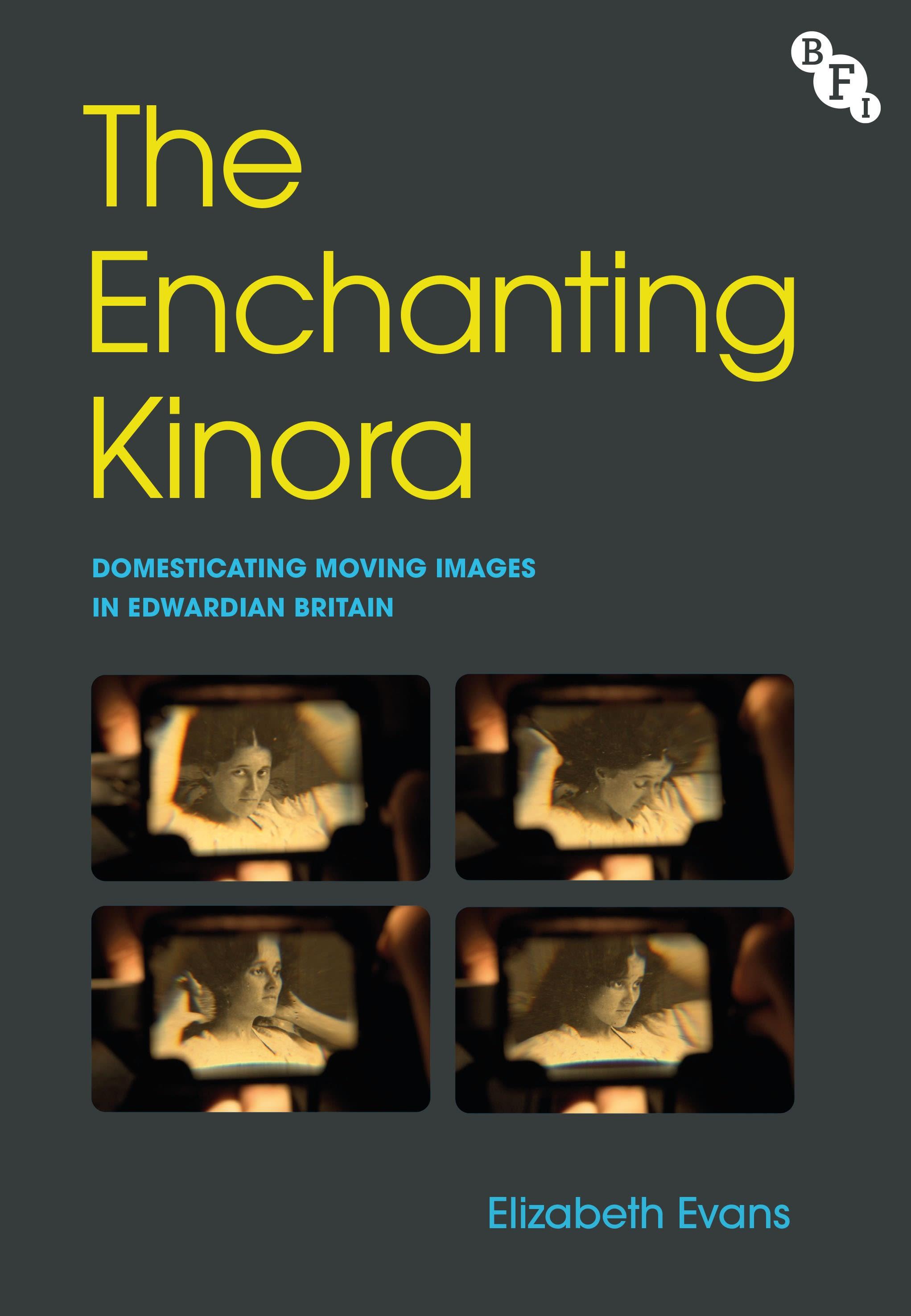
Marketed as more affordable and safer than film cameras, the Kinora system, launched in 1903, was one of the first amateur filmmaking devices and represents one of the earliest attempts to create a domestic market for moving images.
In The Enchanting Kinora, Elizabeth Evans examines the Kinora in its technological, industrial and socio-cultural context to explore how early attempts to domesticate moving images were configured. She closely analyses 84 previously unexamined Kinora reels, filmed using the early motion picture device between 1908-1913 and held by the Smedley Collection. These include 23 reels that were produced for public consumption and others that were meant solely for private viewing by the Smedley family. She goes on to consider the reels as material objects, examining not only their content, but also how the collection was preserved and catalogued by members of the family. Finally, she reflects on her own connection to the reels as the Smedleys' great-granddaughter.
In doing so, Evans expands our understanding of moving images' emergence as part of a wider network of cultural practices in Edwardian Britain that featured within domestic as well as public and professional spaces.
In The Enchanting Kinora, Elizabeth Evans examines the Kinora in its technological, industrial and socio-cultural context to explore how early attempts to domesticate moving images were configured. She closely analyses 84 previously unexamined Kinora reels, filmed using the early motion picture device between 1908-1913 and held by the Smedley Collection. These include 23 reels that were produced for public consumption and others that were meant solely for private viewing by the Smedley family. She goes on to consider the reels as material objects, examining not only their content, but also how the collection was preserved and catalogued by members of the family. Finally, she reflects on her own connection to the reels as the Smedleys' great-granddaughter.
In doing so, Evans expands our understanding of moving images' emergence as part of a wider network of cultural practices in Edwardian Britain that featured within domestic as well as public and professional spaces.
Pages: 256
Category: Litteraturvetenskap & Teori
e-ISBN: 9781839026904
Shipping weight: 1.2 kg
Ships in: 1-2 days
Pay easily by card, Klarna, Apple Pay or Google Pay. Not happy? You always have a 14-day money-back guarantee. Read more in our terms. If you have any questions, email us at hello@memmo.org.
Memmo makes studying easier – wherever you are in the world. We bring your course books and smart study tools together in one place: summaries, quizzes, podcasts and flashcards. Plus Ted, your study buddy who answers anything you wonder. Over 50,000 students already study here – built to help you learn faster and stress less.