
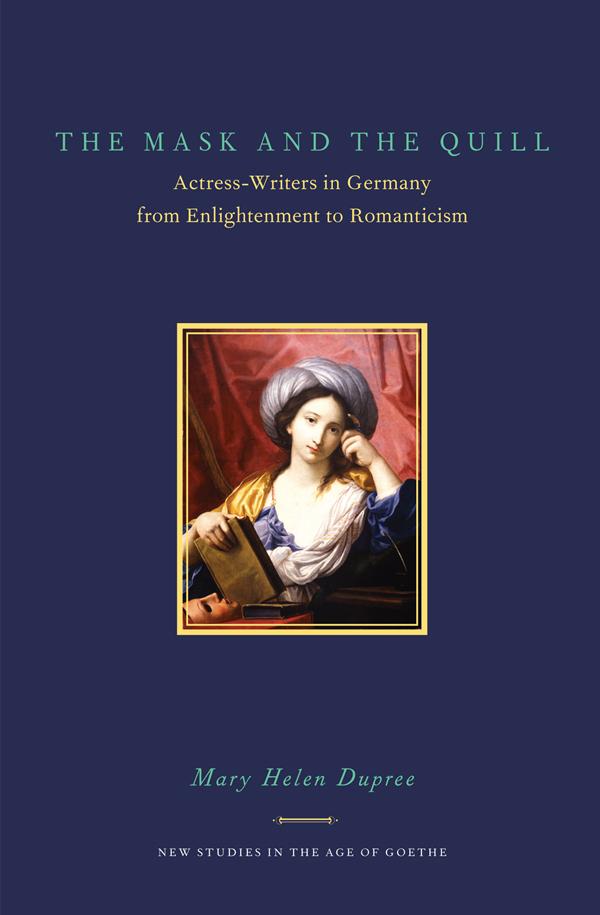
In the last three decades of the eighteenth century, a small but significant number of German actresses, including Sophie Albrecht (1757-1840), Marianne Ehrmann (1755-1795) and Elise Bürger (1769-1833), began to publish poetry, autobiography, drama and short fiction under their own names. These "actress-writers" came of age at a time when the status of the actress was beginning to be radically redefined in accordance with Enlightenment aesthetics and the cult of sensibility, as the model of the enterprising actress-director in the tradition of Caroline Neuber gave way to an idealizing view of the actress as sentimental heroine. The Mask and the Quill: Actress-Writers in Germany from Enlightenment to Romanticism, is an exploration of this generation of actress-writers, their significance for German literary and cultural history, and their attempts to come to terms with the new image of the actress through literature and performance.
In their texts and performances, Albrecht, Ehrmann and Bürger articulated an entirely new sense of what it meant to be an actress and a woman writer. They identified themselves with the cult of sensibility, with the theater reform movement, and above all with an image of the actress as Gefühlsschauspielerin or "actress of emotion," which emerged in the mid-1770s in response to the death of the Hamburg tragedienne Charlotte Ackermann (1757-1775). While some scholars have described this generation as a silent one, forced to submit to increasingly passive ideals of domesticity, actress-writers of the era defied this trend by using the image of the Gefühlsschauspielerin as a passport to literary activity. Their close relationship to theater and the nascent genre of "paratheatrical literature" provided them with a public voice, access to literary circles and a language with which to articulate their identity as actresses and as writers. More importantly, it provided them with a space from which to critique contemporary notions of gender and virtue.
In their texts and performances, Albrecht, Ehrmann and Bürger articulated an entirely new sense of what it meant to be an actress and a woman writer. They identified themselves with the cult of sensibility, with the theater reform movement, and above all with an image of the actress as Gefühlsschauspielerin or "actress of emotion," which emerged in the mid-1770s in response to the death of the Hamburg tragedienne Charlotte Ackermann (1757-1775). While some scholars have described this generation as a silent one, forced to submit to increasingly passive ideals of domesticity, actress-writers of the era defied this trend by using the image of the Gefühlsschauspielerin as a passport to literary activity. Their close relationship to theater and the nascent genre of "paratheatrical literature" provided them with a public voice, access to literary circles and a language with which to articulate their identity as actresses and as writers. More importantly, it provided them with a space from which to critique contemporary notions of gender and virtue.
Pages: 200
Category: Litteraturvetenskap & Teori
e-ISBN: 9781611480252
Shipping weight: 1.2 kg
Ships in: 1-2 days
Pay easily by card, Klarna, Apple Pay or Google Pay. Not happy? You always have a 14-day money-back guarantee. Read more in our terms. If you have any questions, email us at hello@memmo.org.
Memmo makes studying easier – wherever you are in the world. We bring your course books and smart study tools together in one place: summaries, quizzes, podcasts and flashcards. Plus Ted, your study buddy who answers anything you wonder. Over 50,000 students already study here – built to help you learn faster and stress less.